The Ajrakh Saree Of Gujarat
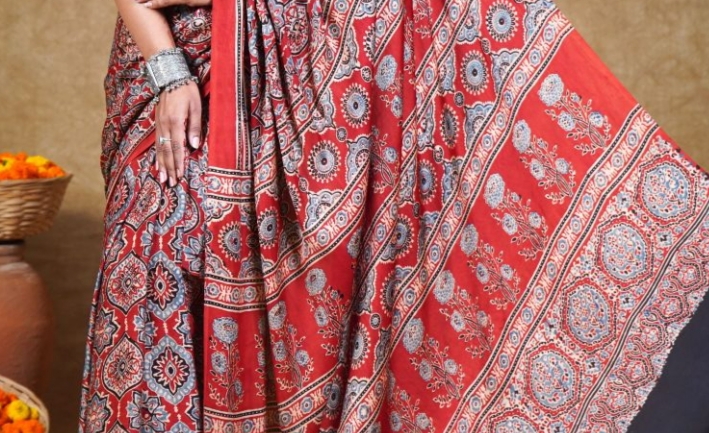
There are few textiles in the world that carry as much history in a single yard of cloth as the Ajrakh saree. Deep indigo blues, rust reds, and earthy blacks arranged in symmetrical geometric patterns, Ajrakh is not merely a print, but a centuries-old conversation between craft, community, and the land itself.
Origins Rooted in the Indus Valley
The word “Ajrakh” is widely believed to derive from the Arabic azrak, meaning blue, a nod to the deep indigo that dominates the craft. Some artisans and historians trace the technique back to the Indus Valley Civilization, with evidence suggesting a textile tradition thousands of years old in the Sindh region of present-day Pakistan.
The craft’s modern home, however, is Kutch in Gujarat. According to popular accounts, the Khatri community, the artisan caste most associated with Ajrakh today migrated from Sindh to Kutch in the 16th century at the invitation of the local ruler, carrying the technique with them. Ajrakh printing also continues to be practiced in Barmer, Rajasthan, and in Sindh, Pakistan, making it a shared cultural inheritance across the border.
What Makes Ajrakh Different from Ordinary Block Print
Not all block-printed fabric is Ajrakh. What sets it apart is its complexity: a single piece of cloth passes through numerous rounds of washing, resist-printing, and dyeing, sometimes 15 to 20 distinct stage, before it is finished. The process can take anywhere from two to three weeks depending on the intricacy of the design.
The broad steps are:
- Fabric preparation — Cotton (or occasionally silk) is washed, treated with substances like camel dung, castor oil, and soda ash to prepare it to absorb dye evenly, then sun-dried.
- Block printing with resist paste — Hand-carved wooden blocks, often made from teak or sheesham, are used to stamp a resist paste (traditionally a mix of lime and gum) onto the fabric in intricate motifs. This resist blocks dye from penetrating in specific areas, allowing patterns to emerge.
- Natural dyeing — The fabric is dyed in stages using natural sources: indigo for blue, madder root (al) for red, iron and jaggery fermentations for black, and turmeric or pomegranate rind for yellows.
- Repeated washing and re-printing — Between dye baths, the cloth is washed in flowing river water (traditionally in the Kutch desert, near sources like the Saran river) to remove excess dye and paste, then printed again for additional layers of colour and pattern.
- Final finishing — A last wash and sun-drying sets the colours and softens the fabric.
Because every stage is done by hand, no two Ajrakh sarees are ever quite identical, each carries the small variations of the artisan’s hand and the day’s weather and water.
The Motifs and Their Meaning
Ajrakh patterns are almost entirely geometric and nature-inspired, built from repeating grids of:
- Stars, rosettes, and trellises
- Stylised flowers and creepers
- Small geometric borders framing a central field
This is partly rooted in the Islamic artistic tradition of the Khatri community, which historically avoided figurative imagery in favour of abstract, symmetrical design, patterns that seem to expand infinitely, mirroring ideas of unity and continuity.
Types of Ajrakh
Artisans and textile historians classify Ajrakh work into a few traditional variants:
- Teli Ajrakh — The oldest and most labour-intensive style, involving oil treatment of the cloth for a distinctive sheen and depth of colour.
- Sabuni Ajrakh — Involves an initial steaming process, giving a slightly different finish.
- Ek Pasi Ajrakh — Printed on only one side of the fabric, a lighter and quicker variant.
Why Ajrakh Sarees Are Prized Today
In an age dominated by synthetic dyes and machine printing, Ajrakh stands out for reasons that go beyond aesthetics:
- Sustainability — The dyes are plant- and mineral-based, and the process avoids harsh chemical treatments, making Ajrakh one of the more environmentally conscious textile traditions still practiced at scale.
- Livelihood and heritage — Buying genuine Ajrakh supports artisan families, many in Ajrakhpur (a village near Bhuj, Gujarat, literally named for the craft) who have practiced the technique across generations.
- Individuality — Since every saree is hand-printed and hand-dyed, slight irregularities are a mark of authenticity rather than a flaw.
- Versatility — Ajrakh sarees now appear in cotton, modal, and silk, worn everything from casual daywear to festive and wedding occasions, and are often paired with contemporary blouse styles and draping techniques.
How to Identify an Authentic Ajrakh Saree
Because Ajrakh’s popularity has led to a flood of machine-printed imitations, a few things help distinguish the real craft:
- Both-side visibility of the print — In traditional Ajrakh, the pattern is often visible (though softer) on the reverse side of the fabric, since it’s dyed rather than surface-printed.
- Slight irregularities — Genuine hand-block work will have minor inconsistencies in alignment; a perfectly uniform, sharp repeat usually signals machine printing.
- Earthy, slightly muted dye tones — Natural dyes tend to look a shade softer and less uniformly saturated than chemical dyes.
- Smell and feel — Freshly made natural-dye Ajrakh sometimes carries a faint earthy scent from the dyeing process, and the cotton typically has a slightly stiffer, textured hand-feel compared to smooth machine-printed cotton.
A Craft Worth Preserving
An Ajrakh saree is, in many ways, a wearable archive, of Indus Valley trade routes, migrations across the Sindh-Kutch border, generations of Khatri artisan families, and an ecological approach to dyeing that predates the term “sustainable fashion” by millennia. Choosing one is not just a fashion decision; it’s a small act of keeping a very old, very human craft alive.