The Gadwal Saree Of Telangana
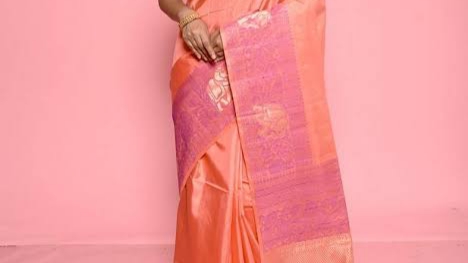
In the town of Gadwal, positioned between the Krishna and Tungabhadra rivers in what is now Telangana’s Jogulamba Gadwal district, weavers developed a technique so precise that a finished saree, according to local legend, could once be folded small enough to fit inside a matchbox. That technique, joining a cotton body to a silk border and pallu without a single visible seam remains the defining feature of the Gadwal saree today.
A Weave Born of Two Cultures
Gadwal’s geography placed it at a genuine cultural crossroads, and its textile tradition reflects that. Sitting between Telugu and Kannada-speaking regions, the town’s weaving drew on the cotton traditions of the Deccan plateau alongside the silk and zari techniques favoured by Maratha and Mughal courts, a blend of influences rarely found together in a single textile.
The craft gained real momentum under royal patronage roughly two hundred years ago, during the era of the Gadwal samasthanam (a small princely estate), reportedly encouraged by Queen Maharani Adhi Lakshmi Devamma. Local zamindars commissioned these sarees for regional royalty and temple rituals, giving the weave both a courtly and a sacred association from early on. Commercial production expanded further in the 1930s, aided by manually operated spinning equipment, and the saree’s popularity spread nationally after a Gadwal-focused retail centre opened in Hyderabad in 1946.
A Technique With a Mythic Origin Story
Gadwal weaving communities often trace the craft’s origin not to any single historical weaver but to divine inspiration. One widely repeated legend holds that the goddess Bhadrakali or Renuka Devi herself taught the first weaver how to interlock cotton and silk into a single cloth earthly in material, celestial in effect. This framing reflects a broader idea in Indian handloom culture, where weaving is treated less as ordinary craft and more as shastra, a form of sacred knowledge handed down from the divine. Reinforcing this spiritual association, the idol of the goddess at Tirupati’s Brahmotsavam festival is traditionally dressed in a Gadwal saree, and a select family of Gadwal weavers is honoured each year with the task of crafting sarees specifically meant to adorn temple deities.
Kupadam: The Technique That Defines the Weave
What truly sets a Gadwal saree apart is its construction method, known locally as kupadam (also called kottu, kuttu, or tippadam). Rather than weaving the entire saree as one continuous piece, artisans weave the cotton body, the silk border, and the silk pallu separately, then interlock them together with painstaking precision a technique demanding enough that it typically takes two skilled weavers, working as a family unit, four to eight days to complete a single saree.
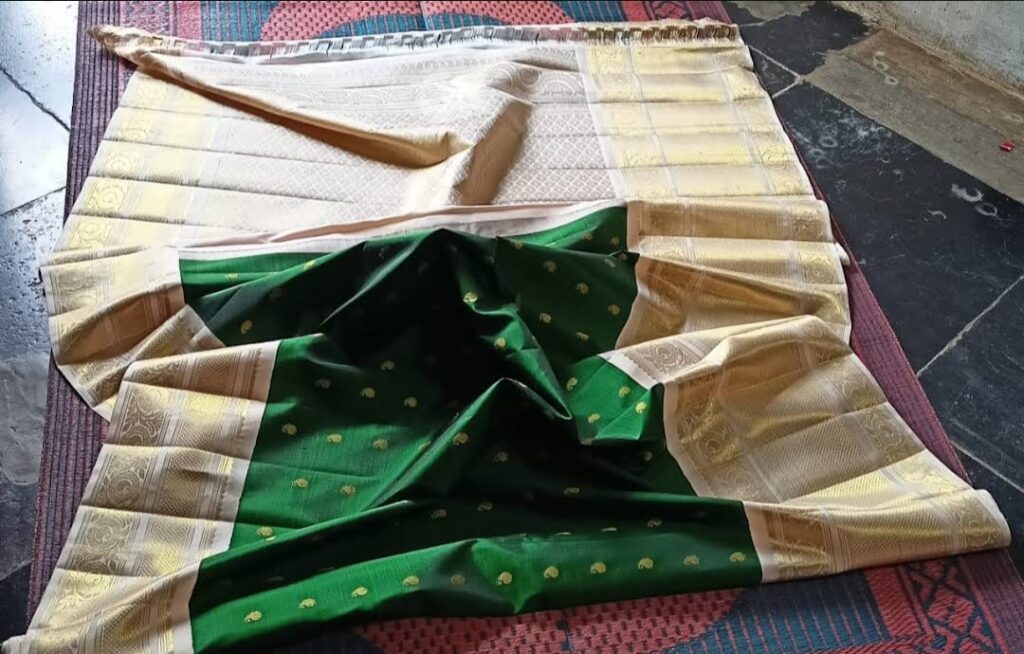
This interlocking leaves a distinctive wavy joining line where the border meets the body a visual signature also seen, using a related technique, in Kanchipuram silk sarees. The result is a fabric that can be folded and refolded without the contrasting sections coming apart or fraying at the seam, despite being made from two entirely different fibres.
Materials and Motifs
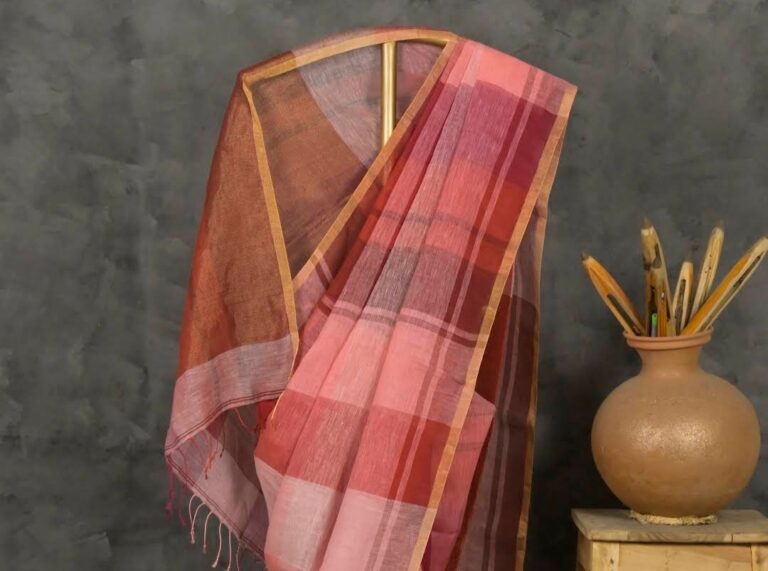
The traditional Gadwal saree uses fine, often unbleached cotton yarn (commonly 80s to 100s count) for the body, prized for its breathability in the Deccan’s hot climate, while the border and pallu are woven in tussar or mulberry silk, frequently sourced from neighbouring Karnataka. Zari metallic thread traditionally made from silver or gold-coated copper, often sourced from Surat is worked into the silk sections to create the saree’s signature ornamentation.
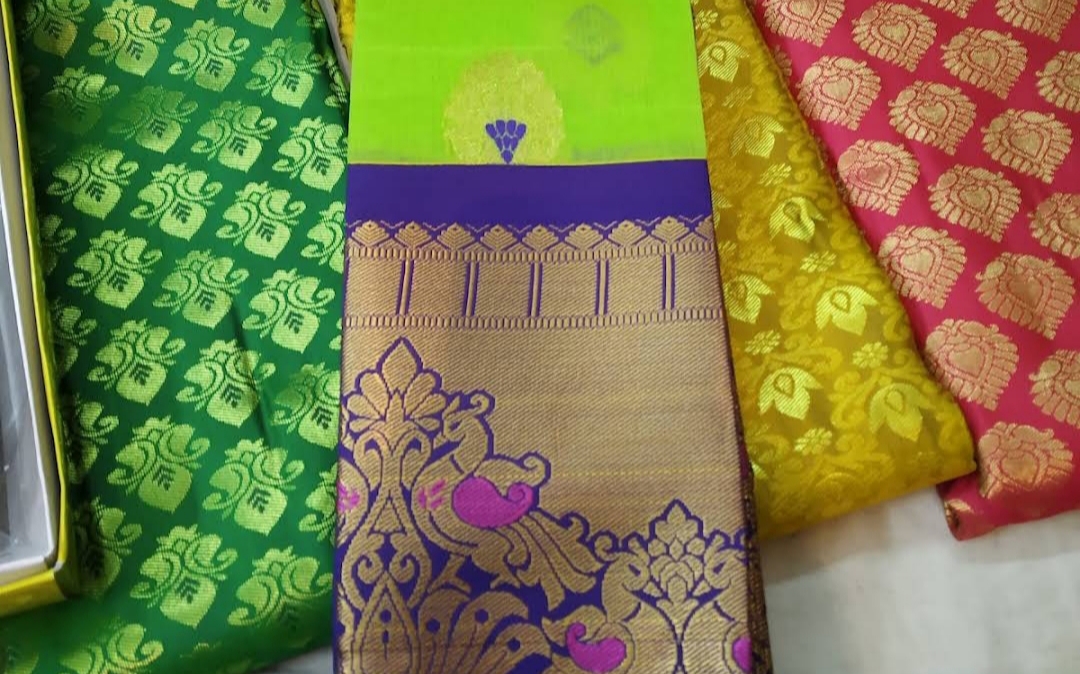
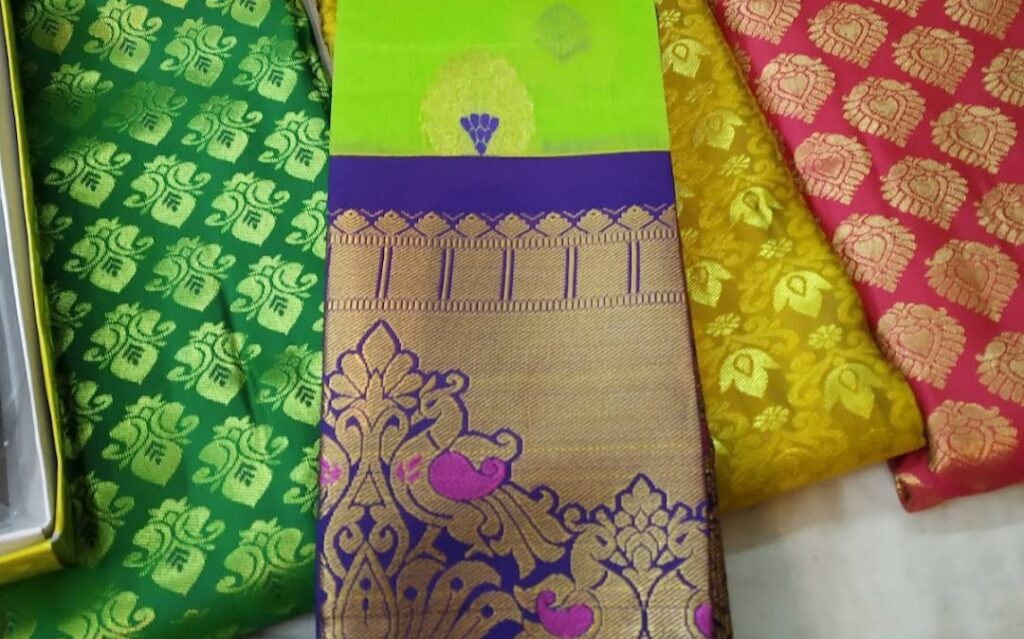
Design follows what might be called an architectural logic: the cotton body is typically left plain or only lightly patterned, while the border and pallu carry the visual weight, much like a temple’s unadorned sanctum sits beneath an elaborately carved gopuram. Motifs commonly include temple domes and towers, floral vines, peacocks, and other South Indian architectural and natural forms, often echoing the sacred associations tied to the craft’s origin stories.
A hybrid known as the Sico saree (short for silk-cotton) has also grown popular in recent decades roughly half cotton, half silk offering a lighter, more affordable alternative while retaining the signature contrast border and zari-worked pallu.
Kumbam: Gadwal’s Other Name
Gadwal sarees are also known regionally as Kumbam or Kotakomma sarees, names that refer specifically to the design style of the interlocked border. Whether called Gadwal, Kupadam, Kotakomma, or Kumbam, these terms largely describe the same underlying craft and interlocking technique, with the different names reflecting regional preference as much as any technical distinction.
From Royal Patronage to a Protected Craft
Like many of India’s regional handlooms, Gadwal weaving faced serious disruption under British colonial rule, as mill-made cloth and industrial competition undercut demand for handwoven textiles. Local cooperatives, caste-based weaving guilds, and family workshops, predominantly from the Devanga and Padmasali weaving communities helped keep the tradition alive through the twentieth century. The Handloom Reservation Act of 1985 offered further protection, and the Gadwal saree received a Geographical Indication tag (accounts place this as early as 1999, with formal registration completed in 2010), legally recognising and safeguarding its name and technique.
A Saree Built for Both Comfort and Ceremony
What makes the Gadwal saree enduringly popular is precisely the contrast at its core: a breathable, lightweight cotton body suited to long wear in a hot climate, paired with a silk border rich enough for temple offerings, royal courts, and bridal trousseaus. It remains a fixture of South Indian weddings and religious ceremonies, often passed down as a family heirloom, while lighter cotton-bodied versions continue to serve as comfortable, everyday festive wear.
To wear a Gadwal saree is to wear the product of two river valleys’ worth of cultural exchange and a weaving technique precise enough to have earned its own body of myth, proof that sometimes the most technically demanding craft is also the one that feels lightest to wear.