The Arni Saree Of Tamil Nadu
Overshadowed in fame by its more celebrated neighbour Kanchipuram, the town of Arni (also spelled Arani) in Tamil Nadu’s Tiruvannamalai district has, for centuries, quietly woven some of South India’s finest silk sarees. Lighter, more affordable, and distinct in construction from Kanchipuram silk, Arni sarees represent a living thread of Tamil weaving heritage that deserves to be known in its own right.
A Town Named for a Forest
Arni sits on the banks of the Kamandala river, about 132 km west of Chennai. Its name is believed to derive from “Araneeyam,” meaning a place surrounded by forest, a reminder that this weaving town grew up amid hills and woodland rather than a grand temple city.
The region’s political history runs deep: Arni was ruled successively by the Pallavas and then the Cholas, and later came under Vijayanagara rule. Silk weaving in Arni is said to have flourished as a hub since the Chola dynasty, continuing through the Vijayanagara and British periods. Local tradition holds that the weaving craft has been carried forward largely by the Mudaliar and Sengunthar communities, alongside descendants of the Saurashtrian weaving lineage that also shaped Kanchipuram’s silk tradition, communities said to have migrated south after waves of invasion in North India centuries ago, eventually lending their skills to Tamil weaving centres including Kumbakonam and Arni.
One enduring, oft-repeated piece of local pride: it is said that the first flag hoisted at the Red Fort on India’s independence was a silk flag woven in Arani.
What Sets an Arni Saree Apart
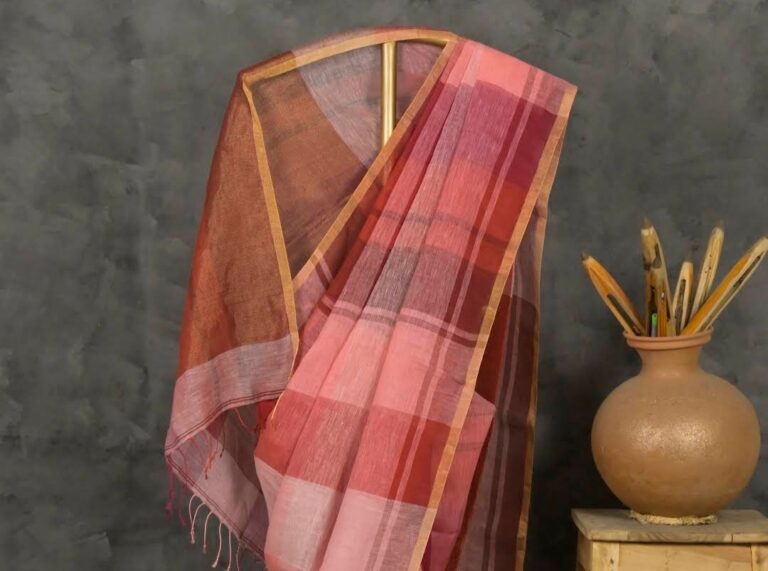
Arni’s silk is distinguished less by density of zari work (as with Kanchipuram) and more by its lightness, softness, and clever construction. A signature feature is that a genuine Arni saree is often woven with two different bodies and two different pallus, meaning one side of the saree is a different colour from the other, effectively giving the wearer two sarees in one.
This is achieved through the korvai technique, an interlocking weave used to join contrasting borders and body colours seamlessly, without stitching. Arni is particularly known for check patterns and temple borders (thazhampoo reku), created using this korvai method. These checks, locally called kottadi, come in several traditional sizes: tiny “kasa-kasa kattam” (poppy-seed) checks so fine they blur into a grey tone, medium “puliyam-kottai” (tamarind seed) checks, and large “lungi” or “kerchip” checks.
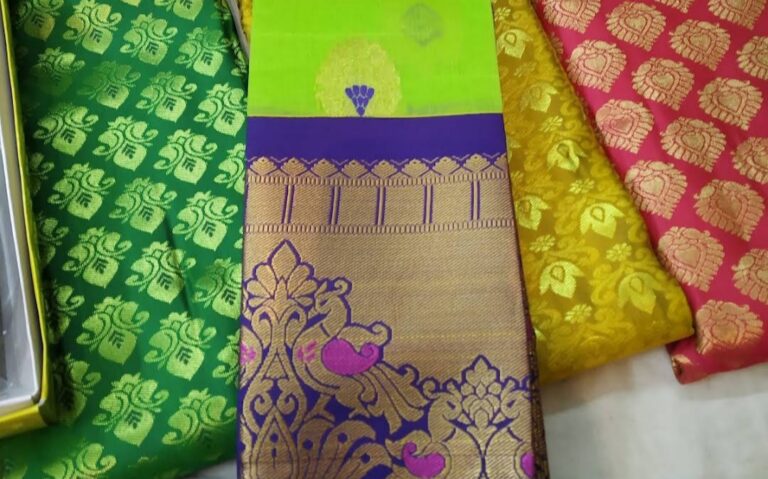
Motifs favour nature and temple architecture: mangoes, coconuts (kalasam), gopuram (temple tower) borders, lotus, creepers, and in some accounts, peacocks and parrots. The temple border motif is popularly believed to derive from the shape of the kewra flower (thazhampoo), a fragrant blossom that grows along Tamil Nadu’s riverbanks.
From Yarn to Saree: The Weaving Process
Making an Arni saree begins well before the loom is threaded. Raw yarn is washed and dyed in a boiler, with workers continually turning it so the colour sets evenly, a step considered central to the saree’s characteristic durability of colour. After dyeing, the yarn is washed, dried, and starched, which fixes the colour more permanently and gives the thread a polished finish.
The prepared yarn is then loaded onto the loom as the warp, a length known locally as a pavu (or pavvu). A single pavu typically yields four sarees, and weaving one pavu takes roughly a week of steady work. Traditionally, weaving relied on a hand-thrown shuttle and foot treadles, with intricate border and motif designs achieved through dobby or jacquard attachments, designs today are often first digitised and then punched onto cards that guide the jacquard mechanism as the saree is woven. A finishing application of natural gum gives the finished cloth its characteristic light stiffness without further chemical treatment.
Most handloom Arni sarees run to about 5.5–6.5 metres in length, and while some are still produced on traditional pit or frame looms, power looms have become common for faster production, a single handloom saree can take about a week, compared to roughly a day on a power loom.
Recognition and Revival
Arani silk sarees have received a Geographical Indication (GI) tag, and Arani is regarded as the second most renowned silk-weaving centre in Tamil Nadu after Kanchipuram, contributing significantly to the local district economy. More than 35,000 traditional weavers are estimated to remain active in the region today. The GI tag has helped formalise recognition for what was, for a long time, treated as a quieter cousin to Kanchipuram’s silk, despite its own distinct techniques and centuries-old lineage.
Why Arni Sarees Still Matter
In a market often dominated by heavier, more elaborately zari-laden silk sarees, Arni’s offering is refreshingly different: lightweight, breathable, comparatively affordable, and built with a construction technique, the two-tone, two-pallu korvai body that is genuinely unusual among Indian handloom sarees. They are practical for everyday wear and travel, yet dressy enough for weddings and festivals when woven with fuller zari borders.
Like many regional handloom traditions, Arni’s silk industry faces the pressures of power-loom competition and shrinking numbers of master weavers trained the traditional way by watching and doing, rather than through formal instruction. Choosing a genuine handloom Arni saree, distinguished by its korvai borders and kottadi checks, is a way of keeping alive a craft that has, in its own understated way, been dressing Tamil women and once, perhaps, the nation’s flag, for centuries.