Keep Calm and Carry On: The Poster That Missed the War and Conquered the World
In the summer of 1939, with war against Germany looking all but certain, Britain’s Ministry of Information began preparing for the worst. Officials expected that within hours of any declaration of war, German bombers would appear over British cities, dropping high explosives and possibly poison gas. The government needed a way to keep the public calm and cooperative if that nightmare came true, so a Home Publicity committee was assembled to design a set of morale-boosting posters that could be distributed the moment disaster struck.
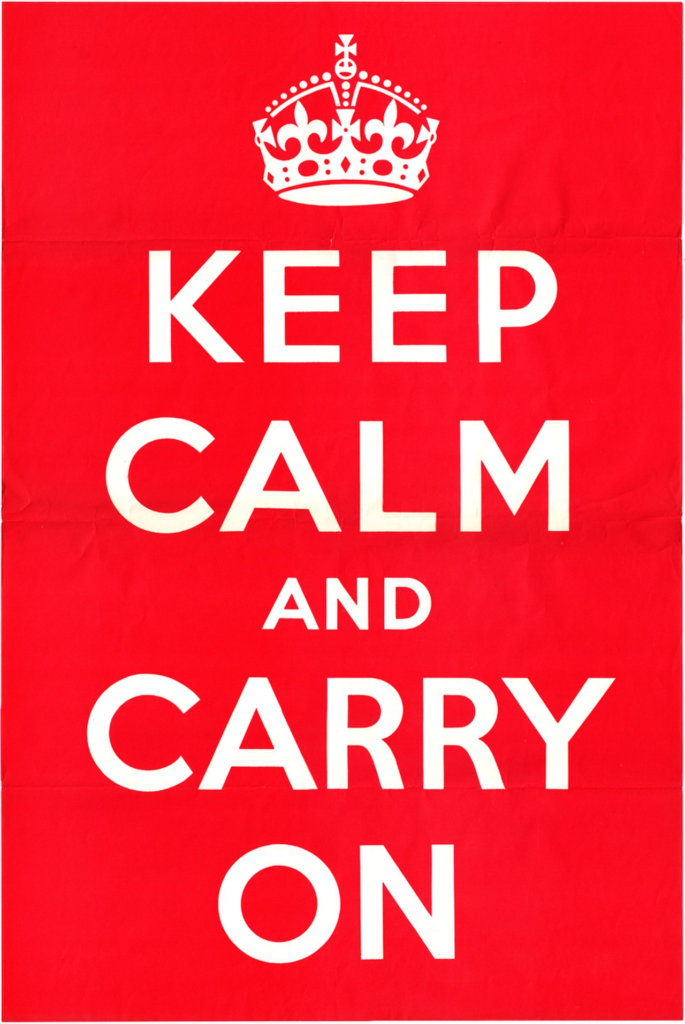
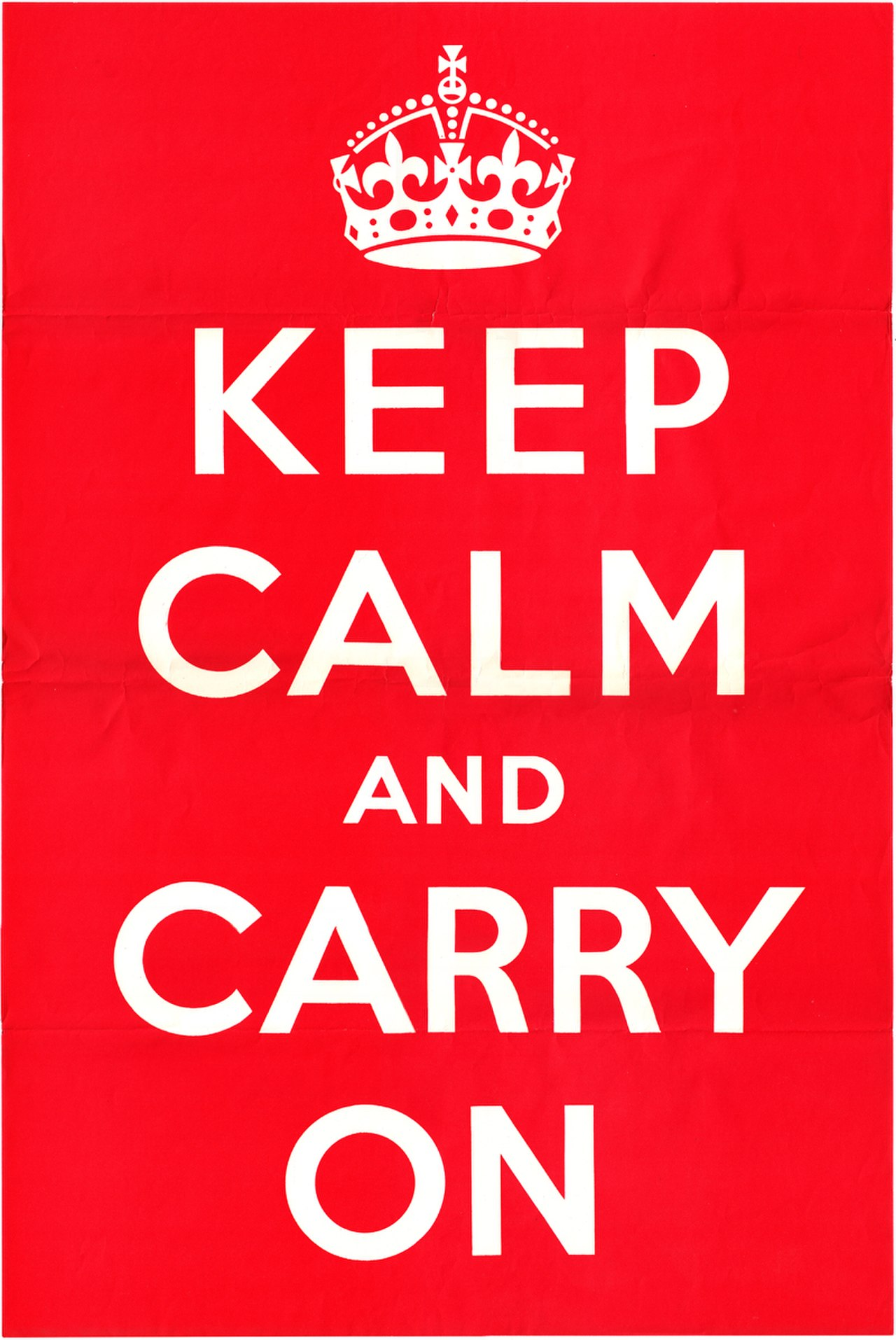
Between June 27 and July 6, 1939, the committee settled on a set of three slogans, each meant to be paired with a plain, bold design featuring the crown of King George VI and stark colored backgrounds for maximum visibility at a distance:
- “Your Courage, Your Cheerfulness, Your Resolution Will Bring Us Victory”
- “Freedom Is in Peril. Defend It With All Your Might”
- “Keep Calm and Carry On”
The lettering, likely hand-drawn by an artist named Ernest Wallcousins, echoed the clean look of humanist sans-serif typefaces of the era, similar to Gill Sans. Nearly 2.45 million copies of “Keep Calm and Carry On” were printed between late August and early September 1939, in eleven different sizes and in either red or blue. It was, in fact, the largest print run of the three, accounting for the majority of the total posters produced.
Why It Was Held Back
Unlike its two companion posters, which were distributed and displayed almost immediately, “Keep Calm and Carry On” was never issued to the public during the war. The plan was to hold it in reserve, ready to be unveiled only after a genuinely catastrophic event, such as a mass bombing raid or an invasion, when the public’s spirits would need the biggest possible boost.
That moment never quite arrived in the way officials expected. The Blitz, when it began roughly a year later, was devastating but did not produce the sudden, singular catastrophe the posters were designed for. There was also a growing unease within government circles about how the poster’s message might land. Some officials worried it sounded patronizing, as though the state were talking down to its citizens rather than rallying them as equals. The vivid red background of many printed copies didn’t help either, since it reminded some observers uncomfortably of Communist propaganda. With the moment for its “big reveal” never quite materializing, and doubts mounting about its tone, the poster simply sat in storage.
By April 1940, stockpiles of unused posters were still being kept, but as the war dragged on and paper became an increasingly scarce wartime resource, the government launched a national paper salvage campaign. The vast majority of the “Keep Calm and Carry On” copies were pulped and recycled for other uses, leaving only a small number of originals in existence, some estimates suggest as few as a couple of dozen survived, if that.
Sixty Years of Obscurity
For the rest of the twentieth century, the poster all but vanished from public memory. Unlike its two counterparts, which had at least been seen and documented at the time, “Keep Calm and Carry On” existed mostly as a footnote for historians of British wartime propaganda, if it was known at all.
Rediscovery at Barter Books
The poster’s unlikely second life began in the year 2000 in Alnwick, a market town in Northumberland in the north of England. Stuart Manley and his wife, Mary, ran Barter Books, a second-hand bookshop housed in a converted Victorian railway station. Stuart was sorting through a box of old books the couple had purchased at auction when he found a folded, yellowing poster at the bottom of the box. Neither he nor Mary had ever seen it before.
Struck by its simplicity, a bold red background, a small white crown, and the calmly authoritative message beneath it, the Manleys had the poster framed and hung it up near the shop’s till. It didn’t take long for customers to start noticing. Visitors began asking whether they could buy a copy of their own, and the requests kept coming.
Recognizing the interest, Stuart Manley contacted the Imperial War Museum to check on the poster’s copyright status. Since it had been produced by a government ministry, it fell under Crown Copyright and, importantly, was in the public domain, meaning the Manleys were free to reproduce it without seeking permission. Starting in 2001, Barter Books began printing and selling copies of the poster themselves.
From Shop Curiosity to Global Icon
Sales were modest at first, but everything changed in late 2005, when a Guardian journalist featured the reproduction poster in a list of Christmas gift ideas. According to Stuart Manley, “all hell broke loose” after the piece ran, and demand surged well beyond what the small bookshop could have anticipated.
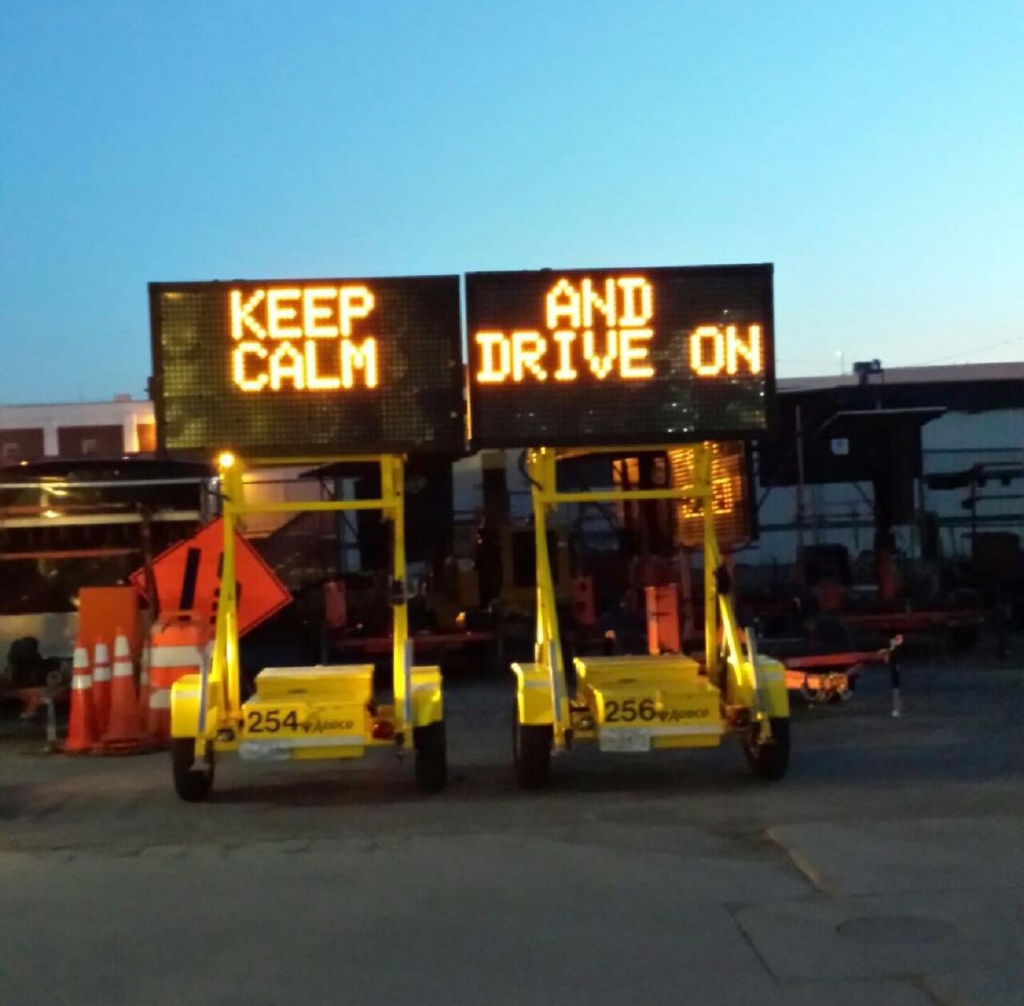
Other companies soon began producing their own versions, and the design’s stark, adaptable format made it perfect fodder for parody and reinvention. It appeared on mugs, t-shirts, tote bags, and greeting cards, and inspired countless riffs such as “Keep Calm and Party On” or “Keep Calm and Carry Chips.” Interest accelerated even further during the 2008 financial crisis, when the poster’s message of stoic resilience in hard times found fresh resonance with a public facing economic uncertainty. By 2007, Barter Books alone had already sold around 50,000 copies, a figure that continued to climb as the design spread online and became a full-blown internet meme.
The poster’s ubiquity eventually created legal friction. A private individual registered “Keep Calm and Carry On” as a trademark in the UK and EU and used it to challenge other sellers of similar merchandise. However, because the phrase had become so widely used across so many products, courts found it difficult to treat it as distinctive enough to belong to any single company, and the trademark faced serious pushback and revocation proceedings.
A Complicated Legacy
Mary Manley, one of the original discoverers, later reflected on the poster’s journey from a forgotten wartime relic to a mass-market design cliché with some ambivalence, noting that she hadn’t wanted it trivialized, but that it had since been trivialized well beyond what she imagined.
Historians researching the Ministry of Information have also pushed back gently on the popular narrative that has grown up around the poster. Academic work, including a four-year research project based at the University of London, has shown that the decision-making behind the poster was less a matter of grand strategic vision than of budget compromises and shifting bureaucratic judgment calls, made in real time as the war unfolded.
What is clear is the irony at the heart of the story: a poster created to steel the British public for the worst of the war never once hung in a shop window or on a train platform during the conflict it was designed for. Its true public debut came six decades later, at the bottom of a box of second-hand books, in a bookshop far from London, where two people who knew nothing of its original purpose simply liked the way it looked.