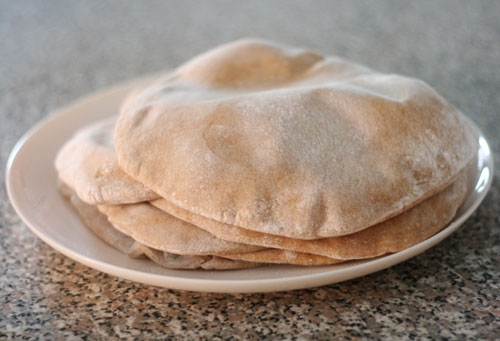
Vegan Pita Bread
I love pocket pita. I love dipping it in baba ghanoush or hummus, and I love cutting it in half and filling it with avocado and sprouts for a simple, yet delicious sandwich. I usually buy pita at the store, but lately I’ve decided to start making my own to save money. Not only that, it’s actually kind of fun to make pita because of how interesting it looks as it puffs up in the oven.
This is so easy that you’ll probably wonder why you haven’t gotten around to making it at home yourself. Sure, not every single pita puffs up the way you may hope, but it’s fresh and still tastes really nice.
Pita Bread
This recipe makes 8 pitas
- 3 cups flour (white or whole wheat, or a mixture of the two is fine)
- 1 1/2 teaspoons salt
- 1 tablespoon sugar or agave nectar
- 1 packet yeast (or, if from bulk, 2 teaspoons yeast)
- 1 1/4 to 1 1/2 cups water, roughly at room temperature
- 2 tablespoons olive oil, vegetable oil, vegan butter, or shortening
If you are using active dry yeast, follow the instructions on the packet to activate it. Otherwise, mix the yeast in with the flour, salt, and sugar.

Add the olive oil and 1 1/4 cup water and stir together with a spoon.

All of the ingredients should form a ball. If some of the flour will not stick to the ball, add more water (I had to add an extra 1/4 cup).

Once all of the ingredients form a ball, place the ball on a work surface, such as a cutting board, and knead the dough for approximately 10 minutes (or until your hands get tired). If you are using an electric mixer, mix it at low speed for 10 minutes.
(The purpose of kneading is to thoroughly combine the ingredients and to break down the flour so that the dough will become stretchy and elastic and rise well in the oven. A simple hand kneading technique is to firmly press down on the dough with the palm of your hand, fold the dough in half toward you like you are closing an envelope, rotate the dough 90 degrees and then repeat these steps, but whatever technique you are comfortable using should work.)
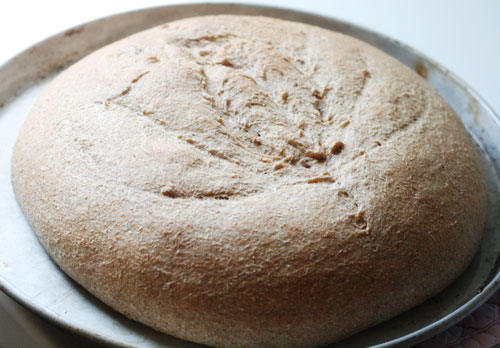
When you are done kneading the dough, place it in a bowl that has been lightly coated with oil. Form a ball out of the dough and place it into the bowl, rolling the ball of dough around in the bowl so that it has a light coat of oil on all sides. Cover the bowl with plastic wrap or a damp kitchen towel and set aside to rise until it has doubled in size, approximately 90 minutes.

Here you can see that it has approximately doubled in size.

When it has doubled in size, punch the dough down to release some of the trapped gases and divide it into 8 pieces. Roll each piece into a ball, cover the balls with a damp kitchen towel, and let them rest for 20 minutes. This step allows the dough to relax so that it’ll be easier to shape.

While the dough is resting, preheat the oven to 400 degrees Fahrenheit. If you have a baking stone, put it in the oven to preheat as well. If you do not have a baking stone, turn a cookie sheet upside down and place it on the middle rack of the oven while you are preheating the oven. This will be the surface on which you bake your pitas.
After the dough has relaxed for 20 minutes, spread a light coating of flour on a work surface and place one of the balls of dough there. Sprinkle a little bit of flour on top of the dough and use a rolling pin or your hands to stretch and flatten the dough.

You should be able to roll it out to between 1/8 and 1/4 inch thick. If the dough does not stretch sufficiently you can cover it with the damp towel and let it rest 5 to 10 minutes before trying again.

Open the oven and place as many pitas as you can fit on the hot baking surface. They should be baked through and puffy after 3 minutes.
It should start forming bubbles after about a minute of baking.

This one has puffed up perfectly. I can cut this one in half and use it to make a sandwich by filling it up with hummus, avocado and sprouts.

If you want your pitas to be crispy and brown you can bake them for an additional 3 to 5 minutes, but it isn’t necessary.