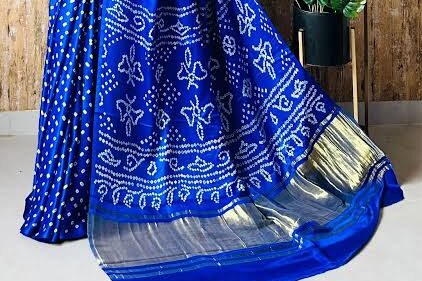
Patola Saree (Gujarat)
There are textiles that are made, and then there are textiles that are achieved. The Patola saree belongs firmly to the second category. It is the kind of cloth that stops conversations, that makes people reach out instinctively to touch it, and then pull their hand back — uncertain whether something so extraordinary should be handled at all. Weavers in the ancient city of Patan have been producing it for at least seven centuries. Today, exactly one family continues to make it in the traditional way. And yet, somehow, the Patola endures — resistant to time the way its dyes are resistant to fading, stubborn in its brilliance the way only truly great things can afford to be.
A City That Was Once a Capital
To know the Patola, you must first know Patan. Situated in northern Gujarat, Patan was once the capital of the Solanki dynasty, one of medieval India’s most powerful and culturally sophisticated kingdoms. Between the tenth and thirteenth centuries, it was a city of enormous wealth and artistic ambition — home to the extraordinary Rani ki Vav stepwell, now a UNESCO World Heritage Site, whose carved walls display a sculptural programme of breathtaking complexity. A city that could produce Rani ki Vav was a city capable of demanding the finest things in every medium. And in silk, what it demanded was the Patola.
The Salvi community of weavers — who are believed to have migrated to Patan from Karnataka or Maharashtra, depending on which account you follow — became the makers of this extraordinary cloth. They brought with them the double ikat technique, a weaving process so demanding that it remains, even today, one of the rarest textile skills in the world. In Patan, this technique found its fullest expression and its most exacting standard. The city and the cloth became inseparable in the cultural imagination of Gujarat.
What Makes a Patola: The Double Ikat Mystery
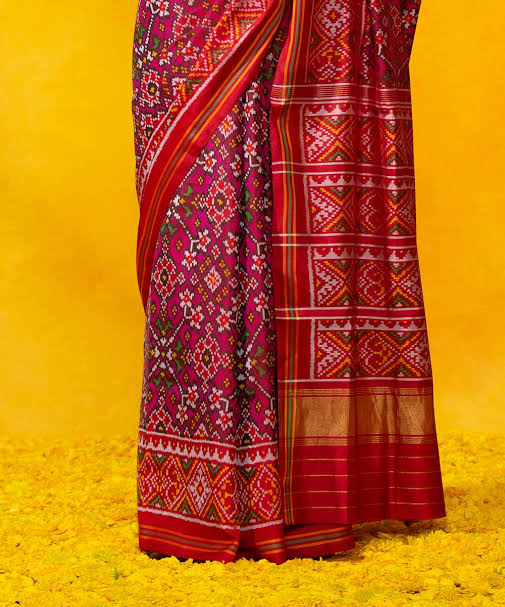
To understand why the Patola is the way it is — the geometric precision of its patterns, the identical design on both faces of the fabric, the colours that seem to glow from inside the silk rather than sitting on its surface — you need to understand what double ikat actually means, and why it is so extraordinarily difficult.
In most woven textiles, pattern is created at the loom — by the weaver’s manipulation of warp and weft threads as they interlace. In a single ikat fabric, one set of threads — either warp or weft — is resist-dyed in a pattern before weaving begins. In double ikat, both sets of threads are resist-dyed before weaving, and the two dyed patterns must align perfectly when they intersect at the loom to produce a coherent design.
Think about what this requires. Before a single thread is woven, the weaver must calculate exactly where every colour on every warp thread will meet every colour on every weft thread, and plan the resist-dyeing of both sets accordingly. The finished design exists, in a sense, before the weaving begins — encoded in the dyed threads, waiting to be revealed by their interlacing. A single miscalculation, a single thread out of place, and the pattern dissolves into blur.
There are only three places in the world where double ikat is still produced in its traditional form: Patan in India, Tenganan in Bali, and Okinawa in Japan. Each tradition arrived at this technique independently, and each produces a fabric of distinctive character. But many textile scholars consider the Patola of Patan the most technically demanding of the three, by virtue of the fineness of its silk threads and the complexity of its patterns.
The Making: Months Woven into Metres
Ask a Salvi weaver how long it takes to make a Patola saree, and the answer will stop you in your tracks. A simpler piece — relatively speaking — takes four to six months. A heavily patterned saree of the finest quality can take a full year. A single saree. Twelve months. Two or three weavers working every day.
The process begins with the silk itself, which must be of the highest quality — fine, strong, with an even lustre. The yarn is first sorted and spun, then arranged into bundles that correspond to the warp and weft of the planned saree. The pattern is calculated — and this calculation, for complex traditional designs, is itself a significant intellectual undertaking, requiring the weaver to hold the entire structure of the cloth in his mind before a single thread is dyed.
The resist-binding then begins, on both warp and weft threads simultaneously. Using cotton thread, the weavers bind off the sections of each thread that should remain undyed in the first colour bath. The threads are dyed, the bindings removed, new bindings applied to protect the first colour, and the process repeated for each subsequent colour. A Patola with four colours has undergone four rounds of this binding and dyeing on both sets of threads. The threads, when they come off the dye frame, look like a coded message — a sequence of coloured sections that means nothing in isolation but will resolve into pattern when woven together.
Then comes the weaving itself, on a simple frame loom. Two or three weavers sit together. The weft thread is passed through the warp, but before each weft thread is beaten into place, the weavers check — thread by thread, colour by colour — that the dyed sections are aligning correctly with those of the warp. If they are not, the thread is shifted, coaxed into position. The beating is done gently, carefully, with constant vigilance. This is why the weaving is so slow. Every centimetre of a Patola is checked, corrected, and confirmed before the weaver moves forward.
The result of all this — the months of binding, the careful dyeing, the painstaking weaving — is a fabric that is the same on both sides. Turn a Patola saree over, and the design is identical: no floating threads, no blurred edges, no reverse side. This reversibility is the Patola’s signature, the proof of the double ikat technique, and the quality that weavers point to with the quiet pride of people who know they have done something others cannot replicate.
The Language of Pattern
Patola designs are not decorative in any casual sense. They are a formal visual language with a grammar and a vocabulary that have been maintained for centuries, and every element of that language carries meaning.
The most iconic Patola motif is the naari — the female figure, stylised to geometric abstraction, repeated across the field of the saree in rows that create an almost hypnotic rhythm. The naari figures face each other in pairs or stand in procession; they carry flowers or lamps; they dance. Rendered in the angular geometry that double ikat imposes — because curved lines are essentially impossible when your pattern is built from the intersection of dyed thread sections — they have a quality somewhere between folk art and sacred icon.
Other beloved motifs include the paan — the betel leaf — arranged in interlocking diagonal grids; the chhabdi — basket — filled with flowers; the elephant, the parrot, the lotus, and the dancing peacock. Borders carry their own distinct patterns — typically dense geometric meanders or floral chains that frame the central field with architectural precision.
The colours of traditional Patola are rich and saturated: deep crimson, forest green, saffron, indigo, ivory, and black. The natural dyes from which they were historically made — lac, indigo, turmeric, pomegranate — have largely been replaced in contemporary production by synthetic dyes that can achieve the same intensity with less uncertainty. A handful of weavers have returned to natural dye experiments in recent years, producing Patolas of subtler, earthier tones that have found an appreciative audience among collectors who value the full traditional process.
Royalty, Ritual, and the Red Dot
The Patola saree has never been ordinary cloth. From its earliest documented history, it was associated with power, wealth, and sacred protection. The Solanki kings of Patan wore Patola. The merchant princes of Gujarat gave Patola sarees as diplomatic gifts. In the trading networks of medieval Asia — when Gujarati merchants ranged across the Indian Ocean to Southeast Asia, East Africa, and the Arabian Peninsula — Patola cloth was among the most valued items of exchange. In Bali and Java, Patola sarees were considered sacred objects, preserved in temple treasuries and brought out only for the highest religious ceremonies. Some of these sarees are still there, centuries old, their colours undimmed.
In Gujarat itself, the Patola saree is the supreme bridal textile for certain communities — particularly among the Jains and the Patidars. The traditional bridal Patola is red, worked with the naari or paan motif, edged with a broad golden border. A bride wearing one is understood to be wearing not merely a beautiful garment but a protective amulet, a statement of family honour, and a connection to generations of women who wore the same cloth before her.
The Jain community’s relationship with Patola is particularly deep. Jain merchants were among the principal patrons of Patan’s weavers for centuries. The geometric precision and bilateral symmetry of Patola design — its refusal of asymmetry, its insistence on perfect order — resonates with Jain philosophical values of balance and cosmic regularity. It is a fabric that thinks the way Jain cosmology thinks.
One Family, One Tradition
This is perhaps the most arresting fact about the Patola today: in Patan, the authentic double ikat Patola is made by a single family. The Salvi family — specifically the descendants of Shri Maganbhai Salvi — are the last practitioners of the complete traditional technique in the city that gave the textile its name.
This is not merely a romantic detail. It is a crisis and a miracle simultaneously. A crisis because the knowledge required to make a Patola — the calculation of the double ikat pattern, the binding and dyeing of both warp and weft, the careful weaving that checks every thread — exists in the hands and minds of a very small number of people. If those people stopped, the knowledge would be gone. Not diminished, not reduced — gone.
And a miracle because they have not stopped. The Salvi family continues to weave. The younger members of the family have chosen to learn the craft rather than abandon it for more immediately lucrative work. They have spoken in interviews about the weight of this responsibility — about knowing that they are carrying something irreplaceable, that the existence of this tradition in its complete form depends on their continuing to practise it every day.
A genuine Patan Patola today costs between one and several lakhs of rupees, depending on size, complexity, and the reputation of the piece. This is not a luxury price in any cynical sense. It is simply what it costs when something takes a year to make by hand, using techniques of extraordinary difficulty, with materials of the highest quality. There is no surplus in that price. There is barely enough.
The Imposters and the Real Thing
Given the Patola’s prestige and price, it should surprise no one that imitations are widespread. Rajkot Patola — produced in Rajkot, Gujarat, using a single ikat technique — is a beautiful textile in its own right, far more affordable and widely available than the Patan original. It is sold openly and honestly as Rajkot Patola by reputable sellers. The problem arises when single ikat pieces are misrepresented as Patan double ikat — a confusion, whether innocent or deliberate, that is easy to exploit given that many buyers cannot distinguish between the two.
The simplest test for double ikat is the reverse side: a genuine Patan Patola looks the same from both faces. A single ikat piece does not. Beyond this, the fineness of the thread, the sharpness of the pattern edges, the weight of the silk, and — frankly — the price are all indicators. A Patan Patola being sold for a few thousand rupees is not a Patan Patola.
The Patola received Geographical Indication protection in 2013, placing it in the same category of protected regional heritage as Banarasi silk and Darjeeling tea. This legal recognition matters. But the most durable protection for the tradition is not legal but human — the continuation of the Salvi family’s work, the education of the next generation, and the existence of buyers who understand what they are buying and value it accordingly.
What It Feels Like
It is worth saying something about what it actually feels like to hold a Patola saree — because no amount of historical and technical description quite prepares you for the object itself.
The silk is heavy and cool, with a density that comes from the tightly woven double ikat structure. The surface has a slight texture — the resist-bound sections of thread create a barely perceptible dimensional quality — but it is smooth in the way that only the finest silk can be smooth, with a liquid quality to its drape. The colours are startling in their clarity. This is silk that has been dyed before weaving, in multiple baths, with each colour driven deep into the fibre — not painted onto the surface but living inside the thread. Light does not bounce off a Patola. It seems, somehow, to come from within.
And the pattern — the precise, resolved, geometrically immaculate pattern, identical on both faces — produces a feeling that is difficult to name. It is something between admiration and disbelief. You know, intellectually, that a human being made this. But the evidence of the senses insists that it could not have been made by human beings. It is too exact. Too coherent. Too complete.
This is what a year of careful work looks like. This is what seven centuries of refined technique produces. This is what it means when knowledge is passed from hand to hand, generation to generation, without interruption — when a family decides, quietly and without fanfare, that some things are worth the difficulty of keeping alive.
A Thread That Must Not Break
The Patola saree is, in the end, a lesson in the relationship between time and beauty. In an era that celebrates speed — faster production, faster delivery, faster consumption — the Patola stands as a quiet refusal. It cannot be hurried. It cannot be automated without ceasing to be itself. It demands months. It demands skill accumulated over a lifetime. It demands the willingness to calculate and recalculate, to check and recheck, to move one centimetre at a time across a loom while holding the entire structure of the cloth in your mind.
That such a thing still exists — that somewhere in Patan, in a workshop that looks much as it must have looked centuries ago, a family is still sitting at a loom and doing this — is genuinely moving. It asks something of us too: that we pay attention, that we learn to distinguish the real from the imitation, that we understand what we are holding when we hold one of these sarees.
Because what we are holding, in the end, is not just cloth. It is time. It is knowledge. It is the accumulated devotion of people who believed that beauty was worth the trouble it costs.
A Patola is not woven. It is resolved — thread by thread, colour by colour, into something that has no business being as perfect as it is.