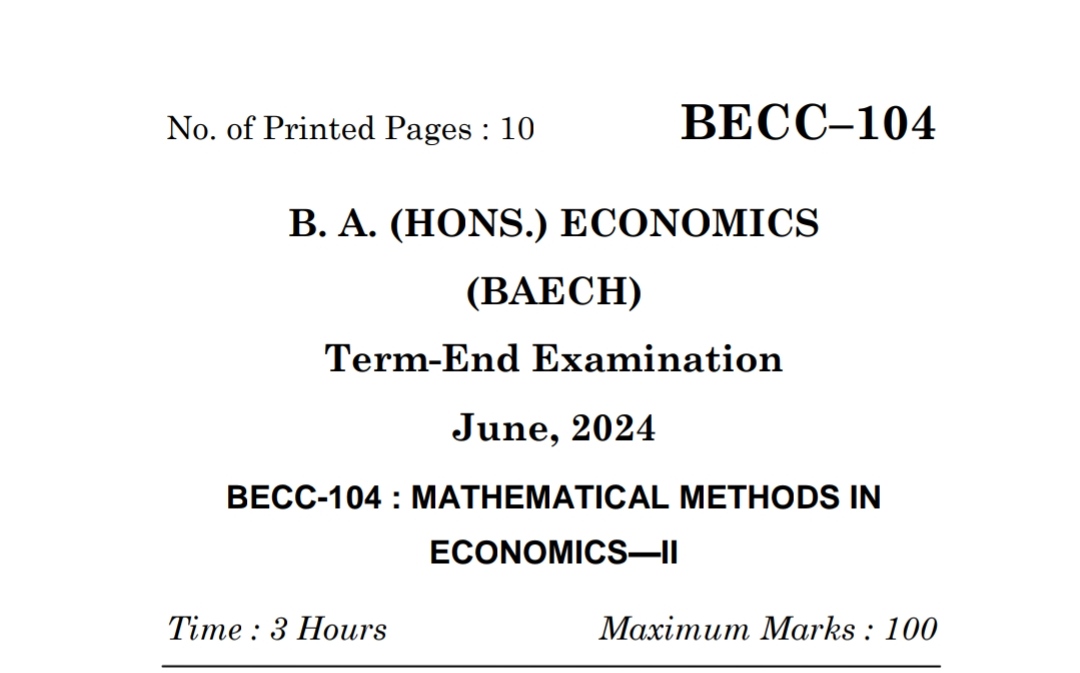
Most Important Concepts In BECC-104 For TEE Prep
Comparative Statics
Comparative statics is the analysis of how the equilibrium values of endogenous variables in a model change when one or more exogenous parameters change, while holding all other parameters fixed (“ceteris paribus”).
It answers questions of the form: “If parameter a increases by a small amount, by how much does the equilibrium outcome x⁺ change?”
Difference between non-optimization and optimization contexts
| Aspect | Non-optimization context (e.g., supply–demand, IS–LM, fixed-point equilibrium) | Optimization context (consumer/firm problem, constrained maximization) |
|---|---|---|
| Starting point | Equilibrium defined by a system of equations (market clearing, accounting identities) | Equilibrium defined by first-order conditions (FOCs) of an explicit objective + constraints |
| How comparative statics is done | Totally differentiate the equilibrium equations and solve the resulting linear system (often via Cramer’s rule or matrix inversion) | Totally differentiate the FOCs (or use the Implicit Function Theorem on the system ∇L = 0) |
| Typical tool | Direct algebra on the equilibrium conditions | Envelope theorem (often avoids solving for all choice variables) or bordered Hessian |
| Information obtained | Only the sign/magnitude of total effect (dx*/da) | Decomposes into substitution + income effects; envelope gives ∂V/∂a directly without finding dx*/da explicitly |
In short: non-optimization comparative statics compares two equilibria directly; optimization comparative statics exploits the fact that the optimum satisfies necessary conditions and uses those conditions (or the envelope) to find the response.
Linear Differential Equation
A linear differential equation (ordinary, ODE) is one in which the dependent variable y and all its derivatives appear only to the first power and are not multiplied by each other or by nonlinear functions of y.
General form (nth order):
aₙ(x) y⁽ⁿ⁾ + aₙ₋₁(x) y⁽ⁿ⁻¹⁾ + … + a₁(x) y′ + a₀(x) y = g(x)
- If g(x) = 0 → homogeneous
- If g(x) ≠ 0 → non-homogeneous
- Coefficients aᵢ(x) constant → constant-coefficient linear DE
How the solution is obtained (constant-coefficient case, most common in economics)
- Solve the homogeneous equation
Characteristic (auxiliary) equation:
aₙ rⁿ + aₙ₋₁ rⁿ⁻¹ + … + a₀ = 0
Roots r₁, r₂, … give basis functions (e.g., e^{r t}, t e^{r t} for repeated roots, sin/cos for complex roots). - Find a particular solution yₚ(x) to the non-homogeneous equation
- Undetermined coefficients (when g(x) is polynomial, exponential, sin/cos)
- Variation of parameters (general method)
- Laplace transforms (very common in dynamic optimization)
- General solution = homogeneous solution + particular solution
y(x) = c₁ y₁(x) + … + cₙ yₙ(x) + yₚ(x) - Apply initial/boundary conditions to determine constants cᵢ.
Envelope Theorem in Constrained OptimizationLet the problem be
V(a) = maxₓ f(x, a)
subject to g(x, a) = 0 (or vector of constraints)
Form the Lagrangian:
L(x, λ, a) = f(x, a) + λ g(x, a)Envelope theorem states that at the optimum (x*(a), λ*(a)),
dV/da = ∂L/∂a |_{(x*,λ*,a)} i.e., you can differentiate the Lagrangian directly with respect to the parameter a, ignoring the fact that x and λ also depend on a. The indirect effects through dx*/da and dλ*/da cancel out because of the first-order conditions.This is extremely powerful: it gives comparative-static information without solving for how the choice variables themselves change.
Compensated (Hicksian) Demand Function and Shephard’s Lemma
- Compensated/Hicksian demand xʰ(p, u) is the solution to the expenditure-minimization problem:
e(p, u) = minₓ p·x subject to u(x) ≥ ū It tells how much of each good is bought when the consumer is compensated (via lump-sum income) to stay at fixed utility ū while prices change. - Shephard’s lemma (dual to Hotelling’s lemma):
∂e(p, u)/∂pᵢ = xᵢʰ(p, u) The derivative of the expenditure function with respect to price i is exactly the Hicksian demand for good i.
(Analogous to “price = marginal cost” in duality.)
Short Notes
(a) Roy’s Identity
Roy’s identity links the Marshallian (uncompensated) demand to the indirect utility function v(p, m): xᵢ(p, m) = – (∂v/∂pᵢ) / (∂v/∂m)It is the dual counterpart of Shephard’s lemma. It lets you recover ordinary demand directly from the indirect utility function without solving the utility-maximization problem again.
(b) Multivariate Function
A multivariate (or multivariable) function is a rule that assigns to each point in an n-dimensional domain (usually ℝⁿ) a unique real number:
f: ℝⁿ → ℝ, written f(x₁, x₂, …, xₙ)Key concepts used in economics:
- Partial derivatives ∂f/∂xᵢ
- Total differential df = Σ (∂f/∂xᵢ) dxᵢ
- Gradient ∇f = (∂f/∂x₁, …, ∂f/∂xₙ)
- Hessian matrix of second partials (for concavity/convexity)
- Chain rule and implicit-function theorem (foundation of comparative statics)
Almost all optimization in microeconomics (utility, profit, cost) involves multivariate functions.