Explaining Samuelson-Musgrave Solution With Examples
Imagine society has to decide how much of a public good to produce, things like street lights, clean air, national defence, a fireworks show, a public park, or a lighthouse. These goods are special because:
- Everyone enjoys them at the same time (non-rival)
- You cannot stop someone from enjoying them (non-excludable)
Because of this, the normal market rule (“each person pays the full price”) completely fails. People become free-riders, they enjoy the benefit but don’t want to pay, hoping others will pay for them.
So the market either produces too little or nothing at all.
The Samuelson-Musgrave Solution (the correct rule)
Produce the public good up to the point where:The TOTAL extra happiness that ALL people together get from one more unit
exactly equals
the extra cost of producing that one more unit.
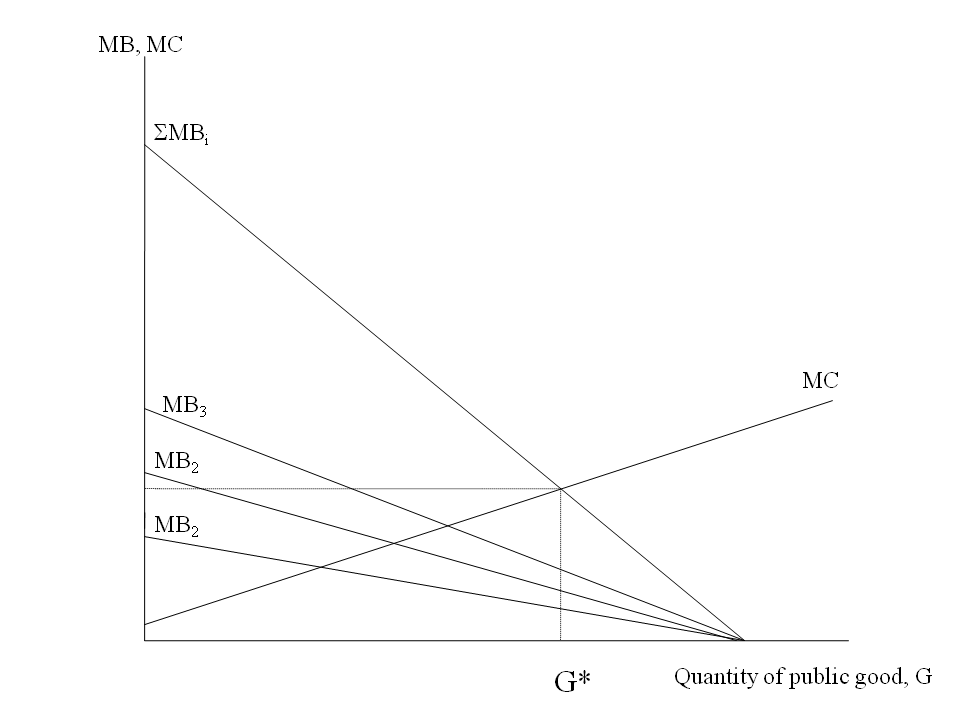
In simple words: Sum of what every single person is willing to pay for one extra unit Cost of producing one extra unit.
That’s it.
Real-life example (Fireworks for a town).
- Cost of firing one extra rocket = ₹10,000
- Town has 1,000 people.
Now ask each person secretly: “How much would you be willing to pay for this one extra rocket?”
- Person 1: ₹20
- Person 2: ₹15
- …
- Average person: ₹12
Total willingness = 1,000 × ₹12 = ₹12,000Since ₹12,000 > ₹10,000 → Fire the extra rocket (society gains).If the average willingness falls to ₹8 → total ₹8,000 < ₹10,000 → Stop. We have already reached the optimal amount.
This is the Samuelson condition (1954).
Musgrave (1959) explained how the government should actually implement it through the “allocation branch” of the budget.
Contrast with private goods (very important)
| Type of Good | Market Rule | Optimal Condition |
|---|---|---|
| Private good (apple, shirt) | Each person pays full price | Each person’s MRS = Price = MRT |
| Public good (fireworks, defence) | No one wants to pay → market fails | Sum of everyone’s MRS = MRT |
For private goods we add horizontally (market demand).
For public goods we add vertically (sum the willingness to pay of all people for the same unit).Why this is called “solution to optimal allocation”
It tells society exactly how much public good is the right amount, neither too little (under-provision) nor too much (waste of tax money).
It is the Pareto efficient level of public goods.Governments try to achieve this through taxes (income tax, property tax, etc.) that roughly match people’s willingness to pay, or through voting/referendums.
The Samuelson-Musgrave solution says:
“Add up how much every citizen values one extra unit of the public good, and keep producing until that total value exactly equals the cost of one more unit.” No single person pays the full cost, society pays according to the sum of everyone’s valuation.(Exactly parallel to Nash: “No one wants to change alone” → here “Society should not change the quantity alone without comparing total benefit vs cost”.)