Chikankari Saree (Uttar Pradesh)
There is an art form that looks, at first glance, like it could not possibly have been made by human hands. White thread on white cloth, worked in stitches so fine and so numerous that the fabric seems to have grown its own flowering, to have exhaled a pattern from within itself rather than having one applied from outside. You lean closer. You hold it to the light. And what you see stops you completely: a world of shadow and texture, of raised and flat and pierced and looped work, a vocabulary of thirty two distinct stitches operating simultaneously across a single piece of cloth to produce something that is not quite embroidery and not quite lacework but something uniquely itself. This is chikankari, and the city that made it is Lucknow, and the saree it adorns is one of the most refined and most deeply cultured objects in the entire tradition of Indian textile art.
The City of Tehzeeb
To understand chikankari, you must first understand Lucknow, because no craft is more completely the product of its city than this one. Lucknow without chikankari is imaginable, just barely. Chikankari without Lucknow is not.
The city grew to its cultural peak in the eighteenth and nineteenth centuries, when the Nawabs of Awadh, having established an effectively independent kingdom after the decline of Mughal power in Delhi, made their capital a centre of extraordinary refinement. The Nawabs of Awadh were not conquerors or builders of empire in the conventional sense. They were, above all, patrons: of music, of poetry, of dance, of cuisine, of architecture, of dress. The culture they presided over, known as the tehzeeb of Lucknow, was one of the most elaborately cultivated in South Asian history: a civilization organized around the ideal of exquisite manner, of the perfectly chosen word, of the gesture executed with such precision that it became art.
In this culture, dress was not vanity. It was communication. The way a nobleman tied his turban, the way a courtesan wore her dupatta, the precise drape of a muslin kurta: these were as legible and as meaningful as spoken language. And in this context, chikankari found its fullest expression and its most demanding standard. A craft that produces beauty through restraint, that works in white on white so that its effects are visible only in light and shadow, was perfectly suited to a civilization that valued the understated over the obvious, the suggested over the declared.
Origins: The Persian Thread
The origins of chikankari are, like the origins of most ancient crafts, somewhat disputed and somewhat mythologized. The most widely accepted account connects the craft to the Mughal period, and specifically to the influence of Persian embroidery traditions that entered India through the Mughal court. The word chikan is believed to derive from the Persian chikeen, referring to a type of embroidered fabric.
One beloved legend attributes the introduction of chikankari to Nur Jahan, the extraordinarily gifted Empress who was the effective partner of Emperor Jahangir in governance and in aesthetic matters. According to this account, Nur Jahan brought Persian embroiderers to the Mughal court and, deeply appreciating their work, encouraged the development of the technique in India. Whether or not this specific attribution is historically verifiable, it captures something true about chikankari’s genealogy: it is a meeting of Persian refinement and Indian craftsmanship, of Mughal court culture and the specific genius of the artisans of Awadh.
As the Mughal empire declined and the centre of cultural gravity shifted from Delhi to Lucknow, chikankari moved with it. The Nawabs of Awadh became the primary patrons of the craft, and it was in Lucknow’s workshops and the zenana apartments of its great households that chikankari developed its full complexity and its thirty two stitch vocabulary. By the nineteenth century, Lucknow chikankari was recognized across the subcontinent as the finest of its kind.
Thirty Two Stitches: A Language of Thread
The defining characteristic of chikankari, the quality that separates it from other embroidery traditions and makes it so extraordinarily difficult to master, is its vocabulary of thirty two distinct stitches, each with its own name, its own technique, its own visual effect, and its own appropriate application. No single piece of chikankari uses all thirty two, but the skilled craftsperson must know all of them and must understand intuitively which stitch belongs where in a composition.
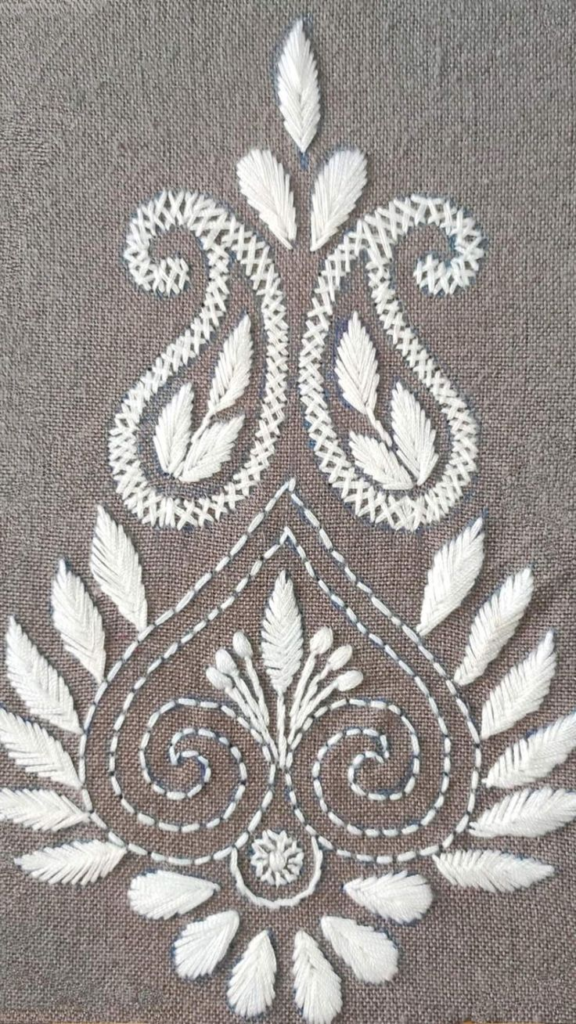
These stitches fall into three broad families, each producing a different relationship between the embroidery and the fabric surface.
The flat stitches sit on the surface of the cloth without raising it, creating patterns of shadow and texture through the arrangement of thread rather than through dimensionality. Taipchi is the most fundamental of these: a simple running stitch that forms the skeleton of most chikankari compositions, laid down first as a guide for the more complex stitches that follow. Pechni wraps around the taipchi thread to create a cable like effect. Bakhiya, or shadow work, is laid on the reverse of the fabric so that it shows through as a shadow on the front, creating areas of subtle colour change within the white work that are visible only in certain lights.
The raised stitches lift the embroidery above the fabric surface, creating a three dimensional texture that catches the light and casts tiny shadows. Murri creates small raised knots resembling rice grains, clustered together to fill flower centres or to create areas of concentrated texture. Phanda produces round, bead like knots slightly larger than murri. Ghas patti creates raised leaf and blade shapes that stand clearly above the fabric plane. The raised work in chikankari has a sculptural quality: you can feel it with your fingertips, and the shadow it casts changes with the angle of the light.
The cut or open work stitches are perhaps the most technically demanding and the most spectacular. Jali work involves withdrawing threads from the fabric and working the remaining threads into a fine mesh or lattice, creating areas of openwork that are essentially woven lace made in situ on the ground fabric. The finest jali is so delicate that it must be handled with extraordinary care; it is also, when held to the light, breathtakingly beautiful, the light passing through the mesh in patterns determined by the geometric precision of the withdrawing and working.
Learning all thirty two stitches, and more importantly learning when and how to use each one, takes years of practice. A master chikankari artisan carries in her fingers a library of techniques that can be called upon according to the demands of a particular design, a particular fabric, a particular patron’s taste. This embodied knowledge is the real treasure of the Lucknow tradition.
The Making: From Drawing to Saree
The production of a chikankari saree begins not with needle and thread but with block printing. The design for the embroidery is first printed onto the fabric using carved wooden blocks and a washable blue dye. The printed lines serve as the guide for the embroiderer, who works along and within them to produce the embroidered pattern. When the embroidery is complete, the saree is washed, removing the printed guidelines so that only the white thread work remains.
This process of block printing the design before embroidery is one of the distinctive features of the Lucknow tradition, and it serves both a practical and an artistic function. Practically, it ensures that the design is consistently placed across the length of the fabric, that the repeat patterns of the border and the scattered motifs of the body are evenly distributed. Artistically, it means that the design is conceived as a whole before the embroidery begins: the embroiderer is not improvising but interpreting, bringing the printed design to life through her choice of stitches.
The fabric most traditionally associated with chikankari is fine white cotton muslin, the transparent, lightweight fabric that was the prestige textile of the Mughal and Nawabi courts. On this fabric, the white thread embroidery achieves its most characteristic effect: the stitches are visible primarily through the shadows they cast and the textures they create, the whole composition revealing itself fully only when the fabric is held to strong light. On muslin, chikankari is at its most ethereal, most ghostly, most demanding of the viewer’s attention.
In contemporary production, chikankari is worked on a much wider range of fabrics: georgette, chiffon, silk, cotton lawn, and the finer grades of both mulberry and tussar silk. Each fabric responds differently to the needle and thread, and the skilled embroiderer adjusts her technique accordingly. Georgette requires a different tension than cotton. Silk demands a lighter hand. The relationship between the fabric and the embroidery is always a negotiation, and the quality of the result depends on how well that negotiation is understood.
The actual embroidery is done almost entirely by women, working at home in the lanes and neighbourhoods of Lucknow and the surrounding district. This domestic, distributed mode of production has been a characteristic of the chikankari industry for centuries. A single complex saree may involve the work of several embroiderers, each specialising in different stitches: one working the flat work, another the raised knots, a third the delicate jali. The work of assembly and coordination is done by the master craftsperson or the workshop owner who oversees the whole.
The time required to complete a chikankari saree varies enormously with the complexity of the design and the fineness of the work. A simply worked saree with light embroidery on the border and pallu might be completed in a few days. A fully worked saree, with dense embroidery covering the entire body in all three families of stitch, might take several months and represent hundreds of hours of labour. The price of the finished saree reflects, or should reflect, this labour: the gap between a genuinely handworked chikankari saree and a machine embroidered imitation is the gap between months of skilled hand work and a few hours of mechanical production.
White on White: An Aesthetic of Restraint
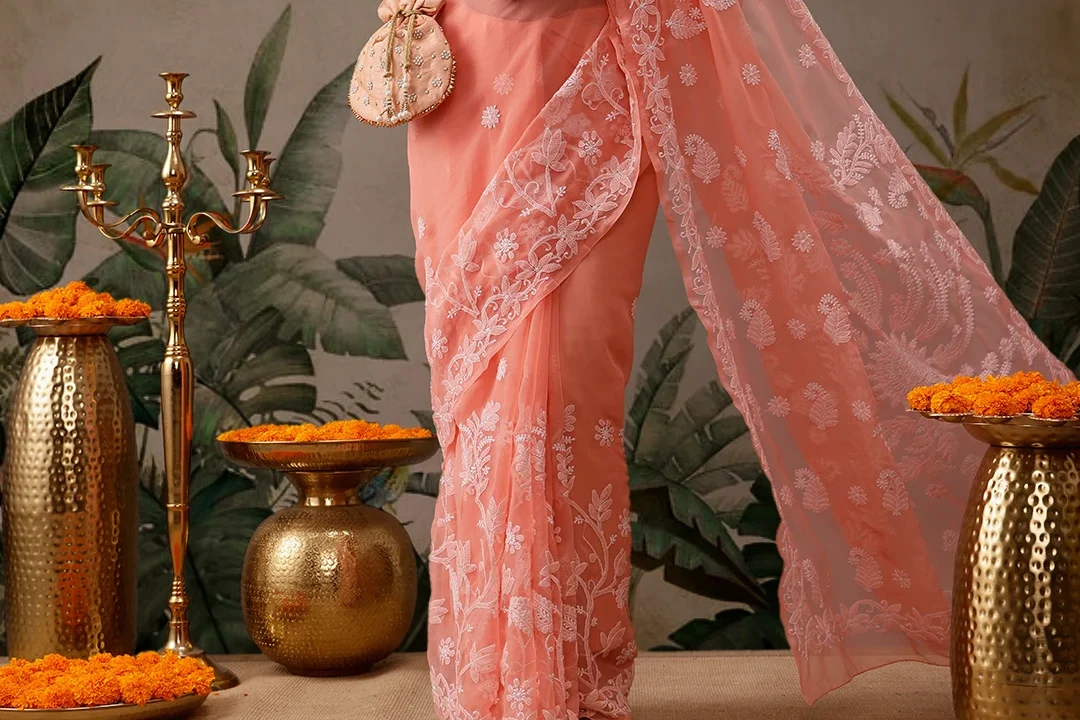
The traditional chikankari palette, white thread on white or cream fabric, is one of the most demanding aesthetic choices in any textile tradition. When colour is unavailable as a tool, every other element of design must work harder: the texture of the stitch, the density of the pattern, the relationship between filled and unfilled areas of the cloth, the play of light across raised and flat surfaces. Chikankari, working within this severe constraint, has developed a visual language of extraordinary sophistication.
The white on white effect creates a fabric that is constantly changing in appearance. In flat artificial light, a chikankari saree may look almost plain, its embroidery barely visible. In natural light, especially the strong sideways light of a late afternoon, the stitches reveal themselves in a cascade of tiny shadows, the composition suddenly legible and astonishing. In candlelight or lamplight, the raised work catches the flickering flame and seems to move. The fabric has different faces for different conditions, a quality that rewards continued wearing and attention.
This changeability is philosophically interesting. A chikankari saree does not present itself all at once. It unfolds gradually, requiring time and light and attention to reveal its full complexity. This is very much in keeping with the Lucknow aesthetic of tehzeeb: the belief that true refinement does not announce itself loudly but reveals itself slowly, to those with the patience and the sensitivity to perceive it.
In recent decades, coloured chikankari has become popular: thread in pastels, in bright colours, in contrasting shades worked on coloured fabric grounds. This development has made the craft more commercially accessible and has allowed it to reach audiences and occasions that the traditional white work could not address. The finest coloured chikankari, using good quality thread and maintaining the full vocabulary of stitches, is beautiful in its own right. But among those who know the tradition most deeply, the white on white work retains a special status: it is the most demanding, the most characteristic, and the most completely Lucknawi form of the craft.
Motifs: The Garden and the Court
The design vocabulary of chikankari is drawn from two primary sources: the natural world, particularly the garden, and the architectural and decorative motifs of the Mughal and Nawabi courts.
From the garden come the flowers that dominate chikankari composition. The lotus, the rose, the marigold, the mango blossom: these appear in endless variation, stylised to greater or lesser degrees, scattered as individual motifs across the body of a saree or massed into elaborate arrangements in the pallu and border. The kairi or mango shape, better known in Western contexts as the paisley, is ubiquitous in chikankari, appearing at every scale from the tiny scattered buti to the large pallu motif. Leaves, stems, vines, and creepers connect and frame the floral elements, creating compositions of organic complexity.
From the court comes the architectural vocabulary: the pointed arch, the jali screen, the mehrab or prayer niche shape, the geometric lattice. These elements appear most clearly in the jali work of chikankari, where the openwork mesh often takes geometric forms derived from the stone jali screens of Mughal architecture. There is something deeply appropriate about this: the same impulse that drove Mughal stonemasons to pierce marble into lace patterns drove Lucknow embroiderers to pierce muslin into the same effects, using needle and thread in place of chisel and stone.
The finest chikankari compositions balance these two vocabularies: the organic flow of the floral against the geometric precision of the architectural, the naturalistic against the abstract, the dense against the open. This balance is what separates a great chikankari design from a merely competent one.
The Craftswomen of Lucknow
The women who embroider chikankari sarees in Lucknow are among the most skilled and most economically vulnerable people in the Indian craft economy. They work from their homes, in the lanes of the old city and in the villages of the surrounding district, typically learning the craft from their mothers and grandmothers and beginning to embroider for payment from their early teenage years.
The income available to chikankari workers has historically been very low relative to the skill and time their work requires. The middle layers of the production chain, the contractors and wholesalers who connect the embroiderers to the market, have traditionally captured a large portion of the value created by the work. A woman who spends a week producing the border embroidery for a saree that will retail for several thousand rupees may receive a fraction of that amount for her labour.
This economic structure has been challenged, with varying degrees of success, by cooperative organizations, social enterprises, and direct to consumer initiatives that attempt to shorten the chain between the embroiderer’s hand and the buyer’s purse. Organizations working in Lucknow have helped groups of chikankari workers register their own labels, receive fair wages, and access markets that previously bought their work only through intermediaries. These efforts have made a genuine difference in the lives of some workers while the broader structural problem of low wages for piece work embroidery remains difficult to solve at scale.
The Geographical Indication tag granted to Lucknow chikankari in 2008 provided legal recognition of the craft’s regional identity and traditional process. This protection helps distinguish authentic Lucknow chikankari from the machine embroidered and imported imitations that have flooded the market, though distinguishing the two requires either experience or a good lens: the difference between hand stitching and machine embroidery is clear to the trained eye but invisible to the casual buyer.
Lucknow’s Other Saree
Chikankari is not the only textile tradition associated with Lucknow. The city is also the home of jamdani style muslin weaving and, particularly, of the kota style fabrics that use a distinctive open weave to create a fabric of exceptional lightness and transparency. But chikankari is the one that has defined Lucknow in the textile imagination of India, the craft most completely identified with the city’s cultural character.
This identification goes deep. When a woman in Mumbai or Delhi or Chennai wants to signal her appreciation of Lucknowi culture, of its refinement and its particular aesthetic sensibility, she reaches for a chikankari saree or a chikankari kurta. The craft has become shorthand for a certain kind of Indian elegance: not the heavy opulence of the Banarasi or the spectacular geometry of the Patola, but something quieter and more personal, more intimate in its effects, more demanding of close attention.
This is a remarkable achievement for a craft that works in white on white, that requires a strong light and a willing eye to reveal its full complexity. It speaks to how completely chikankari has embedded itself in the cultural consciousness, how successfully it has communicated its particular beauty across the distance of geography and the barrier of unfamiliarity.
The Machine and the Hand
The contemporary chikankari market is divided, not always transparently, between genuine handwork and machine embroidery. The machine embroidered chikankari saree, produced using computerized embroidery machines, can achieve a reasonable visual approximation of certain chikankari stitches at a tiny fraction of the cost. For buyers who prioritize price and who are not in a position to examine the work closely, machine embroidered chikankari is an attractive option.
But it is not chikankari. The machine cannot produce the raised stitches with the same quality as the hand. It cannot execute jali work at all. The thread tension in machine embroidery is uniform in a way that hand embroidery is not, and this uniformity, paradoxically, looks less refined up close: the slight variations of hand tension are what give chikankari its organic quality, its sense of having been made by a living person rather than a programmed mechanism.
More fundamentally, machine embroidered chikankari does not support the community of craftswomen whose skill and livelihood are inseparable from the tradition. To buy machine embroidery labelled as chikankari is to purchase the appearance of the tradition while undermining its substance. This matters, and buyers who care about craft as a living practice rather than merely as an aesthetic object have increasingly come to understand that it matters.
Chikankari and the Lucknow Gharara
The chikankari saree exists within a broader ecosystem of Lucknawi dress culture that includes the gharara, the kurta, the dupatta, and the sherwani, all of which have been adorned with chikankari embroidery at various points in the tradition’s history. The saree, however, holds a special place in the chikankari tradition because it offers the largest canvas: six metres of fabric across which the embroiderer’s art can be distributed with the full complexity that the thirty two stitch vocabulary demands.
A fully worked chikankari saree, with embroidery on the body, the border, and an elaborate pallu, is one of the most technically ambitious objects in Indian textile craft. It requires the coordination of multiple embroiderers, the oversight of an experienced master craftsperson, careful planning of the design so that it distributes appropriately across the full length of the fabric, and months of painstaking stitching. The finest examples are not merely sarees but arguments: demonstrations of what human hands can achieve when they are given the time and the skill to achieve it.
The Shadow and the Light
There is a quality in chikankari that no other textile tradition quite replicates: its dependence on light. A chikankari saree in a dark room is almost nothing. Hold it to a window, and it becomes everything. The stitches that were invisible a moment ago now cast their tiny shadows, the jali work glows, the raised knots catch the light on their upper surfaces while their undersides remain in shadow, and the whole composition reveals itself in its full complexity.
This dependence on light is not a limitation. It is the craft’s deepest intelligence. Chikankari understands that beauty is not a fixed property of an object but a relationship between the object, the light, and the eye that perceives them. It is a textile that changes with the time of day, with the weather, with the angle from which it is seen. It rewards continued looking. It gives more the more you attend to it.
In this, it is very much a product of the civilization that made it: Lucknow’s tehzeeb, which understood that the deepest pleasures are not the ones that overwhelm you immediately but the ones that unfold over time, that require cultivation and attention, that offer something new each time you return to them.
An Embroidery That Endures
The chikankari saree has survived the fall of the Nawabs, the disruptions of colonial rule, the economic pressures of independence and liberalization, and the market flood of machine produced imitations. It has survived because it is genuinely irreplaceable: because no machine has yet produced the jali work that a skilled hand produces, because no algorithm has designed a chikankari composition with the organic intelligence of an experienced craftsperson, because no synthetic fabric has the relationship with white thread embroidery that fine cotton muslin has.
It has also survived because of the women who stitch it. Sitting in their homes in the lanes of Lucknow, working in the particular concentrated quiet that fine needlework requires, they are the living continuity of a tradition that stretches back through the Nawabi court to the Mughal ateliers and beyond. Their fingers carry knowledge that no book fully contains. Their eyes can read a design and know immediately which stitch it calls for, which density, which weight of thread. This knowledge is not infinite. It requires wearers and buyers willing to value it enough to sustain it.
The chikankari saree asks, ultimately, for the same thing that tehzeeb asks: attention. The willingness to look carefully, to appreciate what is subtle, to find beauty in restraint rather than in abundance. This is not a difficult thing to give. It requires only the decision to slow down, to hold the fabric to the light, and to see what the hands of Lucknow have made.