Chanderi Saree (Madhya Pradesh)
There are textiles that carry the weight of history in every thread. Not metaphorically but literally: the knowledge of how to make them was accumulated across centuries, refined by generation after generation of weavers who understood that they were working within a tradition larger and longer than any individual life. The Chanderi saree is this kind of textile. It comes from a small town in Madhya Pradesh that was once a significant medieval kingdom, that sat on the trade routes connecting northern and central India, and that produced, from the intersection of its geography and its history and the specific genius of its weavers, a cloth of such extraordinary delicacy that it has been described as woven air, as moonlight made textile, as the fabric that makes other fabrics feel heavy by comparison.
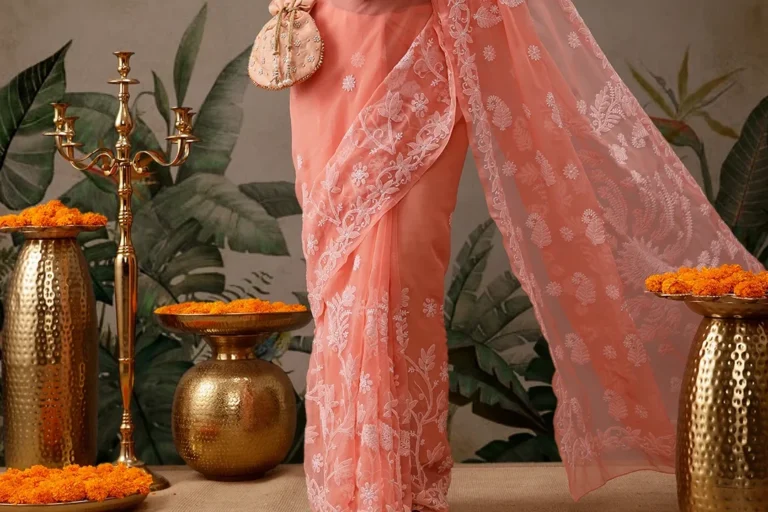
To hold a fine Chanderi saree is to understand immediately that you are holding something made at the very limit of what is possible with thread and loom. It is transparent in the way that only the finest fabrics are transparent: not sheer in the manner of synthetic chiffon, which is merely thin, but luminous in the manner of a fabric whose every thread is so fine and so carefully placed that light passes through the weave the way it passes through still water, carrying with it a quality of depth that opacity cannot achieve.
The Town at the Crossroads
Chanderi sits in the Ashoknagar district of Madhya Pradesh, on the edge of the Vindhya plateau where the flat agricultural plains of the north begin to give way to the rocky, forested terrain of central India. It is not a large town. It is not, by any obvious contemporary measure, a significant one. But it carries in its geography and its architecture the evidence of a past of considerable importance.
The town was a strategic prize for much of medieval Indian history, sitting as it did at the intersection of trade routes connecting Delhi and Agra to the Deccan, and the western ports of Gujarat to the eastern heartland. It was fought over by the Rajput kingdoms of Rajasthan, the Malwa Sultanate, the Delhi Sultanate, and eventually the Mughals, each of whom recognized its value as a trading and military node. The ruins of its fort, perched on a rocky hill above the town, and the extraordinary collection of medieval monuments scattered through and around Chanderi, mosques and tombs and step wells and carved gateways, testify to a history of resource and ambition that the town’s current modest scale does not immediately suggest.
It was within this context of medieval commercial activity that the Chanderi weaving tradition developed and flourished. The town’s position on trade routes meant access to fine yarn from across the subcontinent, access to markets for finished cloth, and exposure to the aesthetic influences of multiple courts and cultures. The weavers of Chanderi absorbed these influences and transformed them into something distinctively their own: a textile that drew on the silk weaving traditions of the north, the cotton weaving traditions of central India, and the specific demands of the royal and merchant patrons who commissioned their finest work.
Silk and Cotton: The Marriage of Fibres
The most characteristic and most celebrated form of Chanderi fabric is a blend of silk and cotton that produces a textile unlike either fibre alone. The warp, which runs the length of the fabric, is typically of fine silk, providing the structure and the lustrous sheen that catches the light. The weft, which crosses the warp at right angles to create the body of the fabric, is typically of fine cotton, providing breathability, softness, and a slight matte quality that moderates the silk’s shine. The interaction between these two fibres, warp of one, weft of another, produces what textile people call a shot effect: the fabric appears to change colour slightly as it moves, the silk catching the light at one angle and the cotton absorbing it at another.
This silk cotton combination is not merely a technological convenience. It is an aesthetic decision of considerable sophistication, one that produces a fabric with qualities that neither silk alone nor cotton alone could achieve. Pure silk of comparable fineness would be too delicate for everyday wear and too expensive for most buyers. Pure cotton of comparable transparency would lack the lustre and the drape that makes Chanderi so distinctive. The combination creates a fabric that is simultaneously practical and beautiful, accessible and refined, a daily wear textile that manages to feel like a luxury.
The weavers of Chanderi also produce fabric in pure silk and in pure cotton, each with its own character and its own market. Pure Chanderi silk, woven to the same standards of fineness as the silk cotton blend, has an intensity of lustre and a fluidity of drape that the blend cannot quite match. Pure Chanderi cotton, woven fine enough to be semi transparent, has a freshness and a lightness that is distinctly its own. But it is the silk cotton blend that most people mean when they speak of Chanderi, and it is this combination that represents the tradition’s most complete expression of its particular aesthetic vision.
Transparency as Achievement
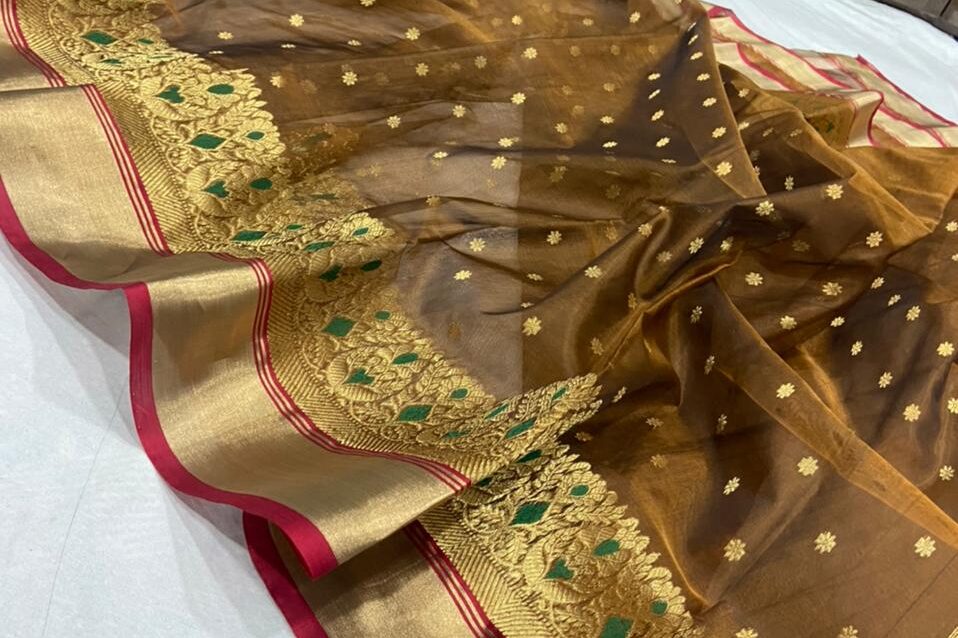
The transparency of fine Chanderi is not accidental. It is the result of deliberate choices made at every stage of production: the selection of the finest available yarn, the setting of the warp at a density that allows light to pass between the threads, the weaving of the weft at a tension that keeps the fabric open rather than closing it up. Achieving this transparency while maintaining enough structural integrity for the fabric to drape well and survive wearing is a technical challenge of considerable difficulty.
The finest Chanderi fabric, held to strong light, reveals its warp and weft threads as distinct, individually visible elements of a structure that is open and regular. The light that passes through is not simply transmitted but slightly coloured by the fabric, tinted by the natural character of the silk and cotton, so that the shadow a Chanderi saree throws on the skin beneath it is not colourless but carries a faint warmth. This is different from the cold transparency of synthetic sheer fabrics, which transmit light without this warmth, and it is one of the qualities that those who love Chanderi find impossible to replicate with any substitute.
The transparency also means that Chanderi requires a careful relationship with the body beneath it. A Chanderi saree is typically worn over a well fitted blouse and petticoat, and the colour of these underlayers affects the appearance of the saree significantly. A white Chanderi over a white petticoat looks different from a white Chanderi over a coloured one. The interplay between the saree and what lies beneath it is part of the aesthetic experience of wearing Chanderi, a dimension of the textile’s beauty that opaque fabrics do not have.
The Woven Motif: Booti and Border
Against the luminous, transparent ground of the Chanderi fabric, the woven motifs appear with a particular clarity and force. The contrast between the open weave of the body and the denser weave of the patterned elements creates a visual effect that is almost three dimensional: the motifs seem to float on the surface of the fabric, suspended in the transparency like flowers preserved in water.
The most characteristic Chanderi motif is the asharfi booti, the coin motif, a small circular or square element scattered across the body of the saree in a regular or irregular distribution. This motif, which appears in Chanderi weaving with remarkable consistency across centuries, is believed to have origins in the gold coin imagery of the medieval court: a reference to wealth and abundance that became decorative and then traditional and finally simply Chanderi, so embedded in the visual identity of the cloth that it no longer requires its original meaning to justify its presence.
Beyond the asharfi booti, Chanderi employs a range of floral and geometric motifs drawn from the same broad vocabulary of Indian textile design that appears in other weaving traditions: the lotus, the mango or kairi, the creeper and vine, the geometric lattice. What distinguishes the Chanderi interpretation of these common motifs is the manner of their execution: worked in supplementary weft using silk or zari thread on a ground that is itself already fine and slightly transparent, they have a jewel like precision and clarity.
The borders of a Chanderi saree are typically its most densely worked elements. The characteristic Chanderi border combines woven geometric or floral patterns with zari work, the metallic thread adding a brightness to the border that frames and anchors the more delicate body. The contrast between the relative openness of the body and the relative density and brightness of the border is a compositional choice of great elegance: it gives the saree a structural clarity, a sense of designed proportion, that makes the whole more than the sum of its parts.
The pallu, traditionally the most elaborate section of any Indian saree, in Chanderi is worked with concentrated versions of the motifs that appear more sparsely in the body, often with additional zari work and sometimes with small figurative elements: the dancing peacock, the elephant in procession, the flowering tree. The pallu of a well made Chanderi saree is a composition in miniature, a small world of pattern and light enclosed within the larger luminosity of the fabric.
The Weavers’ Community
The weaving community of Chanderi is largely Muslim, belonging to the Ansari community of weavers whose presence in the town stretches back at least to the medieval period. This is a familiar pattern in Indian handloom weaving: the Ansari weavers of Varanasi, of Chanderi, of Murshidabad, represent a thread of continuity through the upheavals of Indian history, communities whose identity has been shaped by their craft across generations of political and social change.
In Chanderi, the weavers live primarily in the old town, in lanes and neighbourhoods that have a density and a particular quality of light, narrow streets between old houses, that suggest a medieval urban fabric not entirely transformed by modernity. The pit looms are in the homes, as they typically are in traditional Indian weaving communities: the loom is not a factory object but a domestic one, part of the household in the most literal sense, present in the room where the family lives and works.
The social organization of Chanderi weaving has traditionally been hierarchical, with master weavers who control designs and manage production working with wage weavers who execute the technical work of the loom. This hierarchy has been modified in recent decades by the growth of cooperative models and by the direct access to urban markets that some weavers and weaver groups have achieved. But the fundamental structure, in which design knowledge and market access are concentrated in fewer hands than the actual weaving skill, remains a challenge for the equitable distribution of the value created by the tradition.
The Mughal Influence and the Royal Warrant
The Chanderi weaving tradition reached its historical peak during the Mughal period, when the court’s insatiable appetite for fine textiles created demand for the best that Chanderi’s weavers could produce. Chanderi fabrics appear in Mughal imperial records and in the accounts of travelers and traders who visited the region during this period. The refinement of the Chanderi weave, the pursuit of ever greater fineness and transparency, was driven in significant part by the demands of these imperial patrons, whose aesthetic standards were among the most exacting in the world.
After the decline of Mughal power, Chanderi continued to supply the courts of central India: the Maratha rulers, the Scindias of Gwalior, the various princely states of the region. Each court brought its own aesthetic preferences and its own demands, and the Chanderi weavers adapted their work accordingly. The tradition of working to the specific requirements of powerful patrons gave Chanderi weavers an unusually refined understanding of how to produce textiles that satisfied exacting aesthetic standards, a training in excellence that shaped the tradition’s character even as the specific patrons changed.
With the end of the princely states after Indian independence, the court patronage that had sustained Chanderi weaving for centuries disappeared overnight. The weavers were faced with the challenge of finding new markets in a democratic, commercial economy that operated on entirely different principles from the court system they had served. This transition was painful and difficult, and many weavers struggled through the decades after independence. The revival of interest in Indian handloom textiles that began in the 1970s and 1980s, driven by urban educated consumers, craft organizations, and the efforts of designers who understood the value of what Chanderi produced, helped stabilize and eventually strengthen the tradition’s market position.
Natural Dyes and the Chanderi Palette
The colour palette of Chanderi sarees has evolved considerably over the centuries, moving from the natural dye colours of the pre colonial period through the aniline dyes of the colonial era to the reactive and acid dyes of contemporary production. Each era has left its mark on the tradition, and the question of what colours are most authentically Chanderi is one without a simple answer.
The natural dye colours that characterised older Chanderi production were, like those of all natural dye traditions, complex and slightly unpredictable: the warm saffrons and ochres of turmeric and pomegranate, the deep reds and pinks of madder and lac, the cool blues of indigo, the soft greens of combined plant dyes. These colours had a quality of depth and organic warmth that synthetic dyes struggle to replicate, and in recent years there has been a revival of interest in natural dye Chanderi among weavers and buyers who value the aesthetic and environmental qualities of plant based colour.
Contemporary Chanderi is produced in an enormous range of colours, responding to the fashion preferences of a broad and varied market. The pastels, which suit the transparency of the fabric particularly well, are enormously popular: soft pinks and peaches and mints that allow the luminosity of the Chanderi weave to express itself fully without the colour becoming dominant. Deeper colours, worked on the silk warp, produce a fabric with a richness and intensity that is different from the pastel Chanderi but equally beautiful in its own way. Dual tone Chanderi, in which the warp and weft are dyed in contrasting colours to maximize the shot effect of the silk cotton combination, produces a fabric that seems to contain multiple colours depending on the angle of the light.
Chanderi and Sustainability
The Chanderi saree has a relationship with sustainability that is worth examining carefully, because it is more complex than the simple equation of handloom equals sustainable that is sometimes offered.
On one hand, the traditional Chanderi production process is genuinely low impact: no electricity is used in the weaving itself, the quantities of dye and water consumed are far smaller than those of industrial textile production, and the longevity of a well made Chanderi saree, which can last decades with proper care, compares favourably with the disposability of fast fashion. The silk cotton blend is a natural fibre combination that biodegrades at the end of its life in a way that synthetic fabrics do not.
On the other hand, the silk component of Chanderi raises the ethical questions that all silk production raises: the silkworm must be killed to allow the continuous reeling of the cocoon, and the sericulture industry has its own environmental footprint in terms of the mulberry cultivation that feeds the worms. These concerns have led some buyers to seek peace silk or ahimsa silk alternatives, and some Chanderi weavers have begun producing fabric using these alternatives in response to market demand.
The most honest assessment is that Chanderi, like all traditional handloom textiles, occupies a different point on the sustainability spectrum than industrial production, generally more sustainable in its production process and in its relationship with the lives and livelihoods of the people who make it, while not being without its own complexities and trade offs. The decision to buy Chanderi over synthetic alternatives is, on balance, a choice that supports both environmental and social sustainability, while remaining, like all such choices, imperfect.
The Chanderi Saree in Contemporary Life
The Chanderi saree has found, in the contemporary moment, a particularly appreciative audience among urban Indian women who want a saree that is simultaneously refined and practical, beautiful and wearable, rooted in tradition and compatible with modern life. The lightness of Chanderi, its breathability, its relatively easy drape compared to heavier silks, make it a genuinely comfortable choice for wearing across a full day of work or social activity. The transparency and luminosity of the fabric mean that it always looks considered, always looks like a choice made with care, without requiring the formal staging that a heavier silk demands.
Designers working with Chanderi in the contemporary market have explored its possibilities extensively. The transparent ground has proved receptive to a wide range of surface treatments: block printing on the woven fabric, embroidery applied after weaving, natural dyeing in complex colour sequences, and experimentation with new motif vocabularies that update the traditional design language without abandoning it. Some of the most successful contemporary Chanderi sarees combine the traditional woven booti and border with printed or embroidered elements that reflect current aesthetic sensibilities, creating a dialogue between the traditional and the contemporary that gives the fabric continued relevance.
The growing market for Chanderi has brought increased income to the weaving community and attracted investment in design development and quality improvement. It has also attracted the inevitable imitations: fabrics from other weaving centres that approximate the Chanderi look without the specific character of the genuine article, and machine produced fabrics that replicate the visual effect of the woven motifs without the structural qualities of handloom weaving. The Geographical Indication tag granted to Chanderi fabric in 2005 provides legal protection against these imitations, though as always, the protection is only as effective as the awareness and discernment of the buyer.
Moonlight in Thread
There is a phrase that appears repeatedly in descriptions of Chanderi, across centuries and across different languages: the comparison to moonlight. The cloth is like moonlight, travelers wrote. It is as transparent as moonlight, as luminous as moonlight, as cooling as moonlight on a summer night. This comparison is not mere poetry. It is an attempt to capture something real about the experience of Chanderi: the way the fabric transmits light rather than simply reflecting it, the way it seems to glow from within rather than shining from without, the way it has a quality of coolness and stillness that more opaque and more aggressively lustrous fabrics do not possess.
Moonlight is not the brightest light. It is not the most intense or the most dramatic. But it is the light that makes familiar things strange and beautiful, that adds depth and mystery to surfaces that appear flat and plain in harsher illumination. Chanderi works the same way. It does not overwhelm. It does not demand. It asks to be seen carefully, in good light, with attention. And when it is seen this way, it reveals a beauty that has no precise equivalent in the textile world.
The weavers who make this possible are working, as they have always worked, at the intersection of skill and material and time. They are managing fine threads on simple looms in a small town in Madhya Pradesh, producing fabric of a quality that belies both the simplicity of their tools and the modesty of their surroundings. They are doing what the weavers of Chanderi have always done: finding the very edge of what is possible with silk and cotton and a handloom, and working there, day after day, producing cloth that makes the light itself more beautiful.
The Kingdom in the Thread
Chanderi is no longer a kingdom. The fort above the town is a ruin. The medieval trade routes that made it significant have long since been replaced by railways and highways that bypass the town entirely. The courts that commissioned its finest work no longer exist. The political and economic conditions that gave rise to the tradition have been entirely transformed.
And yet the tradition continues. The looms are still working in the lanes of the old town. The warp threads are still being set with the same care, the silk and cotton still being combined in the same proportions, the booti motifs still appearing in the same positions relative to the border and the pallu. The knowledge is still being passed, precariously in some respects but continuously, from one generation of weavers to the next.
This continuity is not guaranteed. It requires, as it has always required, the existence of people who value the cloth enough to pay a price that makes its production possible, and people who find meaning in making it. Both of these things remain true of Chanderi, though neither can be taken for granted.
What can be said with certainty is that as long as the Chanderi saree is being made in the traditional way, by hand, on pit looms, in the town that gave it its name, it will continue to be one of the most beautiful textiles in the world. Not because of any single spectacular quality but because of the completeness of its vision: the perfect marriage of transparency and structure, of silk lustre and cotton warmth, of ancient motif and living craft. A fabric that has been refined across centuries until it reached the very edge of what thread and loom can achieve, and stayed there.