Bhagalpur Tussar Saree (Bihar)
There is a silk that does not come from careful cultivation or controlled conditions. It does not emerge from the ordered rows of mulberry trees that feed the silkworms of Varanasi or Kanchipuram. It comes from the forest. From wild trees on hillsides and in scrubland, from silkworms that have never been domesticated, that spin their cocoons in the open air according to rhythms older than agriculture itself. This is tussar silk, and the city that has made it most gloriously its own is Bhagalpur, a town on the southern bank of the Ganga in Bihar, which has been weaving this extraordinary fibre for so long that it carries the name Silk City as naturally as it carries the river.
The Bhagalpur tussar saree is unlike any other silk saree in India. It does not try to be Banarasi. It does not aspire to the liquid lustre of mulberry silk or the jewelled density of Kanjeevaram. It is something altogether more elemental: a fabric with the texture of the earth it came from, the colour of the forest floor in autumn, the warmth of something that has not been entirely tamed. To wear a Bhagalpur tussar saree is to wear, in some sense, the wild.
A City on the Ganga
Bhagalpur sits on the Ganga at the point where the river begins to bend eastward toward Bengal, in a stretch of Bihar where the landscape softens from the flat agricultural plains of the Gangetic heartland into something more varied and wooded. The Ganga here is wide and unhurried. The southern bank, where Bhagalpur stands, looks across the river to the forests and hills of Jharkhand, from which the tussar cocoons have historically come.
The city is ancient. It appears in Buddhist texts as Champa, a prosperous trading town of considerable importance. It was a centre of learning and commerce in the medieval period. It has been ruled by the Palas, the Mughals, the Nawabs of Bengal, and the British, each of whom found it valuable enough to administer carefully. Through all of these political changes, the one constant has been the weaving. The silk has always been there.
The weavers of Bhagalpur belong primarily to the Tanti and Panka communities, whose association with the loom stretches back through recorded history. They are the human thread that connects the contemporary Silk City to its ancient predecessor, the people in whose hands and memories the knowledge of tussar weaving has lived across generations of political upheaval and economic change.
Tussar: The Uncultivated Silk
To understand the Bhagalpur saree, you must first understand tussar, and to understand tussar you must understand that not all silk is the same. The silk most familiar to the world, the smooth, luminous, almost liquid fibre of the Banarasi or the Chinese bolt, comes from the cocoon of Bombyx mori, a silkworm so thoroughly domesticated over millennia of selective breeding that it can no longer survive in the wild. It eats only mulberry leaves. It has lost the ability to fly. It exists entirely within the controlled conditions of the sericulture farm, producing a silk of extraordinary uniformity and lustre.
Tussar silk comes from a different world entirely. The primary tussar silkworm, Antheraea mylitta, lives wild on the leaves of arjun, asan, and saja trees in the forests of Jharkhand, Chhattisgarh, Odisha, and Bihar. It is not domesticated. It spins its cocoon on the branch where it feeds, in the open air, subject to the variations of temperature and humidity that characterise a living forest. The cocoon it produces is larger and coarser than the Bombyx cocoon, with a natural golden brown colour that no processing can fully remove.
This natural colour is not a deficiency. It is tussar’s most distinctive and most loved characteristic. The warm, earthy tone of undyed tussar, ranging from pale honey through deep amber to rich chestnut depending on the specific tree the worm fed on and the season in which it spun, is a colour that no dye has ever quite replicated. It is the colour of the forest, of autumn leaves, of the skin of the arjun tree itself. Worn against Indian skin, it has a quality of warmth and rightness that silk of cooler, artificial colours cannot achieve.
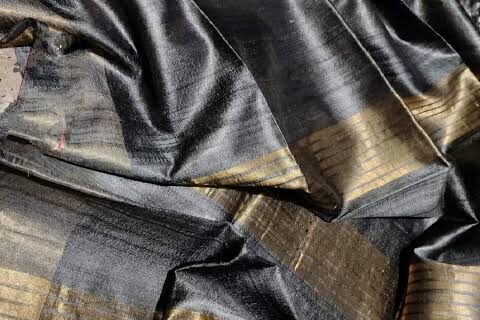
The fibre of tussar is different in structure from mulberry silk. Where mulberry silk is smooth and continuous, ideal for the tight, even weave that produces its characteristic sheen, tussar is slightly irregular, with a texture that catches the light differently at different angles. This texture is what gives tussar its characteristic appearance: not the uniform gloss of mulberry silk but a more complex, slightly matte surface with a subtle shimmering quality, as though the light is moving through the fabric rather than simply bouncing off it.
The Journey from Forest to Loom
The production of a Bhagalpur tussar saree begins not in the weaving sheds of the city but in the forests of Jharkhand, where tribal communities collect the wild tussar cocoons from the trees on which they are spun. This collection, which happens in the cold months after the silkworms have completed their spinning, is itself a form of ancient knowledge: knowing which trees carry the cocoons, which cocoons are of the best quality, how to harvest without damaging the silk inside.
The cocoons are brought to Bhagalpur, where they are processed into yarn. The reeling of tussar is considerably more difficult than the reeling of mulberry silk. The irregular, coarser fibre requires more skill and more physical effort to unwind into a usable thread. The yarn that results is less uniform than mulberry silk yarn but carries within its slight irregularities the marks of its wild origin, the variations that give tussar fabric its characteristic texture and depth.
The yarn is then degummed, partially or completely, to remove the sericin protein that stiffens the raw fibre. The degree of degumming affects the character of the finished fabric: fully degummed tussar is softer and more drapeable, while partially degummed tussar retains more body and a slight crispness. Bhagalpur weavers have developed a nuanced understanding of how to balance these qualities for different types of sarees and different end uses.
Dyeing tussar is a particular art. The natural golden brown of the fibre means that colours do not appear on tussar the way they do on white mulberry silk. Blues become more complex, with a greenish undertone. Reds shift toward rust and brick. Yellows deepen to gold. Greens take on an earthy warmth. These colour shifts are not problems to be overcome but qualities to be understood and worked with. The most skilled dyers of Bhagalpur know how to read the natural colour of the fibre and choose dye shades that will work with it rather than against it, producing colours of unusual depth and complexity that are specific to tussar and cannot be produced on any other fibre.
Weaving: Structure and Soul
The Bhagalpur tussar saree is woven on both pit looms and frame looms, by weavers who have typically learned their craft within the family and the community. The weave structure of most Bhagalpur tussar is relatively straightforward: a plain weave or simple twill that allows the natural texture and colour of the tussar yarn to speak for itself without the distraction of complex structural patterning.
This restraint is deliberate. The Bhagalpur weaver understands that tussar does not need embellishment the way some other fibres do. Where mulberry silk benefits from the complex interlacing of the Jamdani or the dense zari work of the Banarasi, which add visual interest to a fibre whose very smoothness can seem featureless, tussar is interesting in itself. The texture of the yarn, the slight irregularities of the weave, the way the fabric catches and holds light: these are the decoration. The weaver’s job is not to add ornament but to create the conditions in which the natural beauty of the material can fully express itself.
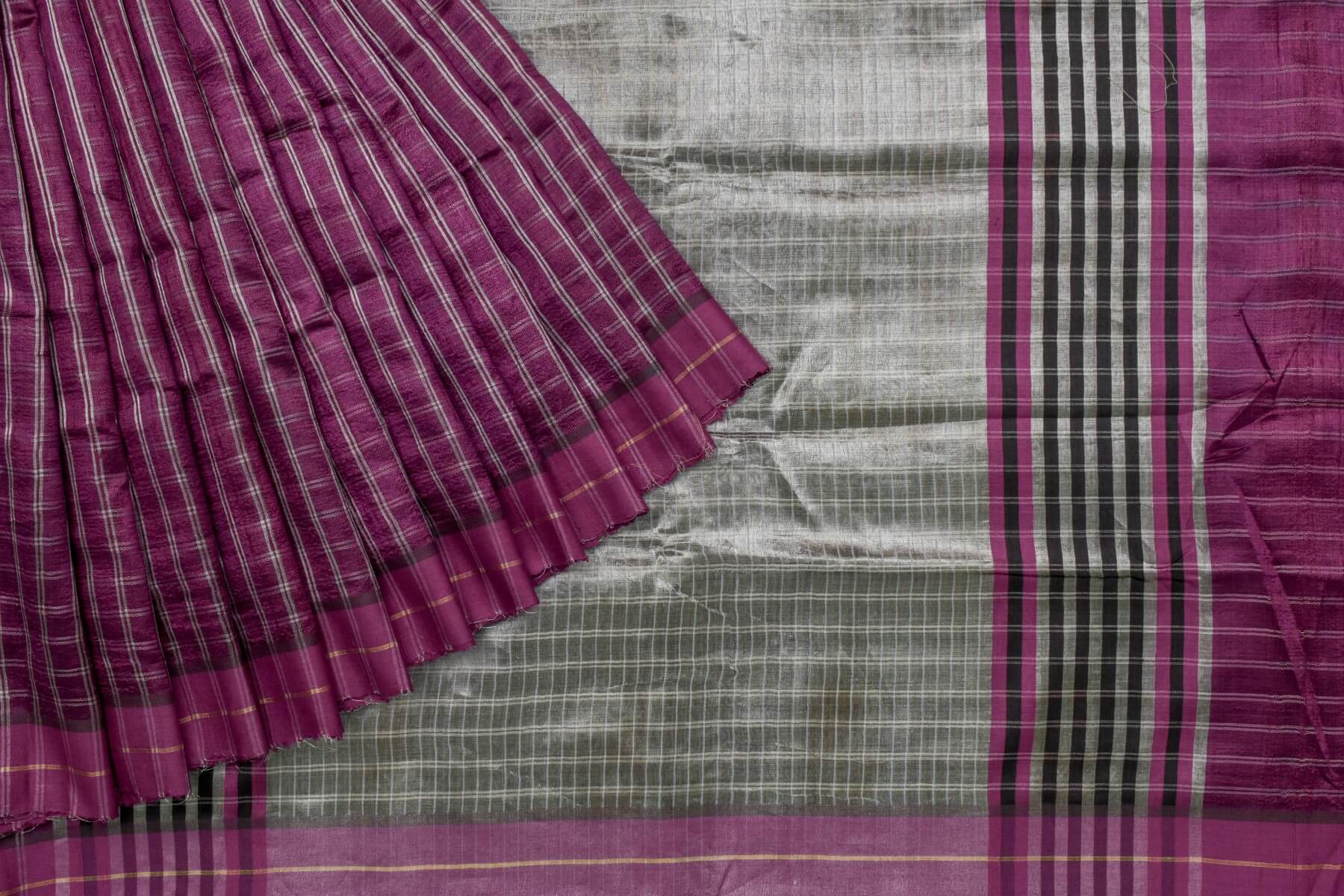
Where Bhagalpur weavers do introduce additional design elements, they tend toward simplicity and directness. Woven borders in contrasting colours, often incorporating geometric patterns in supplementary weft. Checks and stripes created by the arrangement of differently coloured yarns in the warp. Occasional embroidery, particularly the silk thread work known as katan embroidery, added after weaving to the pallu or the border. These additions are exercises in knowing how much is enough, in understanding when to stop before the natural character of the tussar is overwhelmed.
In recent decades, Bhagalpur weavers have also produced tussar sarees with printed surface decoration, using block printing or screen printing to add patterns to the woven fabric. The most successful of these combine the warmth and texture of the tussar ground with the visual clarity of well designed prints, creating sarees that are simultaneously artisanal and contemporary. Less successful attempts have imposed busy or inappropriate patterns that fight with the tussar rather than working with it. The difference lies in whether the designer has understood the material or merely used it as a surface.
The Texture That Cannot Be Faked
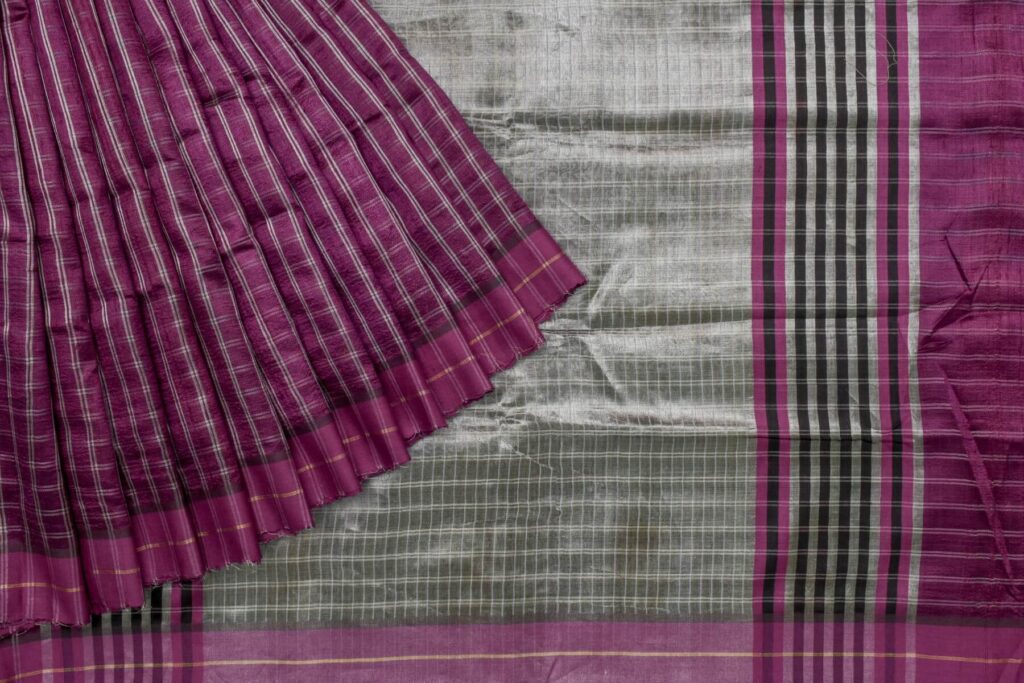
There is something about the texture of Bhagalpur tussar that is worth describing carefully, because it is the quality most central to the experience of wearing one of these sarees and the quality most difficult to convey in images or words.
Tussar has what textile people call drape with body. It is not stiff like a heavily starched cotton or a dense dupion silk. It falls. It moves with the body. But it falls with a certain deliberateness, a weight and presence that is different from the liquid drape of mulberry silk or the soft collapse of fine cotton. It holds the shape of the fold for a moment before releasing, which means that a tussar saree draped on the body has a sculptural quality, a three dimensionality that lighter fabrics lack.
Against the skin, tussar has a slight texture that is not roughness but presence. You are aware of the fabric in a way that you are not always aware of smooth silk or fine cotton. This awareness is pleasant rather than uncomfortable: the textile has a kind of personality that announces itself gently through the skin. And in the heat of a Bihar summer or a Bengal monsoon, this texture is a virtue: the slight irregularity of the weave allows air to circulate between the fabric and the skin in a way that perfectly smooth silk does not.
The sound of tussar is also distinctive. A Bhagalpur tussar saree makes a soft, dry rustling when it moves, different from the crisp swish of a starched cotton or the near silence of heavy silk. This sound, barely audible, is part of the experience of wearing the fabric: a reminder, at each movement, that what you are wearing is something particular and alive.
Katia and Ghicha: The Family Within Tussar
The Bhagalpur tradition does not produce a single type of tussar fabric but a family of related textiles, each with its own character and its own place in the range of human need.
Katia is the coarser, more rustic end of the tussar spectrum, woven from yarn that retains more of the fibre’s natural irregularity and produces a fabric of pronounced texture and earthiness. Katia sarees and dress materials are the most affordable and the most physically robust of the Bhagalpur range, the textiles that can be worn daily, washed without excessive care, and expected to last for years without showing significant wear. They are the working cotton equivalent of the tussar family: honest, unpretentious, and genuinely useful.
Ghicha silk is woven from the broken and waste fibre left after the best tussar yarn has been reeled off the cocoon. Rather than discarding this waste, Bhagalpur weavers developed techniques to spin it into a yarn with a pronounced slubby texture, full of thick and thin variations that create a fabric of remarkable visual interest. A ghicha saree looks almost woven from tweed, its surface alive with irregular thickenings and the shimmer of the silk catching light at different angles. It is the most textured and the most dramatically patterned of the tussar family, not through dye or embroidery but through the structure of the yarn itself.
Between these poles sits the range of standard tussar: smooth enough for comfortable wearing, textured enough to be interesting, available in the full range of colours that Bhagalpur’s dyers have developed, and woven in the variety of border and pallu treatments that the city’s weavers have refined over generations.
Bhagalpur and Bihar: An Undersung Heritage
The Bhagalpur tussar saree is, in the wider conversation about Indian textiles, somewhat undersung. It does not have the global name recognition of Banarasi or Kanjeevaram. It is not as immediately spectacular as a heavily zari worked silk or as instantly legible in its beauty as a Patola. It requires, perhaps, a slightly more educated eye: a willingness to look past the absence of glitter and find the quieter beauty of texture and natural colour.
This relative obscurity is partly a consequence of geography. Bihar is not a state that has historically received the same attention from the Indian and international fashion industries as Gujarat, Rajasthan, or Tamil Nadu. Bhagalpur sits at a distance from the metropolitan centres where textile trends are set and media coverage is concentrated. Its weavers have not always had access to the design partnerships, the craft fairs, and the export networks that have helped other Indian handloom traditions reach wider audiences.
And yet the people who know Bhagalpur tussar tend to know it with a particular devotion. It has a community of loyal wearers in Bengal, where tussar has long been valued as the appropriate fabric for certain ceremonies and certain moods. It has admirers among textile scholars and craft enthusiasts who understand its place in the hierarchy of Indian silk. And it has, increasingly, a younger urban constituency drawn to its naturalness, its earthiness, and its sustainability credentials in an era when questions about how cloth is made and what it costs the natural world have become impossible to ignore.
The Silk Route of Bhagalpur
The commercial geography of the Bhagalpur silk industry is a complex ecosystem involving cocoon collectors in Jharkhand, yarn processors and dyers in Bhagalpur, weavers in the city and surrounding villages, finishers and embroiderers, local traders, and the wholesale and retail markets through which the finished sarees reach buyers. Each node in this network represents both a livelihood and a point of vulnerability.
The relationship between Bhagalpur and the tribal communities of Jharkhand who collect the wild tussar cocoons is particularly important and particularly fragile. The collection of wild tussar is seasonal and subject to the health of the forests where the silkworms live. Deforestation, changing land use patterns, and the loss of the specific host trees that Antheraea mylitta prefers have all affected the availability and quality of wild tussar cocoons in recent decades. There have been efforts to develop semi cultivation methods, in which the silkworms are reared on plantation trees rather than truly wild ones, but fully wild tussar remains the most prized and the production of it is subject to natural fluctuations that no planning can entirely manage.
Within Bhagalpur itself, the weaving industry has faced the pressures familiar from other handloom centres: competition from powerloom imitations, inadequate income for handloom weavers, difficulty accessing premium markets, and the slow attrition of skilled workers as younger generations consider other options. The city has a Silk Weavers Cooperative and various government schemes aimed at supporting the industry, with mixed results. The most effective interventions have tended to be those that help weavers connect directly with buyers, reducing their dependence on traders who absorb much of the value from their work.
The Bhagalpur tussar saree received Geographical Indication status in 2007, an important formal recognition of its regional specificity and traditional process. This protection helps distinguish authentic Bhagalpur tussar from the imitations produced elsewhere, though as with all GI tags, enforcement requires continued attention and effort.
Wearing Tussar: A Seasonal and Ceremonial Logic
In the communities that have worn Bhagalpur tussar sarees for generations, there is a well developed sense of when and how this fabric is most appropriate. Tussar sarees are strongly associated with the transitional seasons, the months when the fierce heat of summer has passed but winter has not yet arrived, when the light in eastern India takes on the golden quality that painters and photographers seek. In this light, the natural amber tones of undyed or lightly dyed tussar seem to contain the season itself.
For festivals and ceremonies, tussar occupies a specific ritual position in Bengali and Bihari tradition. The Durga Puja wardrobe in Bengal has always included tussar alongside tant and Jamdani. In certain communities, tussar is the appropriate choice for religious occasions, valued for the naturalness of its origin and the purity associations of the silk fibre. At weddings, tussar sarees often appear in the trousseau alongside more elaborately decorated silks, providing the quieter note in the wardrobe that sets off the grander pieces.
The contemporary urban wearer of Bhagalpur tussar tends to reach for it when she wants to be impeccably dressed without appearing to try too hard. The fabric has a quality of effortless dignity, a natural authority that comes from its material honesty. It does not need jewellery to validate it. It does not need a particular style of blouse or a specific way of draping. It works, and it works on a wide range of occasions, from the office to the gallery opening to the family dinner, in the way that only genuinely good cloth does.
The Forest in the Fabric
There is something philosophically interesting about the fact that the finest expression of Bhagalpur’s weaving tradition is built on a fibre that cannot be fully controlled or engineered. The tussar silkworm will not be entirely domesticated. The forest that feeds it cannot be replaced by a plantation without loss of quality. The natural colour that makes tussar unique is a product of conditions that the weaver did not create and cannot replicate artificially. The fabric is, in this sense, a collaboration between the human and the natural, a co creation in which the forest has as much say as the weaver.
This is increasingly rare in a world where most materials are engineered to behave exactly as their manufacturers require, where variation is a defect and uniformity is the goal. The slight irregularity of tussar yarn, the natural colour that shifts from batch to batch, the way the fabric responds differently to different dye colours: these are not imperfections. They are the evidence of a living material, one that carries within it the memory of the tree it grew on, the season it was spun in, the forest air it breathed.
To wear a Bhagalpur tussar saree is to wear this aliveness. It is to be in relationship with a material that has its own history and its own character, that was not manufactured to specification but grew according to its own nature in a specific place at a specific time. In this, it offers something that no engineered textile can offer: the feeling of wearing something genuinely natural, genuinely specific, genuinely wild at its roots.
The Silk City’s Promise
Bhagalpur has been weaving tussar for longer than most cities have existed. Through the Mughal empire and its decline, through colonial rule and its end, through partition and independence, through the economic disruptions of liberalization and globalization, the looms of the Silk City have continued. Not without difficulty. Not without loss. But they have continued.
The weavers who sit at those looms today are the inheritors of an unbroken tradition of extraordinary length and depth. Their hands carry knowledge that has been refined across generations, knowledge of how to read the quality of a tussar cocoon, how to reel the yarn to preserve its natural character, how to dye it to bring out rather than mask its natural colour, how to weave it so that the finished fabric has the drape and texture that makes a Bhagalpur tussar saree what it is.
This knowledge is not immortal. It requires weavers willing to learn it and carry it forward, buyers willing to understand and value it, and an economic environment that makes the practice of it possible. All of these things are under pressure. None of them are guaranteed.
But the silk is still coming down from the forests. The looms are still working. And the sarees that emerge from those looms are still among the most beautiful and most characterful textiles being produced anywhere in India today. That is, for now, enough to build on.
A Bhagalpur tussar saree does not shine. It glows, from within, the way the forest does at the end of a golden afternoon, warm and deep and entirely itself.