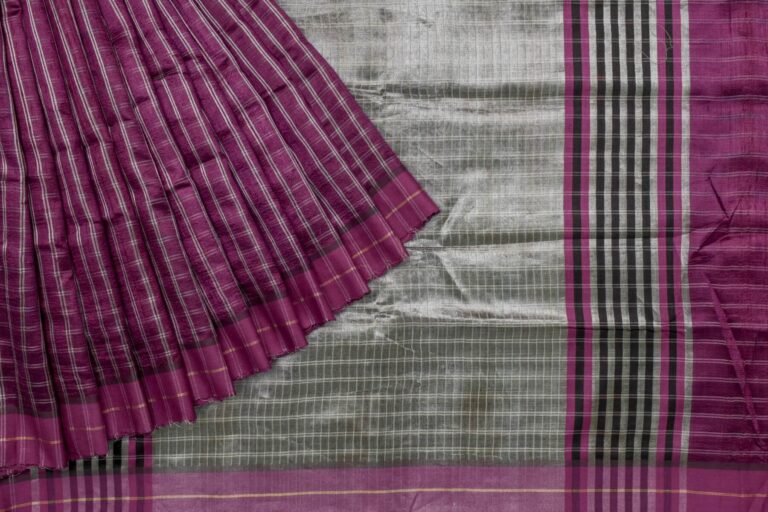
Bengal Cotton Saree (West Bengal)
There is a particular kind of beauty that does not announce itself. It does not glitter or overwhelm. It does not arrive draped in gold or wrapped in the language of grandeur. It simply exists, with a completeness and a self possession that makes everything around it seem slightly overdressed. The Bengal cotton saree is this kind of beautiful. Woven in the deltaic heartland of West Bengal and Bangladesh, along the banks of rivers that have fed both the soil and the imagination of one of the subcontinent’s most intellectually alive civilizations, it is a textile of such refined restraint that it takes a moment to understand what you are looking at. And then it takes your breath away.
A Land Shaped by Water
Bengal is, before anything else, a land of water. The great rivers of the eastern subcontinent, the Ganga, the Brahmaputra, the Padma, the Meghna, the Damodar, spread across the Bengal delta in a vast braided network of channels, tributaries, and wetlands that have shaped everything about the region: its agriculture, its climate, its philosophy, its art, and its cloth. Water is not merely a geographical feature of Bengal. It is a cultural fact, a presence so constant and so defining that it has entered the Bengali imagination at the deepest level.
The Bengal cotton saree is, in some sense, a water textile. The climate that the rivers create, humid, warm, occasionally drenched, occasionally brilliantly clear, demands a fabric that can breathe, that does not cling oppressively to the skin, that moves with the body rather than against it. Fine cotton, woven tightly enough to have structure but loosely enough to allow air, is the perfect answer to this climate. The weavers of Bengal did not choose cotton arbitrarily. They chose it because it was the right answer to where they lived.
The soil of the Bengal delta, enriched by millennia of river silt, produced cotton of exceptional quality. The water of the region, soft and mineral rich in the ways that matter for dyeing and finishing, gave Bengal textiles a character that could not be exactly replicated elsewhere even when the techniques were known. Place and craft were inseparable, as they always are when a tradition has had enough time to fully adapt to its home.
The Muslin and Its Shadow
Any account of Bengal cotton must begin with muslin, because the shadow of that legendary cloth falls across everything that came after it. The muslin of Dhaka, known in Mughal court records as woven air and running water, was perhaps the finest textile ever produced by human hands. Woven from the extraordinarily delicate phuti karpas cotton that grew along the banks of the Meghna river near Dhaka, it was so fine that a full length saree could be folded into a matchbox, so transparent that a woman wearing it was said to appear unclothed, so light that a breeze could carry it from a table. Mughal emperors demanded it. European traders paid fortunes for it. It was, by any measure, the supreme achievement of the weavers art.
The colonial period destroyed this tradition systematically. The mechanically produced cotton of Lancashire mills, arriving in Bengal at artificially low prices through the mechanisms of imperial trade policy, undercut the handloom weavers who could not compete. The market for fine handwoven cotton collapsed. The phuti karpas cotton, grown for no other purpose than this weaving, stopped being cultivated and eventually disappeared. The master weavers, finding no buyers for their extraordinary skill, turned to other work. By the middle of the nineteenth century, the tradition of the finest Dhaka muslin was effectively extinct.
This loss was not merely economic. It was cultural, civilizational. An entire category of human knowledge, the accumulated skill of generations of weavers who had learned to spin cotton to a fineness that modern machinery still struggles to replicate, simply ceased to exist. There have been recent attempts, in Bangladesh, to revive the tradition using cotton varieties genetically traced to the original phuti karpas, and some remarkable progress has been made. But the full tradition, in its original form, is gone. What survives is the memory and the aspiration, both of which matter.
The Bengal cotton saree that continued to be woven after the muslin’s decline was a different thing: less impossibly fine, more practically minded, oriented toward the everyday rather than the imperial. But it carried in its genes something of the muslin’s sensibility: a preference for fineness over heaviness, for restraint over elaboration, for the beauty that comes from quality of material and precision of craft rather than from surface decoration.
Tant: The Everyday Masterpiece
The Bengal cotton saree most widely known and most deeply loved within the region is the tant saree, woven on a traditional pit loom in the weaving villages of Hooghly, Nadia, Murshidabad, and other districts of West Bengal. The word tant refers both to the loom itself and to the saree produced on it, a conflation that speaks to how completely the cloth and the tool have become identified with each other in the Bengali imagination.
The tant saree is not trying to be anything other than what it is. It is a cotton saree of good weight and honest structure, typically woven with a plain or simply patterned body and a border of contrasting colour. The weave is neither very fine nor very coarse but sits in a range that is exactly right for daily use: sturdy enough to drape well and hold its shape, fine enough to feel pleasant against the skin, light enough for the heat of a Bengali summer, warm enough for the mild winters.
What distinguishes a tant saree from ordinary cotton is the quality of its yarn, the tightness of its weave, and above all the character of its border. The tant border is typically woven using an extra weft thread in a contrasting colour, often with a supplementary pattern element, a simple geometric motif, a stylised floral, or the classic dhakai jaal lattice work, that gives the saree’s edges a visual weight and definition. This border, running the full length of the saree in a colour that sets off and completes the body, is often the tant’s most beautiful element: the point where the weaver’s skill is most legible, where the dialogue between colour and structure is most clearly conducted.
The tant saree is the saree of Bengali daily life. It is what a Bengali woman wears to the market, to the school where she teaches, to the neighbour’s house for an afternoon visit, to the puja in the local temple. It is comfortable without being casual, presentable without being formal. It occupies that most useful of positions: appropriate for almost everything. And it has the particular virtue of looking better and better as it is worn, softening and draping with increasing grace as the cotton relaxes with use.
Dhakai Jamdani: Poetry in Thread
If the tant is the prose of Bengal cotton, the Jamdani is its poetry. The Jamdani saree, woven in the Dhaka tradition that straddles the border between West Bengal and Bangladesh, represents the highest artistic achievement of Bengal’s cotton weaving tradition, a fabric in which the technical and the aesthetic reach a pitch of mutual intensity that places it among the great textiles of the world.
The Jamdani technique involves weaving supplementary weft patterns directly into the fabric as it is made, using additional threads of fine cotton or zari that are laid in by hand alongside the ground weave. There is no mechanical pattern making device involved. The weaver works from memory and from a cartoon placed beneath the warp threads, laying each supplementary weft thread individually, motif by motif, across the width of the cloth. Two weavers typically work together on a Jamdani, sitting side by side at the loom, passing the supplementary threads between them in a rhythm that has the quality of a slow and careful conversation.
The patterns that emerge from this process are among the most beautiful in any textile tradition. Flowers, primarily, of a stylised and geometric kind: the panna hajar or thousand emeralds, a dense trellis of floral diamonds; the butidar, an all over field of scattered flower sprigs; the tercha, diagonal stripes of floral motifs; the jalar, an all over floral net. These patterns do not sit on the surface of the Jamdani fabric. They are woven into its structure, inseparable from the ground, visible from both sides, integral in a way that printed or embroidered patterns never quite are.
The finest Jamdani is made from extremely fine cotton yarn, sometimes combined with the most delicate zari. In the best pieces, the ground fabric is so fine that it is almost transparent, and the supplementary woven flowers seem to float on air, suspended in the cloth without visible means of support. This effect, when you see it in a good light, is genuinely startling. The fabric looks as though the pattern has been woven into water.
UNESCO recognised the Jamdani tradition in 2013, inscribing it on the Representative List of Intangible Cultural Heritage of Humanity. This recognition acknowledged what Bengali weavers and their admirers have always known: that the Jamdani is not merely a technique but a living tradition of artistic practice, a form of knowledge and beauty that belongs to the shared heritage of human civilization.
Colour and Its Meanings
The colour vocabulary of Bengal cotton is distinctive and worth dwelling on. Unlike the saturated, jewel toned palette of Rajasthani or Gujarati textiles, Bengal cotton has traditionally favoured a more atmospheric range: the ivory and cream of natural cotton, the soft red of madder, the warm yellow of turmeric and marigold, the deep terracotta of iron mordanted dye, the occasional burst of indigo blue.
These are colours drawn from the landscape of Bengal itself: the pale gold of ripening rice, the green of water hyacinth, the grey of the river in the monsoon, the terracotta of river clay baking in the winter sun. There is a quality of light in Bengal, filtered through river mist and the canopy of mango and jackfruit, that is softer and more diffused than the harsh clarity of the Rajasthan desert or the bright intensity of the Tamil Nadu coast. The colours of Bengal cotton belong to this light. They are colours that reveal themselves gradually, that reward attention, that look different in the afternoon than they do in the morning.
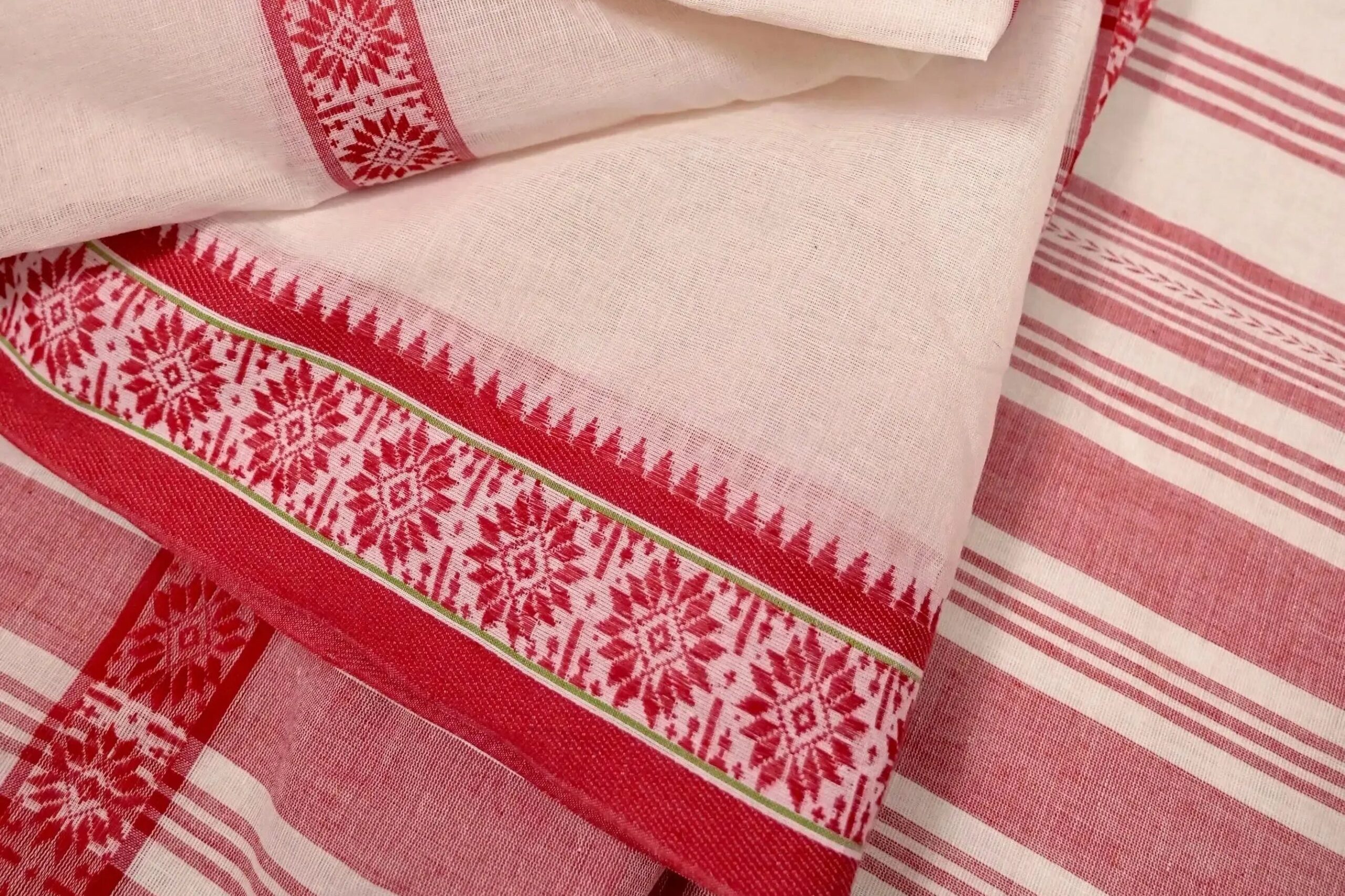
White, in particular, is central to the Bengal cotton tradition in a way that it is not in most other Indian textile cultures. The white tant saree with a red border, so iconic that it has become a visual shorthand for Bengali femininity in popular culture, is a composition of extraordinary simplicity and power. The white is not the blankness of absence but the fullness of the undyed cotton, with all its subtle warmth and texture. The red border is not decoration so much as punctuation: the mark that gives the white its meaning by defining its edge.
This preference for white carries cultural weight beyond the aesthetic. In Bengali Hindu tradition, white is associated with purity and with the goddess Saraswati, patroness of learning and the arts. The white saree is the appropriate dress for certain religious occasions, for widowhood in traditional practice, and for the particular Bengali relationship with intellectual and artistic life that has always valued the life of the mind over the display of material wealth. A woman in a white tant saree with a red border is making a statement about what she values, and what she values is not opulence.
The Weavers of Hooghly and Nadia
The principal weaving districts of West Bengal, Hooghly, Nadia, Murshidabad, and parts of North Bengal, contain hundreds of weaving villages where the tant loom has been a constant presence for generations. Towns like Shantipur, Phulia, Dhaniakhali, and Bishnupur have developed their own distinct variations within the tant tradition, each with characteristic colour combinations, border styles, and weave structures that identify the saree’s origin to the knowledgeable eye.
Shantipur tant is known for its particularly fine yarn and delicate border work. Dhaniakhali tant, produced in a cluster of villages in Hooghly district, is celebrated for its especially tight weave and the distinctive quality of its cotton, which has a slight natural sheen. Bishnupur, famous also for its terracotta temples and its tradition of Baul music, produces tant sarees with borders that incorporate motifs drawn from the temple architecture of the region: the lotus, the conch, the stylised wave pattern that appears on the carved friezes of the Malla dynasty’s brick temples.
The weavers who sustain these traditions are mostly men, working on pit looms in rooms attached to or incorporated into their homes. Their wives and daughters often assist with the winding of bobbins, the preparation of warp threads, and the finishing of the completed sarees. Weaving in these villages is a family enterprise, a shared economy, a way of life organized around the rhythm of the loom.
That rhythm has been disrupted repeatedly in recent decades. The pressures that have afflicted handloom traditions across India have been felt acutely in Bengal. Cheap powerloom cotton sarees, produced in mills outside Bengal, have captured much of the lower price segment of the market. Synthetic sarees, requiring no ironing and offering bright colours that do not fade, have attracted buyers who find the maintenance of cotton more demanding than they want. The income from weaving has often been inadequate to support a family, particularly as the cost of living in rural Bengal has risen.
Many younger weavers have left the loom. Villages that once had hundreds of working looms now have dozens. The knowledge of how to produce the most complex tant borders, the most intricate supplementary weft patterns, is held by fewer and fewer people. This is the familiar crisis of handloom India, and Bengal is not exempt from it.
Tagore and the Cotton Saree
It would be impossible to write about Bengal cotton without acknowledging the cultural weight that the Bengali literary and artistic tradition has placed upon it. Rabindranath Tagore, whose influence on Bengali aesthetic sensibility cannot be overstated, was an admirer and advocate of the handwoven cotton saree. The Tagore family’s engagement with the swadeshi movement of the early twentieth century, which called for the boycott of British manufactured goods including Lancashire cotton and the adoption of Indian handloom cloth, was both political and aesthetic.
Tagore’s vision of what a Bengali woman should wear was centred on handwoven cotton, draped in the distinctive Bengali style with the pallu brought forward over the right shoulder rather than the left. This vision was not merely nationalistic but deeply connected to his ideas about beauty: that it should be indigenous, that it should be appropriate to its place and climate, that it should allow the wearer’s natural grace to express itself rather than imposing upon her the stiffness of formal dress.
The women of Tagore’s family and circle, who appear in photographs from the early twentieth century draped in simple cotton sarees with characteristic borders, established a visual ideal that has persisted in Bengali cultural life ever since. The image of the Bengali intellectual woman, the bhadramahila, in her tant or Jamdani saree, with flowers in her hair and a book in her hand, is one of the most enduring icons of Indian modern culture. The cotton saree is inseparable from this image.
The Durga Puja Saree
In Bengal, one moment above all others defines the relationship between women and their sarees: Durga Puja. The five day festival, the most important and most beloved of the Bengali year, is also the most important occasion for the wearing of new sarees. Families save through the year for the Puja purchases. The saree market in Kolkata in the weeks before Puja is one of the great commercial events of the city, with shops staying open through the night and buyers coming from across West Bengal and Bangladesh to choose the sarees they will wear for each day of the festival.
Cotton sarees, tant and Jamdani, are central to the Puja wardrobe. The fifth and final day, Vijaya Dashami, the day when the goddess’s idol is immersed in the river and the celebration concludes, is traditionally marked by the wearing of white. Thousands of women across Bengal appear on this day in white tant sarees, often with red borders, in a collective visual statement that is one of the most moving sights in Indian festival culture. It is grief and joy held simultaneously in cloth: the white of departure, the red of the continuing life of the festival in memory.
Bangladesh and the River That Flows Both Ways
The Bengal cotton tradition does not respect the border drawn in 1947. It flows, like the Padma, across the line of partition that divided a single civilization into two nations. The Jamdani weavers of Rupganj and Sonargaon in Bangladesh are the direct inheritors of the Dhaka muslin tradition, and the Jamdani sarees they produce are among the finest cotton textiles being made anywhere in the world today. The tant weavers of Tangail in Bangladesh produce sarees that are beloved on both sides of the border, recognisably part of the same tradition as the West Bengal tant while having their own distinct character.
The partition of Bengal was one of the great human tragedies of the twentieth century, displacing millions of people and severing cultural and economic connections that had existed for centuries. The textile tradition survived the partition, adapted to it, and continues on both sides. In this, the Bengal cotton saree serves as a quiet reminder of the civilization that existed before the border was drawn and continues, in some essential way, to exist despite it.
Why Bengal Cotton Endures
The Bengal cotton saree has survived colonial destruction, partition, economic pressure, and the competition of synthetic fabrics for the same reason that all genuinely good things survive: because it is irreplaceable. Not merely in the sentimental sense, though sentiment is real and matters, but in the practical sense. There is no synthetic fabric that feels like a well worn tant saree. There is no powerloom cotton that drapes the way a handwoven Jamdani drapes, with that particular quality of movement and light. There is no digital print that produces the subtle, structural beauty of a supplementary weft pattern woven by two people sitting together at a loom, working from memory.
The Bengal cotton saree asks something of its wearer that synthetic fabrics do not ask: attention, care, a willingness to iron, to starch lightly if desired, to store with some thought. It gives back something in return that synthetic fabrics cannot give: the feeling of wearing something that was made by hand, that took skill and time, that belongs to a tradition of beauty deeper and older than any factory.
In a world where most of what we wear is made by machines in conditions we prefer not to think about, the Bengal cotton saree is a reminder of what cloth can be when it is made by people who care about it, in a place that has shaped it over centuries, using knowledge that lives in the hands rather than in the machine.
A River Still Running
The rivers of Bengal are changing. Some have silted up. Others have shifted course. The hydrology of the delta is not what it was when the muslin weavers first found their extraordinary cotton growing along the Meghna’s banks. And yet the rivers are still there, still feeding the soil, still shaping the light, still present in the imagination of a civilization that has never been able to think about itself without thinking about water.
The Bengal cotton saree is still being woven. In Shantipur and Phulia, in Dhaniakhali and Bishnupur, in Rupganj and Tangail, the looms are still working. The knowledge is still being passed, if more precariously than before, from weaver to weaver, generation to generation. The tant saree is still being worn to the market and the school and the temple. The Jamdani is still being brought out for the festival, still catching the light in that impossible way, its woven flowers still seeming to float on air.
This is not a tradition that is dying. It is a tradition that is under pressure, as it has been before, and that is finding, as it has before, the stubbornness to continue. The weavers of Bengal have outlasted the East India Company. They have outlasted the mills of Lancashire. They have outlasted partition. They are likely, given the chance, to outlast whatever comes next.
A Bengal cotton saree does not declare itself. It simply drapes, and breathes, and endures, the way rivers endure, quietly and without end.