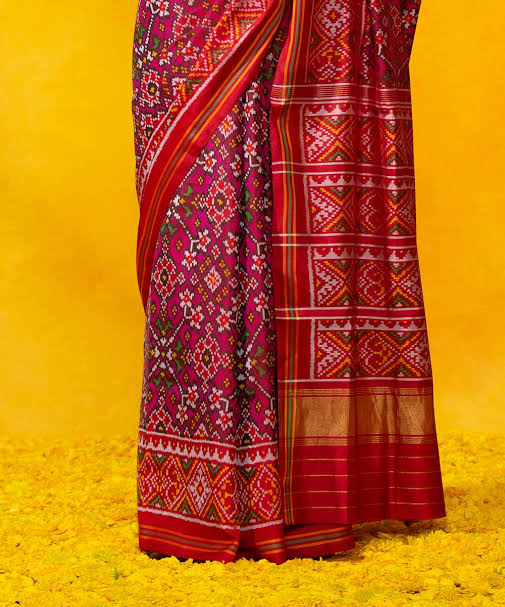
Bandhani Saree (Gujarat)
There is a kind of magic in the act of binding. Tie a thread tightly around a pinch of fabric, submerge it in dye, release it, and what emerges is not merely a pattern but a tiny explosion of preserved colour, a circle of resistance against transformation. Multiply this act ten thousand times across a single length of silk or cotton, and you have bandhani: one of India’s oldest and most joyful textile traditions, a fabric that seems less woven than conjured, less printed than grown.
The bandhani saree is the wearable embodiment of a particular kind of Indian aesthetic sensibility, one that finds beauty not in uniformity but in the dance between order and spontaneity, between the discipline of the grid and the organic warmth of the hand.
The Word and Its Roots
The name bandhani derives from the Sanskrit bandha, meaning to bind or to tie. It belongs to a global family of resist-dyeing techniques that includes Japanese shibori, Indonesian tritik, and West African adire, traditions that arrived independently at the same essential discovery: that thread, tied tightly enough around cloth before dyeing, will protect the fabric beneath it from colour, leaving behind a pattern of undyed circles when the binding is removed.
In India, bandhani is known by different names in different regions. In Rajasthan it is often called bandhej; in Gujarat, bandhani is the preferred term. The craft is also called tie-and-dye in the generic sense, though this phrase scarcely conveys the precision and artistry that distinguish the finest bandhani from the amateur experiments the term might suggest.
Evidence of bandhani’s antiquity in India is substantial. The seventh-century cave paintings at Ajanta depict figures wearing garments with dotted patterns consistent with bandhani. The ancient text Harshacharita makes reference to bandhana-dyed cloth worn at royal occasions. Medieval trade records suggest that bandhani textiles from Gujarat were exported across the Arabian Sea to Persia and East Africa centuries before European trading companies arrived in the subcontinent. The craft is old enough to have forgotten its own beginning.
Geography of the Craft
Bandhani is produced across a broad swathe of western India, but two regions claim the tradition most fiercely: Gujarat and Rajasthan.
In Gujarat, the principal centres are Jamnagar, often called the bandhani capital of India, along with Anjar, Mandvi, and Bhuj in Kutch. Jamnagar’s bandhani is particularly celebrated for the fineness of its dots and the sophistication of its colour combinations. The city’s craftswomen have for generations produced sarees and dupattas of extraordinary delicacy, in which thousands of tiny tied dots create shimmering fields of pattern on silk so fine it seems to dissolve in the light.
In Rajasthan, Jodhpur, Jaipur, and Sikar are the main centres. Rajasthani bandhani tends toward bolder patterns and stronger colour contrasts, the turquoise, saffron, and scarlet combinations that have become iconic images of the desert state’s visual culture. The leheriya technique of Rajasthan, in which fabric is rolled diagonally and tied to create wave-like stripes, is a related resist-dye tradition that shares bandhani’s essential logic while producing a dramatically different visual result.
The communities most closely associated with bandhani production are the Khatri community in Gujarat, the same community that produces ajrakh in Kutch, and various artisan groups in Rajasthan. Within these communities, the tying work has traditionally been done by women, often working at home while the dyeing is handled by men. A single bandhani saree may be tied by several women working simultaneously, their fingers moving with a speed and accuracy that takes years of practice to acquire.
The Making: Fingers as Instruments
The production of a bandhani saree begins long before the first thread is tied. The fabric, silk, cotton, or the fine georgette and chiffon used for contemporary bandhani, is first washed, degummed if necessary, and stretched flat. A pattern is then transferred onto the cloth, either by pressing the fabric against a block carved with tiny points that leave marks on the surface, or by the experienced tyer working directly from memory and tradition, placing dots according to internalised geometric principles.
Then the tying begins. The craftsperson, almost always a woman, uses her thumbnail, which is often kept long and hardened for the purpose, to pick up the tiniest possible pinch of fabric at each marked point. She then winds a thread around this pinch tightly and rapidly, creating a small knot that will resist the dye. The smallest and finest bandhani dots — called choti bindi — may be no larger than a mustard seed. Producing them requires a lightness of touch and a speed of movement that is genuinely astonishing to watch.
A single sari may contain anywhere from several hundred to several hundred thousand individual tied points, depending on the density and complexity of the design. The most elaborate pieces, such as the shikari bandhani, which depicts hunting scenes in tied dot-work, may take a master tyer many months to complete. Each dot is an individual decision, an individual act of the hand.
Once tied, the fabric is dyed. Bandhani typically involves multiple dye baths, with certain areas covered or tied between each bath to achieve the complex multi-coloured patterns characteristic of the best work. A saree with three colours may go through three separate dye cycles. The sequence of dyeing matters enormously: colours must be built from lightest to darkest, since a darker dye applied first will mask a lighter one applied later.
After the final dyeing, the tied points are released, either by the craftsperson or, in contemporary production, by the buyer, who receives the saree still tied and has the pleasure of unfolding it themselves. This moment of release, when the knots are cut and the fabric is opened out to reveal its full pattern, is described by those who have experienced it as genuinely thrilling, a small revelation each time.
A Grammar of Dots
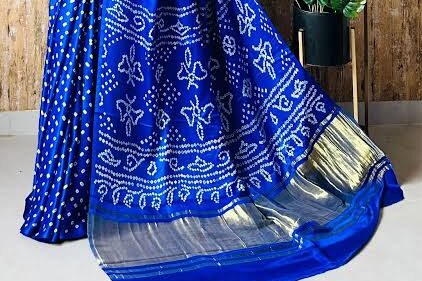
The visual language of bandhani is built entirely from the circle, from the dot produced by each tied and dyed pinch of fabric. Yet from this single elementary unit, bandhani generates a remarkable range of patterns, each with its own name and cultural significance.
Ekdali is the simplest form: a single dot. Chaubundi arranges dots in groups of four; satbundi in groups of seven. Dungar shahi — mountain queen — creates patterns suggesting mountain ranges across the fabric. Shikari depicts hunting scenes. Ambadal evokes the mango, and laddu jalebi the round sweets of festival time. Trikunti arranges dots in triangles; chandrokhani in moon-shaped arcs.
Beyond individual motifs, bandhani compositions are typically organised into broad fields of overall dot-work — called phool or flower patterns — punctuated by larger focal elements such as central medallions, elephants, peacocks, or the paan — betel leaf — shape. The borders of a bandhani saree often carry their own distinct pattern register, and the pallu is typically the most elaborately worked section, dense with figures and motifs.
Colour in bandhani follows its own grammar. Traditional combinations carry cultural and ritual meanings that every wearer recognises. Red and yellow together — kesariya — are the colours of auspiciousness and celebration. Red alone is the colour of the bride. The gharchola saree of Gujarat, traditionally given to a bride by her in-laws on her wedding day, combines red and green in a distinctive checked pattern overlaid with bandhani dots and zari work — a textile so charged with meaning that it is considered inauspicious for a widow to wear it.
Ritual Life and Social Meaning
No Indian textile is more deeply embedded in the ceremonies of life’s passage than the bandhani saree. From birth to death, the dotted cloth accompanies the significant moments of a woman’s life in Gujarat and Rajasthan.
At birth, a newborn is wrapped in yellow bandhani cloth. At a girl’s first menstruation, a red bandhani odhni is given. At marriage — the pivotal moment, the bandhani saree is central to the visual drama of the ceremony. The Rajasthani bride is dressed in panchrangi bandhani, cloth of five colours, that declares her new status to all who see her. In Gujarat, the gharchola saree performs this role with its own distinctive symbolism.
Festivals, too, have their bandhani. Teej, Navratri, Diwali, each occasion has traditional colour combinations in bandhani that signal the season and the mood. During Navratri, the nine nights of devotion to the goddess, the colours worn on each night follow a sequence, and bandhani sarees and dupattas are among the preferred choices for this most visually spectacular of festivals.
Beyond ceremony, bandhani has historically functioned as a social marker. The colours and patterns of a woman’s bandhani could identify her community, her marital status, her region of origin, and her economic standing. The finest silk bandhani of Jamnagar was the dress of merchant families and royalty; coarser cotton bandhani belonged to the working community. Today these distinctions have softened considerably, but the capacity of bandhani to communicate social meaning has not entirely disappeared.
The Contemporary Moment
The bandhani tradition, like all hand crafts, has faced the pressures of mechanisation and market change. Screen-printed and digitally printed imitations of bandhani are widely available at prices no hand-tyer can match. Cheap synthetic dyes have replaced the natural indigo, madder, and turmeric of older production. And the time required to produce authentic bandhani, the months of tying, the careful sequencing of dye baths, is difficult to justify in a market that has been taught to expect low prices and fast delivery.
Yet the tradition has shown a remarkable resilience. Craft organisations and NGOs working in Kutch, Jamnagar, and Rajasthan have helped artisan communities access urban and export markets directly, bypassing the middlemen who historically captured most of the value from their work. Designers, both within India and internationally, have developed a sustained interest in bandhani as a surface for innovation, producing contemporary garments that honour the technique while presenting it in new silhouettes, colour palettes, and fabric combinations.
A particular source of vitality has been the urban Indian consumer’s growing appetite for authentic craft textiles. Young women who might once have chosen synthetic or mass-produced garments are increasingly drawn to the irregularities and warmth of handmade bandhani, its slightly uneven dots, its colours that shift with age, its knowledge of having passed through many hands before arriving at their own.
In 2013, bandhani from Kutch and Jamnagar received Geographical Indication status, formal legal recognition of its regional specificity and traditional process. This protection, though imperfect in its enforcement, represents an important acknowledgement that bandhani is not merely a technique but a cultural heritage belonging to specific communities and places.
The Tyer’s Art
At the centre of all of this, the ritual significance, the aesthetic history, the contemporary market negotiations, is the woman sitting with a length of silk across her lap, her thumbnail moving with quiet speed across the cloth, picking up pinch after pinch of fabric and winding thread around each one. She may be working in a haveli in the old city of Jamnagar, or in a village house in Kutch, or in a workshop in Jodhpur. She is almost certainly working from memory, following patterns she has known since childhood, that her mother knew before her, and her mother’s mother before that.
Her fingers are the repository of a knowledge that cannot be entirely written down or mechanically replicated — a knowledge of pressure and thread tension, of how much fabric to pick up for a dot of exactly the right size, of how the pattern must be built across the whole cloth so that when the ties are finally released, the design emerges whole and coherent from thousands of individual acts of binding.
This is bandhani’s deepest truth: that it is not a pattern applied to cloth from outside, but a pattern generated from within the cloth itself, through the accumulated decisions of the human hand. The design does not pre-exist its making. It comes into being through the tying — and reveals itself, finally, only in the moment of release.
Cloth as Liberation
There is something philosophically suggestive in the central act of bandhani — the binding that creates beauty, the resistance that produces colour, the knot that, when cut, reveals the pattern it was always carrying. Indian philosophical traditions have long been drawn to paradoxes of this kind: the freedom that lies within discipline, the fullness that is found in restraint.
A bandhani saree wears this paradox on its surface. Every dot is a small act of resistance; every colour is the colour that survived the binding. The cloth that emerges from the dye bath — still knotted, its pattern still concealed — is heavy with potential. And when the threads are finally cut and the fabric falls open in a cascade of colour and light, it feels less like the end of a process than the beginning of a story.
In bandhani, every dot is a decision, and every saree a thousand decisions made beautiful.