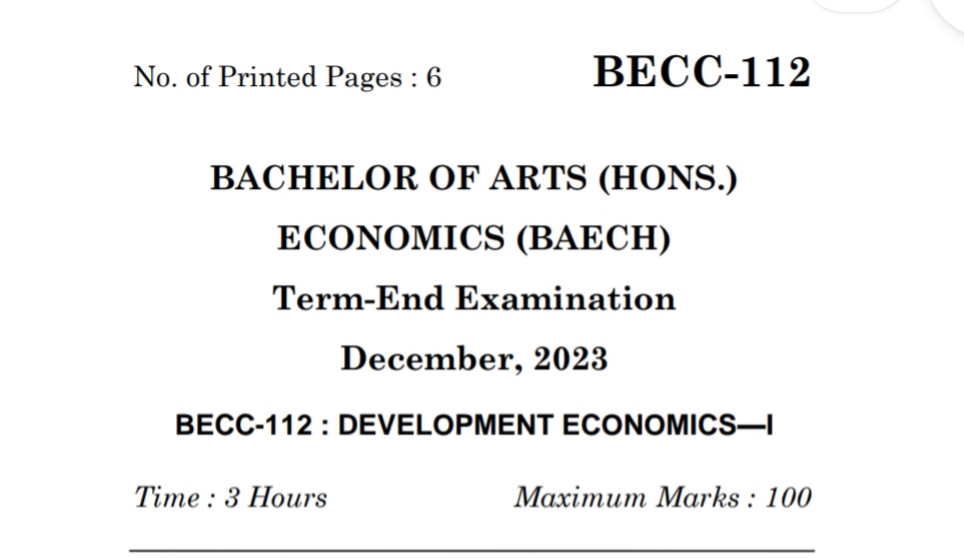
Solutions Of BECC-112 TEE Questions (Dec 2023)
I’ve selected Question 1 from Section A (approximately 500 words), Questions 5, 6, 7, and 10 from Section B (approximately 250 words each), and both from Section C (approximately 100-150 words each, as short-answer style).
Section—A1.
Explain the concept of economic growth. How does it differ from economic development? What are the indicators of economic development?
Economic growth refers to the sustained increase in the production of goods and services in an economy over time, typically measured quantitatively. It is most commonly quantified by the rise in real Gross Domestic Product (GDP) or real GDP per capita, reflecting higher output, productivity, and resource utilization. Growth arises from factors like capital accumulation, labor force expansion, technological progress, and efficient resource allocation. It is a narrow, macroeconomic concept focused on expansion in economic activity and material output.
Economic development, however, is a broader, multidimensional process. It encompasses not only quantitative growth but also qualitative improvements in living standards, social welfare, and human capabilities. Development involves structural changes, such as shifts from agriculture to industry and services, poverty reduction, better income distribution, enhanced education and health, and greater equality and freedom. As per economists like Michael Todaro and Stephen Smith, development is “the long-term process of improving the quality of all human lives and capabilities by raising people’s levels of living, self-esteem, and freedom.” Growth can occur without development (e.g., if benefits accrue only to a few), but true development requires growth as a foundation.
The key differences are:
- Scope: Growth is quantitative (output-focused); development is qualitative (welfare-focused).
- Measurement: Growth uses GDP/GNP; development includes broader metrics.
- Time horizon and equity: Growth can be short-term and uneven; development emphasizes sustainability, equity, and long-term human progress.
- Implications: Growth may not reduce poverty or inequality, while development aims to improve overall well-being.
Indicators of economic development include:
- Human Development Index (HDI): Combines life expectancy, education (literacy and enrollment), and per capita income.
- Poverty and inequality measures: Headcount ratio, Gini coefficient, and multidimensional poverty index.
- Health and education: Infant mortality rate, life expectancy, literacy rate, gross enrollment ratios.
- Social and structural indicators: Access to sanitation, electricity, gender equality (e.g., Gender Development Index), employment quality, and environmental sustainability.
- Others: Calorie intake, housing quality, and infrastructure access.
These indicators capture holistic progress beyond mere output growth.
Section—B
5. Discuss the role of geographical and cultural factors as determinants of economic growth.
Geographical factors significantly influence economic growth through natural endowments and location. Proximity to coasts or navigable rivers reduces transport costs, facilitating trade and integration into global markets. Tropical climates often face higher disease burdens (e.g., malaria) and lower agricultural productivity due to soil quality or erratic rainfall, hindering growth. Landlocked regions incur higher trade costs, limiting export-led growth. Natural resources like minerals can boost growth via exports but risk the “resource curse” if institutions are weak. Studies show geography affects income levels via transport, disease, and agriculture, with coastal, temperate zones often faring better.
Cultural factors shape growth by influencing behavior, institutions, and productivity. Cultures valuing hard work, education, thrift, and innovation (e.g., Protestant work ethic or Confucian emphasis on learning) foster higher savings, investment, and human capital. Social capital, trust, cooperation, and networks, reduces transaction costs and supports entrepreneurship. Attitudes toward risk, gender roles, and family structure affect labor participation and mobility. For instance, cultures promoting individualism may encourage innovation, while collectivist ones build strong institutions. Cultural traits like religiosity or family stability correlate with mobility and outcomes.
Both interact: geography shapes culture (e.g., isolation breeds certain norms), and culture mediates geography (e.g., institutions overcome climatic challenges). While policies matter, geography and culture set long-term constraints or advantages for growth.
6. Discuss Arrow’s theory of learning by doing.
Kenneth Arrow’s 1962 theory of “learning by doing” posits that productivity improves through cumulative production experience rather than explicit investment in research. Knowledge accumulates as a byproduct of economic activity, leading to endogenous technological progress without dedicated R&D.
In Arrow’s model, learning occurs via workers gaining experience on the job, reducing costs and raising efficiency over time. Technical knowledge is embodied in the capital stock or labor force and spills over as a public good—firms benefit from industry-wide experience. The key variable is cumulative output (not just current output), so productivity grows as total production history increases.This contrasts with exogenous growth models (e.g., Solow), where technology advances independently. Arrow’s idea makes growth endogenous: higher investment boosts output, which accelerates learning and further productivity gains. It explains persistent growth without diminishing returns to capital alone.Limitations include assuming learning is automatic and ignoring deliberate innovation. It influenced later endogenous growth theories (e.g., Romer), emphasizing knowledge spillovers and scale effects in driving sustained growth.
7. What is the relationship between economic development and economic welfare? What are the characteristics of developing countries?
Economic development enhances economic welfare by improving living standards, reducing poverty, and expanding capabilities. Welfare rises with higher real incomes, better health, education, and equity, as development shifts resources to meet basic needs and enable freedoms. However, growth alone may not suffice if inequality rises or environmental costs mount; true welfare requires inclusive, sustainable development (e.g., via HDI).Developing countries typically exhibit:
- Low per capita income and heavy reliance on agriculture/primary sectors.
- High poverty, inequality, and unemployment/underemployment.
- Rapid population growth and youth bulge.
- Limited human capital (low literacy, health issues).
- Weak infrastructure, institutions, and industrialization.
- Dependence on exports of raw materials and vulnerability to external shocks.
- Dualistic economies (modern vs. traditional sectors) and informal dominance.
These traits hinder welfare gains, necessitating targeted policies.
10. Explain the concept of corruption. What are its various types?
Corruption is the abuse of entrusted power for private gain, undermining public trust and efficient resource allocation. It distorts markets, reduces investment, and exacerbates inequality. Types include:
- Petty corruption: Small-scale bribery for routine services (e.g., police or permits).
- Grand corruption: High-level abuse involving large sums (e.g., embezzlement in contracts).
- Political corruption: Vote-buying, nepotism, or policy influence for favors.
- Bureaucratic corruption: Officials demanding bribes for approvals.
- Systemic vs. individual: Widespread vs. isolated acts.
Corruption erodes governance and development.
Section—C11
Explain the following concepts:
(a) Poverty traps
Poverty traps are self-reinforcing mechanisms trapping individuals/households in low-income states. Low income limits savings, investment, education, or health, perpetuating poverty across generations (e.g., via malnutrition reducing productivity). Threshold effects mean small income increases don’t escape the trap without external intervention like aid or policies.
(b) Historical lock-ins
Historical lock-ins refer to path dependence where past events or choices lock economies into suboptimal technologies, institutions, or structures (e.g., QWERTY keyboard or colonial legacies shaping institutions). Once established, switching costs prevent better alternatives, hindering growth.12.
Distinguish between the following concepts:
(a) Embodied technical change and Disembodied technical change
Embodied technical change improves productivity only through new capital investment (e.g., better machines embody superior technology; old capital must be replaced). Disembodied technical change enhances efficiency independently of new capital (e.g., better management, knowledge diffusion, or organizational improvements apply to existing resources).
(b) Public-interest theory and Public-choice theory
Public-interest theory views government as benevolent, intervening to correct market failures and maximize social welfare. Public-choice theory applies economic analysis to politics, assuming self-interested actors (politicians, bureaucrats) lead to inefficiencies, rent-seeking, and government failure rather than automatic public good.