Timeline Of G7 (1973 – Present)
The Timeline of the G7 traces the evolution of one of the world’s most influential informal forums for coordinating economic policy, global challenges, and increasingly broader issues like security, climate, and geopolitics.
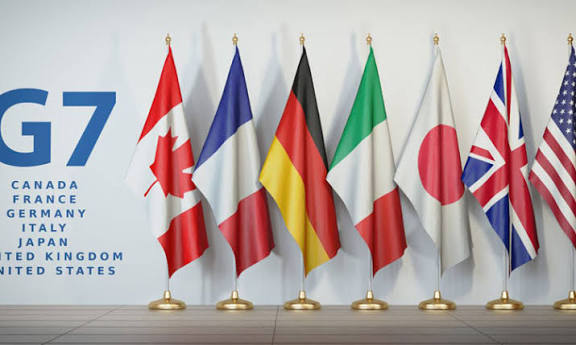
Born out of the economic turbulence of the 1970s, the Group of Seven (originally starting smaller) has adapted over five decades while maintaining its core of leading industrialized democracies.
Origins: The “Library Group” and Early Informal Meetings (1973–1974)
- March 25, 1973 — U.S. Treasury Secretary George Shultz convenes an informal meeting in the White House Library with finance ministers from France (Valéry Giscard d’Estaing), West Germany (Helmut Schmidt), and the United Kingdom (Anthony Barber). This “Library Group” focuses on global financial instability amid the collapse of the Bretton Woods system and rising oil prices.
- Mid-1973 — Japan joins the discussions at the IMF/World Bank Spring Meetings, expanding the group to the Group of Five (G5): France, West Germany, Japan, the United Kingdom, and the United States.
Formation of the Summit Process (1975–1976)
- November 15–17, 1975 — First summit (G6) at Château de Rambouillet, France, hosted by President Valéry Giscard d’Estaing and Chancellor Helmut Schmidt. The G5 invites Italy, forming the Group of Six. Discussions center on the 1973 oil crisis, recession, inflation, and currency stability. The Rambouillet Declaration commits to annual meetings.
- June 27–28, 1976 — Puerto Rico Summit (first as G7). Canada joins, solidifying the Group of Seven: Canada, France, (West) Germany, Italy, Japan, United Kingdom, United States.
Early Years and Expansion of Scope (1977–1990s)
- 1977 onward — The European Economic Community (later European Union) begins participating regularly (represented by the Commission and Council presidents), though without full membership or rotating presidency.
- 1980s — Agenda broadens beyond economics to include international security, debt crises in developing countries, and Cold War-related issues.
- 1990s — Post-Cold War era sees focus on economic transitions in former Soviet states, global financial stability, and emerging challenges like environmental concerns.
The G8 Era (1994–2014)
- 1994 — Russia begins participating in post-summit discussions.
- 1997–1998 — Russia formally joins at the Denver (1997) and Birmingham (1998) summits, creating the Group of Eight (G8). This reflects post-Soviet integration efforts and hopes for democratic alignment.
Return to G7 and Modern Era (2014–Present)
- March 2014 — Following Russia’s annexation of Crimea and involvement in the Ukraine crisis, G7 members suspend Russia’s participation indefinitely, reverting to the original G7 format. No formal expulsion, but summits proceed without Russia.
- 2010s–2020s — Agenda shifts heavily to climate change, digital economy, pandemics, supply chain resilience, support for Ukraine (post-2022 invasion), relations with China, energy security, and global health. The EU’s role remains prominent.
- 2025 — The G7 marks its 50th anniversary (from the first 1975 summit). Recent summits (e.g., Hiroshima 2023, Apulia/Italy 2024, and others) emphasize geopolitical stability, green transitions, and countering authoritarian influences.
The G7 remains an informal, leader-driven forum with no permanent secretariat, rotating annual presidency (among members), and annual summits. It has influenced global responses to crises, from oil shocks to financial meltdowns, pandemics, and wars, while evolving from a narrow economic club to a platform addressing interconnected global threats.