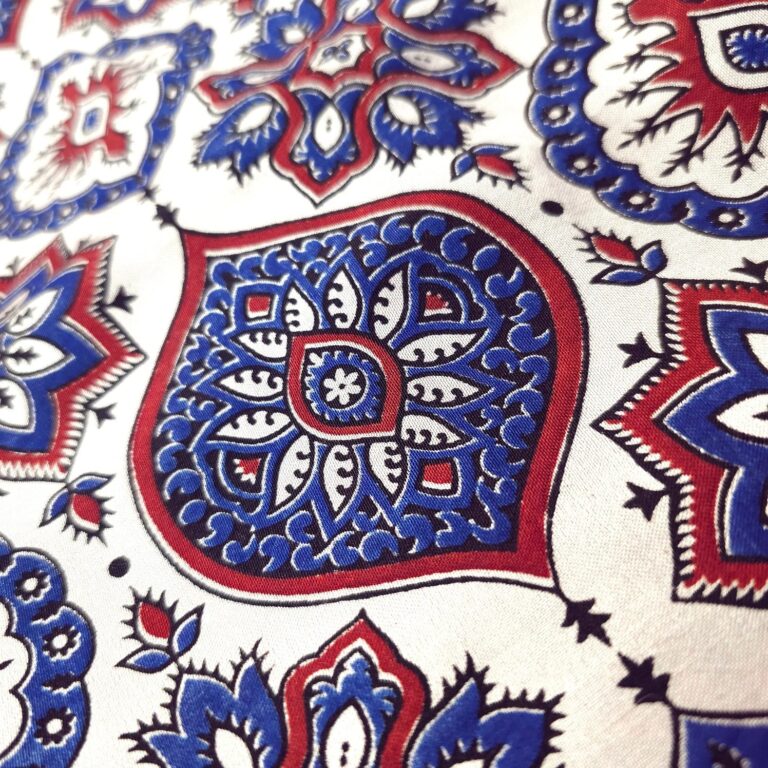
Banarasi Saree (Uttar Pradesh) – Origin, Making & Significance
If the ajrakh saree is a meditation on the natural world, earth pigments pressed patiently into cloth, then the Banarasi saree is its celestial counterpart: a fabric that seems to have been dreamed up in a place where the divine and the terrestrial meet. Woven in the lanes of Varanasi, one of the oldest continuously inhabited cities on earth, the Banarasi saree does not merely clothe the body. It consecrates it.
A City and Its Cloth
To understand the Banarasi saree, one must first understand Varanasi, or Banaras, as it is still called with affection. Situated on the western bank of the Ganga in Uttar Pradesh, the city has been a centre of spiritual life, Sanskrit scholarship, and artistic production for at least three thousand years. It is the city of Shiva, of moksha, of the eternal burning ghats. It is also, inseparably, the city of silk.
The weaving tradition of Varanasi is believed to have deepened significantly during the Mughal period, particularly between the fifteenth and seventeenth centuries, when Persian aesthetic influences arabesque floral patterns, intricate jali work, the vocabulary of the imperial court, fused with indigenous Indian motifs and the devotional iconography of Hindu temples. This synthesis produced something entirely new: a textile that was simultaneously imperial and sacred, Persian in its ornamentation and Indian in its soul.
The weavers themselves, largely from the Muslim Ansari community, became the keepers of this tradition. Their relationship with the city and its Hindu patronage is one of the most eloquent examples of India’s syncretic cultural history, Muslim hands weaving the gold-shot silk in which Hindu brides have been dressed for centuries.
The Anatomy of a Banarasi Saree
A Banarasi saree is distinguished above all by its zari work, the weaving of metallic threads, traditionally real gold or silver, into silk to create patterns of extraordinary opulence. The interplay between the lustrous silk ground and the gleaming zari is the defining visual experience of a Banarasi: a fabric that seems to generate its own light, shifting and shimmering with every movement of the body.
The saree is typically divided into three distinct visual zones. The body, the long central field, carries the primary pattern, which may be densely packed or more sparsely arranged depending on the type and purpose of the saree. The border, running along both long edges, contains its own design vocabulary, often in a contrasting colour or more concentrated zari. And the pallu, the decorative end piece that is draped over the shoulder, is the saree’s crown jewel, almost always more elaborately worked than the rest, a canvas for the weaver’s most ambitious patterning.
The motifs that populate these zones draw from a rich and layered repertoire. Butas and butis, floral sprigs of varying sizes, are among the most beloved and enduring. Jangla patterns fill the ground with dense, all-over foliage. Shikargah designs depict hunting scenes inherited from Mughal court art, populated with elephants, tigers, and horsemen frozen in silk. Meenakari work introduces tiny bursts of colour into the zari using extra weft threads. Tanchoi weave creates richly textured surfaces. Each technique represents a distinct branch of the tradition, with its own history and its own community of specialist weavers.
The Loom and the Hand
The production of a Banarasi saree is an act of profound technical complexity. The city’s weavers work predominantly on pit looms, the weaver sits in a pit beneath the loom, operating the treadles with his feet while his hands manage the shuttle and the intricate pattern mechanism above. Many Banarasi sarees are woven on the Jacquard loom, a nineteenth-century invention that uses a system of punched cards to automate the pattern-weaving process and was, in a very real sense, a forerunner of the modern computer.
Yet even with the Jacquard mechanism, a heavily worked Banarasi saree of the finest quality may take weeks or months to complete. The pure silk yarn must be degummed, dyed in brilliant mineral and chemical colours, and wound onto bobbins before weaving begins. The zari threads, today most often silver-coated copper wound around a silk core, must be woven with extraordinary precision to create the dense, raised patterns that characterise the best Banarasi work.
The most exceptional pieces, made for bridal trousseaux or royal collections, might involve the work of an entire family: one weaver at the loom, another managing the Jacquard cards, others preparing yarn and managing the complex threading of the warp. Weaving in Varanasi is not an individual act but a collective one, distributed across households and neighbourhoods in a centuries-old system of specialised labour.
Varieties: A Taxonomy of Splendour
The Banarasi saree is not a single object but a family of related textiles, differentiated by silk type, weave structure, and ornamentation technique.
Katan sarees are woven from pure silk in both warp and weft, producing a fabric of dense, cool weight and incomparable drape. Organza or kora sarees use a lighter, crisper silk that creates a translucent ground of delicate beauty. Georgette Banarasis, woven from twisted silk yarns, have a characteristic pebbly texture and fluid fall. Shattir sarees blend silk with cotton to create a more affordable but still elegant fabric.
Among the most prized is the Kadwa saree, in which each individual motif is woven separately using its own shuttle, a painstaking technique that produces a fabric with no floating threads on the reverse, considered the hallmark of the highest craftsmanship. The cutwork or jangla technique creates lace-like openwork patterns within the fabric, an almost impossible feat of weaving virtuosity.
Brides, Goddesses, and the Weight of Gold
The Banarasi saree occupies a position of unrivalled ritual importance in the North Indian Hindu wedding. The bridal Banarasi — typically in auspicious red, deep magenta, or warm ivory — is one of the most emotionally weighted garments in Indian culture. It is the saree a mother saves for her daughter, the saree that appears in wedding photographs across generations, the saree that carries the compressed hopes and prayers of a family.
This ritual centrality is inseparable from the saree’s visual character. The heaviness of a bridal Banarasi — the stiffness of its zari, the density of its pattern, the sheer weight of the silk — is understood not as a burden but as a kind of armour, a protective and auspicious cladding for a woman crossing one of life’s great thresholds. In the iconography of Hindu goddesses, Lakshmi and Saraswati are frequently depicted draped in precisely such luminous, gold-worked silk. To dress a bride in a Banarasi is, in some sense, to dress her as a goddess.
Beyond weddings, Banarasi sarees are the formal textile of ceremony and celebration throughout the Hindi-speaking world. They appear at pujas, family gatherings, festivals, and diplomatic occasions. Senior politicians and distinguished women of public life have long favoured them as the appropriate dress for formal national occasions, a recognition that the Banarasi occupies a place in the Indian cultural imagination comparable to haute couture in France.
Crisis, Resilience, and the GI Tag
The past three decades have visited considerable hardship upon Varanasi’s weaving community. Power looms producing imitation Banarasis at a fraction of the cost have flooded the market, eroding the livelihoods of handloom weavers who cannot compete on price. Synthetic zari, brass-coated copper, or even plastic, replaced real silver and gold long ago for most commercial production. Many weavers have been forced to abandon the craft or migrate to other work.
In 2009, the Banarasi saree received a Geographical Indication tag, a legal certification recognising that only sarees woven in Varanasi and a small number of surrounding districts can be authentically called Banarasi. This was an important step, but enforcement remains difficult. The discerning buyer must still rely on tactile and visual knowledge to distinguish the handloom article from its power-loom simulacrum: the slight irregularities of hand-weaving, the quality of the zari’s sheen, the fineness of the silk, the complexity and sharpness of the pattern.
Several government and NGO initiatives have worked to sustain the tradition, providing design inputs, marketing support, and direct-to-consumer platforms. A new generation of urban Indian consumers, drawn to craft and heritage textiles, has created some renewed demand for authentic handloom Banarasis. Young designers have collaborated with Varanasi weavers to produce contemporary sarees with sparser, more modern patterning that appeal to buyers who find traditional designs too heavy for everyday wear.
The Weavers’ City
To walk through the weaving neighbourhoods of Varanasi, Madanpura, Alaipura, Peeli Kothi, is to enter a parallel city, one in which the rhythmic clatter of pit looms fills the narrow lanes from early morning until late at night. In the older havelis, workshops occupy the upper floors, where light filters through latticed windows onto yards of silk stretched across the loom. Bobbins of zari and coloured silk are stacked in corners. Half-finished sarees hang like paintings in progress.
The weavers who sustain this tradition are inheritors of a craft that is simultaneously technical mastery, artistic vision, and daily labour. Many have never travelled outside Varanasi. The city and the loom are the coordinates of their world. That this intimate, localised knowledge produces objects of global aesthetic significance, objects that appear in museum collections from London to New York, on the shoulders of film stars and heads of state, is one of the quiet marvels of traditional craft.
A Fabric Woven with Time
The Banarasi saree is, finally, an argument about value, about what things are worth when they are made by hand, slowly, with inherited skill and genuine material. In its gold-shot silk, one can read centuries of cultural exchange: the Persian garden rendered in Indian thread, the Mughal court’s love of abundance translated into a Hindu bride’s auspicious dress, the Muslim weaver’s devotion producing the garment in which a Hindu goddess is recognised.
It is a fabric in which history has not been archived but kept alive, still being woven, still being worn, still being passed from mother to daughter in the old city on the Ganga, where the looms have not yet fallen silent.