
Ajrakh Saree (Gujarat)
Cloth has always been more than mere fabric. In the hands of the Khatri artisans of Kutch and Sindh, cotton and silk are transformed into something closer to philosophy, a textile so layered in meaning, so painstaking in process, that wearing it feels like an act of reverence. The ajrakh saree is one of India’s most ancient and enduring textile traditions, a symphony of natural dyes, geometric precision, and cultural memory printed block by block onto cloth.
Origin
The word ajrakh is believed to derive from the Arabic azrak, meaning blue, a fitting name for a textile that has always been defined by its deep indigo tones. Some scholars trace alternative roots to the phrase aaj rakh, meaning “keep it today” in Hindi-Urdu, a reference to the lengthy waiting periods between each stage of dyeing and printing. Either etymology speaks to something essential about the craft: its ancientness, and its stubborn insistence on time.
Ajrakh’s origins stretch back at least four thousand years. Excavations at Mohenjo-daro in the Indus Valley have yielded figurines draped in what appear to be trefoil-printed garments strikingly similar to ajrakh motifs, suggesting that the aesthetic vocabulary of this textile predates recorded history. The craft flourished across the Sindh region, present-day Pakistan, before Partition prompted many Khatri families to resettle in Kutch, Gujarat, where towns like Ajrakhpur and Dhamadka became the new heartlands of the tradition.
Making
What distinguishes ajrakh from other block-printed textiles is not merely its visual complexity but the extraordinary process through which it is made. A single saree may pass through as many as fourteen to sixteen distinct stages over the course of several weeks, each step building upon the last in a precise chemical choreography.
The fabric is first washed and treated with myrobalan, a tannin-rich fruit, to prepare it for dye absorption. Then begins the resist-printing process, in which carved wooden blocks are pressed onto the cloth with a paste of lime and gum arabic. This resist protects certain areas of the fabric from absorbing colour, creating the characteristic white outlines and negative spaces that give ajrakh its architectural quality.
The cloth is then dyed in indigo or alizarin red derived from madder root, washed in the river, sun-dried, and re-printed. This sequence is repeated, layer upon layer, colour upon colour, until the final pattern emerges in its full complexity.
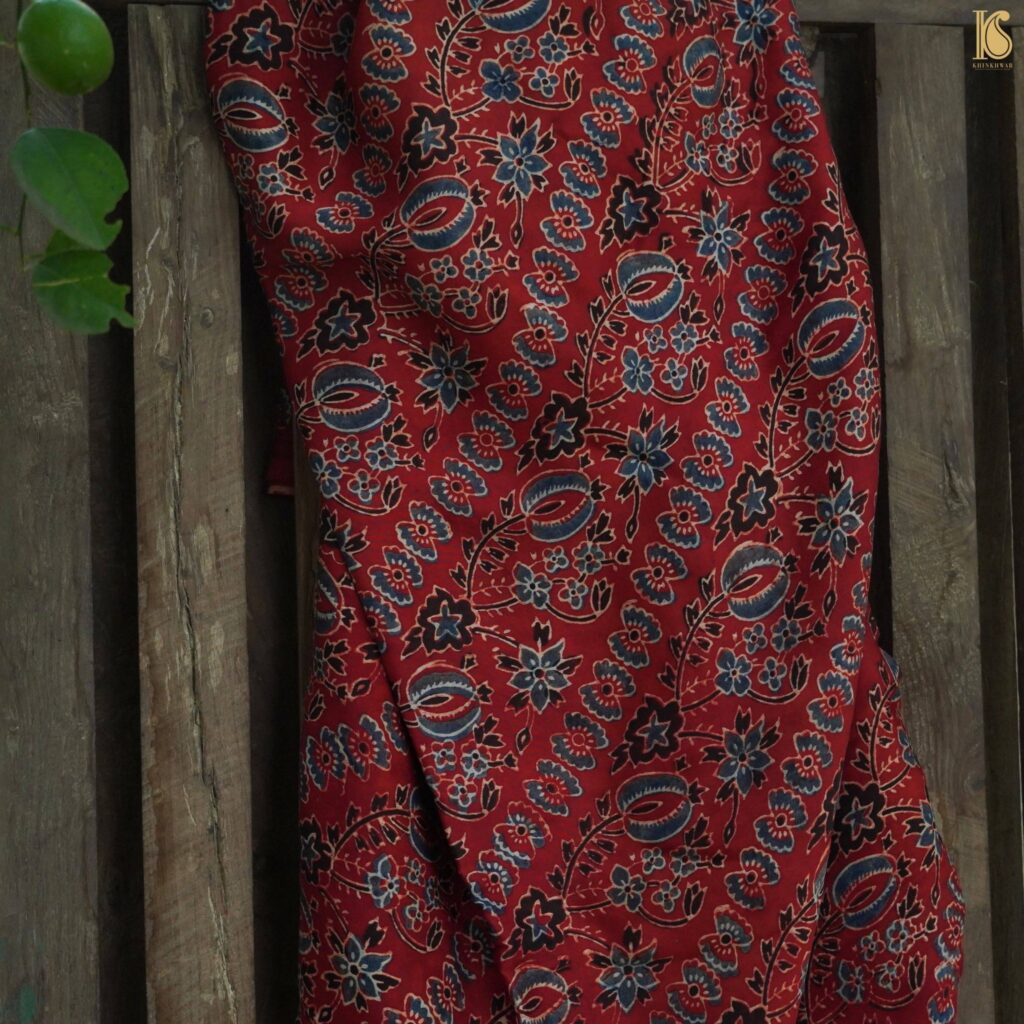
The dyes are entirely natural. Indigo yields the iconic blue; madder root gives the deep brick-red; iron-based mordants produce blacks; pomegranate rind and turmeric add warmth. The artisans’ intimate knowledge of these materials, how they react to one another, to heat, to the mineral content of local water, is itself a form of inherited wisdom, passed from generation to generation within the Khatri community.
Symbolism
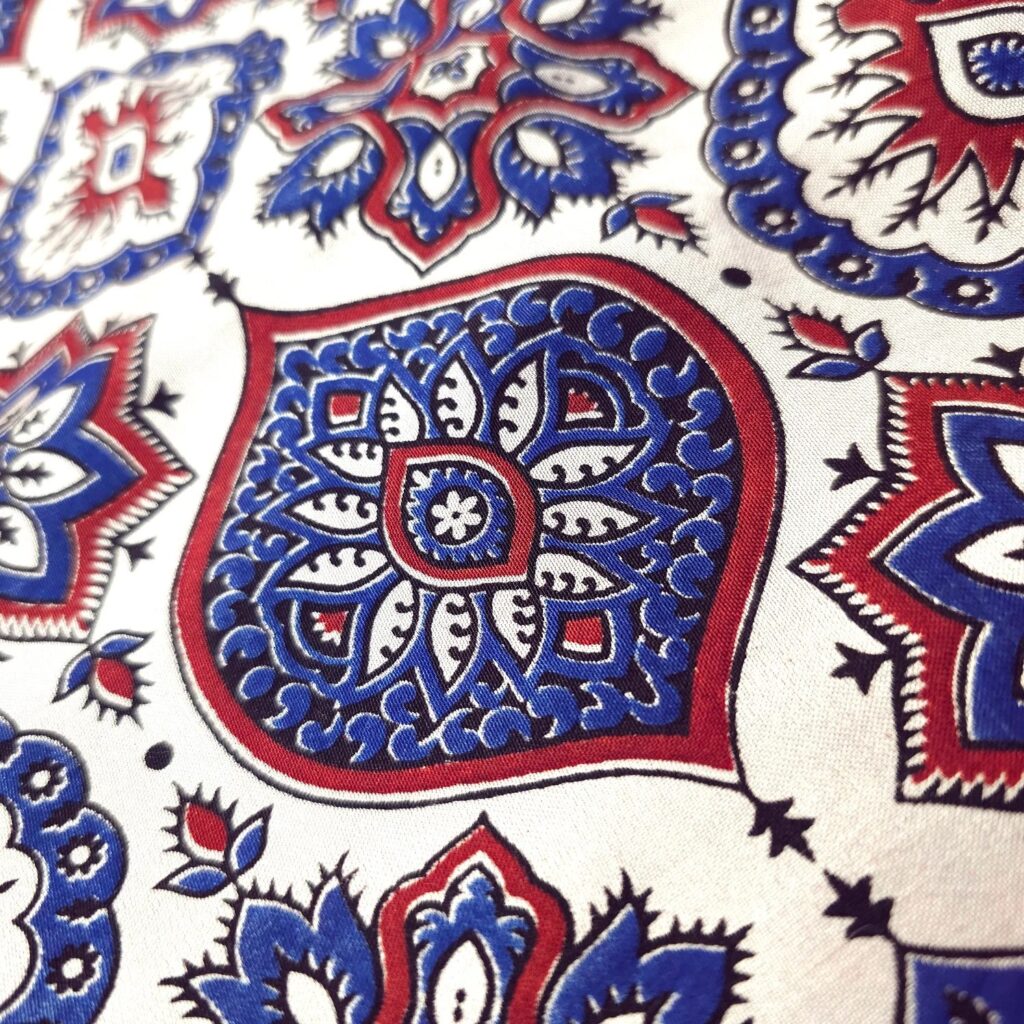
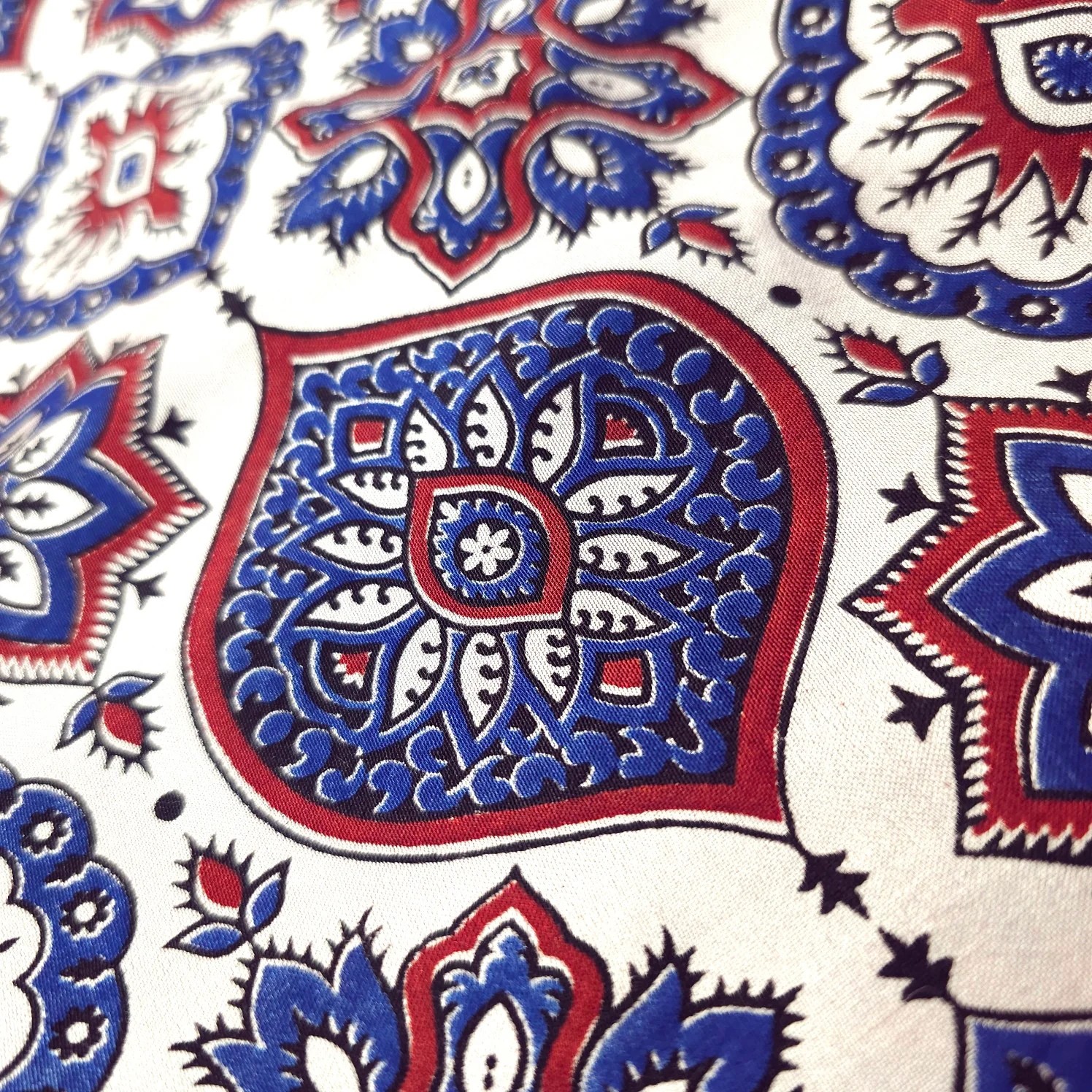
To look closely at an ajrakh saree is to read a text written in geometry. The patterns are built from intricate repeating units, stars, medallions, arabesques, and delicate floral traceries, arranged in a strict bilateral symmetry. The design is characteristically the same on both sides of the fabric, a technical feat made possible by the resist-printing process and one that has no parallel in most other textile traditions.
The cosmos is embedded in the design. The central field of an ajrakh is called the paan, a space densely filled with interlocking geometric forms that echo Islamic architectural tilework and the infinite patterns of the night sky. The borders, called khat, contain their own carefully composed repeating elements. The overall effect is one of controlled abundance — richness held in precise order.
Colour carries meaning too. The combination of indigo blue and madder red is not merely aesthetic but carries associations with sky and earth, water and fire, masculine and feminine — the complementary dualities that sustain life. Many artisans understand their work as an act of cosmological mapping, a representation of the universe’s underlying order.
High Fashion
Historically, ajrakh was woven into the daily life of pastoral communities across Kutch and Sindh. The Rabari and Jat herders used it as a shawl, a turban cloth, a prayer mat, and a prayer wrap. It was gifted at weddings, offered at shrines, and spread on the ground as a seat of honour. Its deep colours hid the dust and stains of outdoor life while its natural dyes kept the wearer cool in the desert heat — a garment perfectly adapted to its environment.
The ajrakh saree as a distinct garment is a more recent development, emerging as urban consumers and the handloom revival movement of the late twentieth century created demand for these textiles in new forms. Designers began collaborating with Khatri artisans to produce sarees in ajrakh-printed fabric, bringing the tradition into metropolitan fashion consciousness. Today, ajrakh sarees appear on the shelves of craft emporiums and the runways of Indian fashion weeks alike.
This transition has not been without tension. The commercialisation of ajrakh has led to the proliferation of machine-printed imitations using synthetic dyes — faster, cheaper, visually similar to the untrained eye, but stripped of the craft’s soul.
Distinguishing authentic hand-block-printed ajrakh from its industrial simulacra requires attention to subtle irregularities: the slight variance in block alignment, the softness of natural-dye colour, the texture of the resist-printed outlines. These “imperfections” are, in fact, the signature of the human hand, the mark of a living craft.
Artisans and Their Legacy
The Khatri community of Kutch, particularly the families of Ajrakhpur, rebuilt after the devastating 2001 earthquake, remains the primary custodian of authentic ajrakh production. Craftsmen like the late Ismail Mohammed Khatri and his descendants have been instrumental in preserving traditional methods while adapting the tradition to contemporary demand. Ismail Khatri was awarded the Padma Shri in 2012, a recognition of a lifetime devoted to a craft that might otherwise have been swallowed by mechanisation.
In recent years, younger members of these families have begun developing new colour palettes and surface combinations, ajrakh printed on modal silk, merino wool, or organic cotton, while remaining anchored to the hand-block-printing and natural-dye processes that define the tradition’s identity. This creative evolution is the mark of a living art form, one that grows without forgetting its roots.
Wearing an Ajrakh Saree
To drape an ajrakh saree is to carry a piece of an extraordinarily long conversation, between human beings and the natural world, between ancient Indus Valley aesthetics and contemporary Indian fashion, between the artisan’s hands and the wearer’s body. The saree’s weight, the slight stiffness of the natural-dyed cotton, the smell of indigo that lingers faintly in new fabric: these are sensory reminders of a process that no machine has yet been able to fully replicate.
In an age of fast fashion, the ajrakh saree stands as a quiet argument for slowness, for the idea that beauty requires time, that craft is a form of knowledge, and that a piece of cloth can hold within its fibres the memory of a civilisation.
The ajrakh saree is not simply worn. It is inhabited.