

SSC Economics Previous Year Questions – Part (2)
This is part-2 of 6 part series where I cover trickiest questions SSC asked in 2025.
1. What does the ‘invisible hand’
concept, as proposed by Adam Smith,
primarily signify?
This question was asked in Shift-3 of SSC Steno exam on 7 August. The answer is option (c) Market equilibrium achieved
via self-interest.
The invisible hand is one of economics’ most famous metaphors, introduced by Adam Smith in The Wealth of Nations (1776). When individuals pursue their own self-interest in a free market, they are led, as if by an “invisible hand”, to promote the economic well-being of society as a whole, even without intending to do so.
Smith’s own example used was a merchant who invests locally to maximize personal profit ends up benefiting the domestic economy, not out of altruism, but as an unintended byproduct.
2. Which curve is typically U-shaped
due to the law of variable proportions?
This question was asked in Shift-2 of SSC Steno exam on 7 August. The answer is option (b) Average Variable Cost Curve.
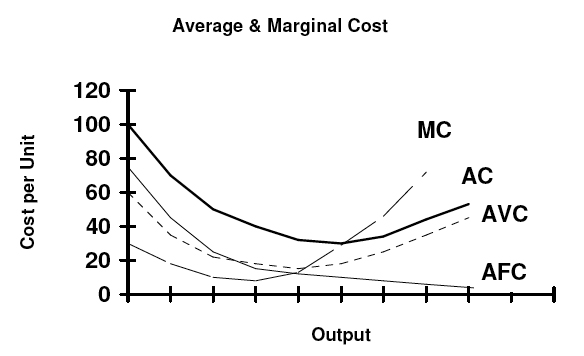
The Average Variable Cost (AVC) curve is typically U-shaped due to the Law of Variable Proportions (also called the Law of Diminishing Returns).
3. Which of the following is a key
reason for the decline in the agricultural
sector in India after 1991 economic
reforms ?
This question was asked in Shift-1 of SSC Steno exam on 6 August. The answer is option (c) Shift toward export-oriented
cash crops and reduced public
investment.
4. The Law of Diminishing Marginal
Utility states that as a consumer
consumes more and more units of a
commodity:
This question was asked in Shift-1 of SSC Steno exam on 6 August. The answer is option (a) Marginal utility derived from
each additional unit decreases.
The Law of Diminishing Marginal
Utility states that as a consumer consumes more and more units of a commodity, the marginal utility derived from each successive unit goes on diminishing, while total utility increases at a diminishing rate. Given by Hermann Heinrich Gossen (Gossen’s First Law) & popularized by Alfred Marshall.
The Law of DMU is a foundational microeconomic principle explaining consumer behaviour, pricing, and welfare economics. It establishes that utility is subjective and decreasing, the more you have of something, the less you value the next unit.
5. Consider the following statements:
The relationship between interest rate
and demand for money is inverse.
The relationship between interest rate
and demand for money is direct.
This question was asked in Shift-1 of SSC Steno exam on 6 August. The answer is option (b) Only 1 is true.
When interest rate rises, the demand for money falls, and vice versa. This is because:
When interest rates are high, people prefer to invest in bonds/assets rather than hold idle cash, which leads to decrease in money demand.
When interest rates are low, holding bonds becomes less attractive after which people prefer to hold liquid cash, this leads to a rise in money demand.
6. What trend is reflected
increasing share of urban people in
non-manual tertiary occupations?
This question was asked in Shift-3 of SSC Steno exam on 8 August. The answer is option (c) Emerging service economy.
7. In what way did fiscal discipline reforms affect center-state financial relations post-1991?
This question was asked in Shift-3 of SSC Steno exam on 8 August. The answer is option (b) States had to adhere to fiscal targets.
8. Which of the following
statements is/are correct?
Statement I: A bank’s main liability is the
deposits it holds.
Statement II: Open Market Operations
involve buying and selling government
bonds.
Statement III: The Bank Rate is the rate
at which RBI lends to commercial banks.
This question was asked in Shift-2 of SSC Steno exam on 6 August. The answer is option (b) I, II and III all three
statements are correct.
Deposits (savings, current, fixed) are money owed by the bank to depositors. From an accounting perspective, deposits appear on the liabilities side of a bank’s balance sheet.
OMOs are conducted by the RBI to regulate money supply in the economy. When RBI buys government securities, money is injected into the system (expansionary monetary policy). When RBI sells government securities, money is absorbed from the system (contractionary monetary policy).
Bank Rate is the rate at which RBI provides long-term loans to commercial banks. It influences the overall interest rate structure in the economy. A higher Bank Rate makes credit costlier which helps in controlling inflation. It is different from Repo Rate, which involves short-term lending with collateral.
9. What significant institution
development emerged from banking
reforms after 1991 to regulate financial
stability?
This question was asked in Shift-3 of SSC Steno exam on 6 August. The answer is option (a) Board for Financial
Supervision (BFS).
After the 1991 reforms, the Board for Financial Supervision (BFS) was established in 1994 as a committee of the Reserve Bank of India (RBI) to strengthen the supervisory framework over the financial system.
BFS supervises commercial banks, financial institutions, NBFCs and urban cooperative banks & ensures implementation of prudential norms. It is chaired by the governor of RBI.
Before BFS, banking supervision was fragmented. The BFS created a dedicated, high-level oversight body that could proactively monitor risks, making it a cornerstone institutional development emerging from the post-1991 banking reform era.
10. Which policy reform targeted
improving competitiveness and
efficiency of the banking system after
1991?
This question was asked in Shift-2 of SSC Steno exam on 6 August. The answer is option (a) Introduction of prudential norms and CRAR.
After the 1991 economic liberalization in India, the Narasimham Committee Report (1991) recommended sweeping banking sector reforms. A key reform was the introduction of prudential norms and the CRAR framework, which required banks to maintain capital adequacy in proportion to their risk-weighted assets (initially set at 8% as per Basel norms).
This was part of broader financial sector reforms that also included deregulation of interest rates, entry of private and foreign banks, and autonomy to public sector banks.