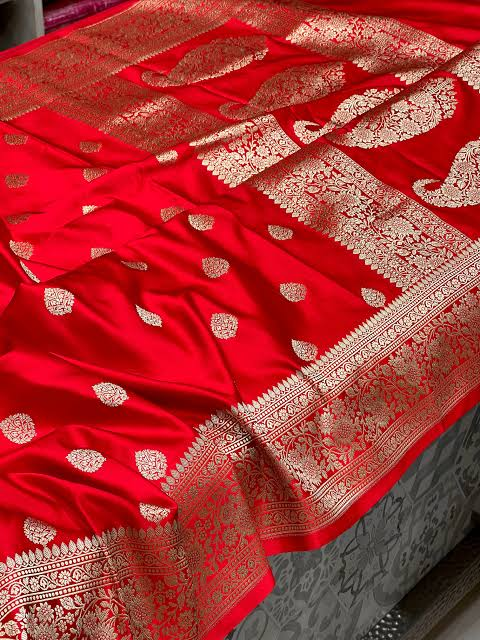

All You Need To know About Kangana Ranaut’s Axomiya Saree Going Viral Of Social Media
There is a moment, when you first see an Axomiya saree spread in full light, when something shifts in your understanding of what cloth can be. It is not the moment of dazzlement that a Banarasi produces, that immediate overwhelming of the senses by gold and colour and density. It is quieter than that, and in some ways more lasting. What you see is a fabric that seems to have grown rather than been made: patterned with motifs drawn from the forests and rivers of one of the most biodiverse landscapes on earth, woven in silk that carries its own natural colour, structured with a logic that reflects centuries of accumulated wisdom about how thread and loom and human hand can work together to produce something irreducibly beautiful. You are looking at the textile tradition of Assam, one of the oldest and most complete weaving civilizations in the world, and what you feel is not admiration exactly but recognition: the sense of encountering something that has been true for a very long time.
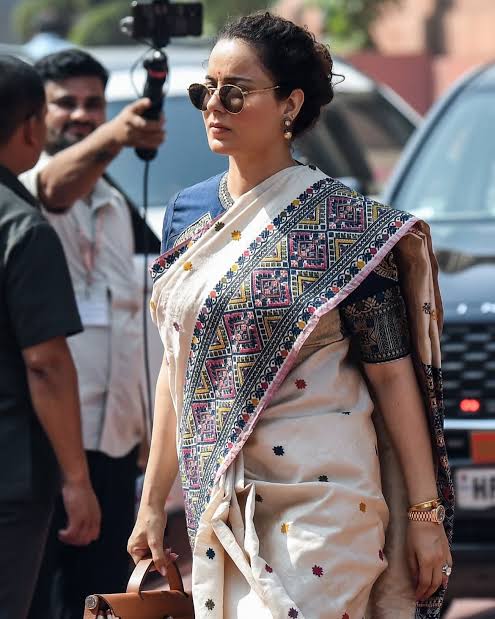
When Kangana Ranaut was recently seen wearing an Axomiya saree, the response across India was immediate. People who had never heard the word paused to look. Fashion commentators reached for superlatives. Social media filled with images and questions: what is this fabric, where does it come from, why does it look so different from everything else? The answers to those questions open into one of the richest and most underexplored chapters in the story of Indian textile culture.
The Land That Made the Cloth
Assam is not like other Indian states. Its geography is singular: a great river valley enclosed by mountains on three sides, opening to the east and drained by the Brahmaputra, one of the mightiest rivers in Asia, which enters from Tibet through a dramatic gorge in the eastern Himalayas and flows westward across the state in a channel so wide that in the monsoon it becomes an inland sea. The valley that the Brahmaputra has created over millions of years is extraordinarily fertile, watered by rainfall that in some parts of the state is among the heaviest on earth, forested with a density and diversity of species that belongs to a region at the intersection of the Indian subcontinent, Southeast Asia, and the eastern Himalayas.
This landscape is not merely the backdrop to Assamese culture. It is its primary subject. The animals that live in the Brahmaputra valley’s forests and wetlands, the one horned rhinoceros, the elephant, the tiger, the deer, the peacock, the various species of heron and duck and kingfisher that inhabit the river, appear constantly in the design vocabulary of Axomiya weaving. The flowers that bloom across the valley, the kopou phool or foxtail orchid that is the state’s floral emblem, the lotus that grows in every pond and wetland, the jasmine and the wild orchids of the hills, are woven into the fabric as naturally as they grow into the landscape. The rivers themselves, in their sinuous movement and their reflective surface, inspire the flowing geometric patterns that characterise some of the tradition’s most characteristic border designs.
Assam’s cultural history is equally complex. The state is home to dozens of distinct ethnic and linguistic communities, each with its own weaving tradition, its own design vocabulary, its own relationship to the loom. The Ahom, who ruled Assam for nearly six centuries, were great patrons of weaving and weavers, and their court established standards of textile excellence that shaped the entire tradition. The Bodo, the Mishing, the Rabha, the Tiwa, the Karbi, and many other indigenous communities each brought their own patterns and techniques to the broader Assamese weaving world. The result is not a single uniform tradition but a rich ecosystem of related traditions, sharing certain fundamental values and techniques while diverging in their specific expressions.
What Is an Axomiya Saree
The term Axomiya saree, axomiya being the Assamese word for Assamese, refers to sarees woven in Assam using the state’s traditional silk fibres and weaving techniques. This is a broad category that encompasses several distinct types of fabric, each with its own character and its own place in the tradition.
The most prestigious and most celebrated is muga silk, the naturally golden silk that is unique to the Brahmaputra valley ecosystem and that we have already examined in some depth. But the Axomiya saree tradition is not limited to muga. It also encompasses eri silk, the soft, warm, creamy white silk produced from the cocoons of the eri silkworm fed on castor leaves, which has a texture and warmth entirely different from the golden muga. It includes pat silk, the mulberry silk variety native to Assam, which is finer and smoother than muga but has its own characteristic lustre and drape distinct from the mulberry silks of other Indian weaving centres. And it includes cotton weaving traditions of great antiquity and beauty, particularly the gamocha, the traditional Assamese cotton towel that is one of the most culturally loaded textiles in the state’s life.
What unites all of these different fabrics within the Axomiya tradition is not the fibre but the design sensibility: a preference for motifs drawn from the natural world, a love of dense supplementary weft patterning, a characteristic approach to the border and the pallu that distributes ornament across the fabric in a particular way, and above all a commitment to the handloom as the only legitimate instrument of this tradition’s highest expression.
Pat Silk: The Smooth Gold of the Valley
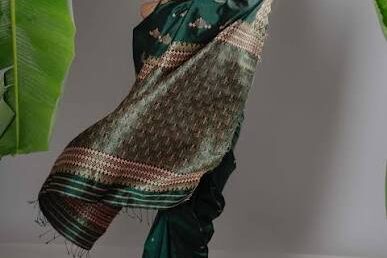
Among the silk traditions of Assam, pat silk occupies a position of particular importance for the Axomiya saree in its most widely known contemporary form. Pat is Assam’s version of mulberry silk: produced from the cocoons of Bombyx mori silkworms fed on mulberry leaves, it is smoother and more uniform than muga, with a cooler, brighter lustre and a more fluid drape.
What makes Assamese pat silk different from the mulberry silk of other Indian weaving centres is the specific character that comes from the local climate and the local sericulture practices. The silk produced in the Sualkuchi area of Kamrup district, which is the primary centre of pat silk weaving, has a quality that experienced textile people can distinguish from mulberry silk produced elsewhere: a slightly different hand, a particular quality of sheen, a characteristic weight and drape that belongs to this specific combination of fibre, climate, and weaving technique.
Sualkuchi, a town on the north bank of the Brahmaputra about thirty kilometres from Guwahati, is often called the Manchester of Assam, a comparison that does the town a disservice by associating it with industrial production when what it actually practices is one of the most refined traditions of handloom silk weaving in India. The town is essentially one long weaving village: almost every household has a loom, and the sound of the shuttle and the treadle is as constant as the sound of the river nearby. The sarees and mekhela chadors produced in Sualkuchi are among the most beautiful silk textiles being made anywhere in India today.
Eri Silk: The Silk of Compassion
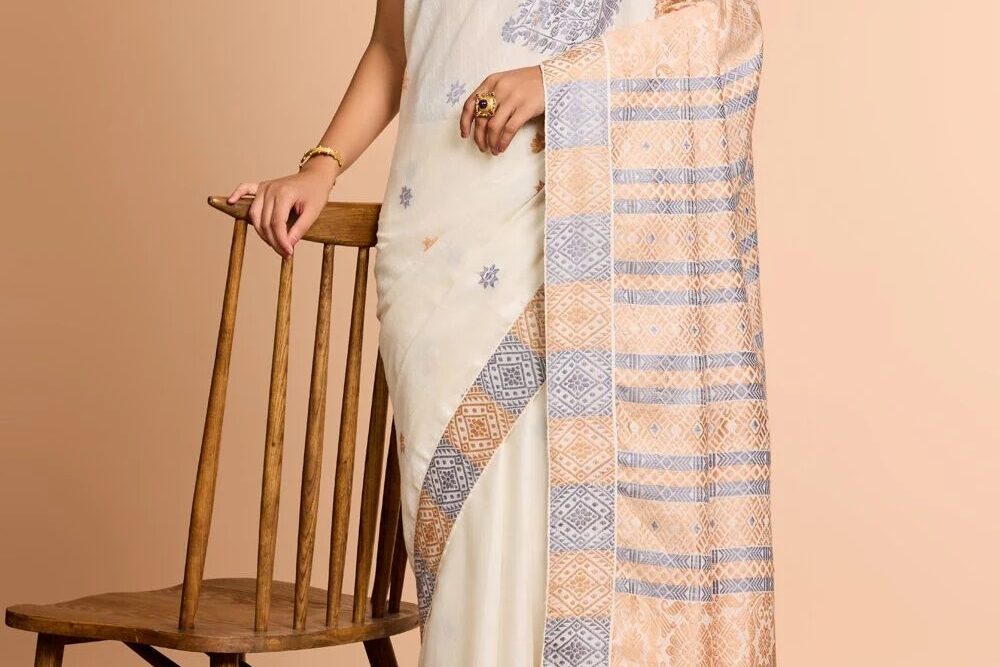
Eri silk holds a special place in the Axomiya textile tradition for reasons that go beyond its aesthetic qualities, considerable as those are. The eri silkworm, Samia ricini, spins an open ended cocoon from which the moth can emerge without being killed, meaning that eri silk can be reeled or spun without the death of the silkworm. This has given eri silk the designation of peace silk or ahimsa silk, and it has a particular resonance in the Vaishnavite religious tradition that is central to Assamese Hindu culture, with its deep commitment to non violence toward all living creatures.
The texture of eri silk is entirely different from muga or pat. It is soft and slightly fluffy, with a warmth and a matte quality that resembles fine wool more than conventional silk. Eri sarees and mekhela chadors have a particular quality of warmth and body that makes them ideal for the cooler months, and their texture takes dye in a way that produces colours of unusual depth and richness. The creamy natural white of undyed eri, worked with supplementary weft patterns in contrasting colours, produces a fabric of great beauty and great simplicity simultaneously.
The communities most associated with eri weaving are spread across the hill districts of Assam and the neighbouring states of the northeast, where the craft has deep roots in indigenous textile culture. Among the Mishing community of the Assam plains, eri weaving has a particularly strong tradition, and Mishing eri textiles are characterized by bold geometric patterns and strong colour contrasts that give them a visual energy quite different from the more refined aesthetic of the Sualkuchi pat silk tradition.
The Mekhela Chador: The Original Garment
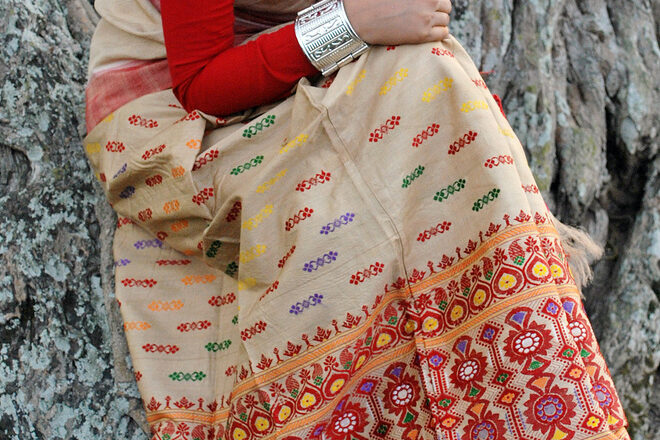
To write about the Axomiya saree is necessarily to write also about the mekhela chador, because the two garments are intimately related and because the design vocabulary of the Axomiya saree is largely drawn from the older mekhela chador tradition.
The mekhela chador is Assam’s classical female garment: a two piece dress in which a cylindrical lower wrap, the mekhela, covers the body from waist to ankle, while a long upper cloth, the chador, is draped over the shoulder and across the chest. Both pieces are woven separately and then worn together, creating a garment of considerable elegance and great flexibility, adaptable to both casual daily wear and formal ceremonial dress depending on the quality of the fabric and the elaborateness of the weaving.
The mekhela chador is the garment in which Assamese cultural identity is most fully and most consistently expressed. It is worn for Bihu, for weddings, for religious ceremonies at the sattras, for the formal occasions of public life. Learning to weave a mekhela chador is part of the education of a traditional Assamese woman, and the ability to produce beautiful weaving is a matter of personal pride and social standing. The loom is not a factory machine in the Assamese imagination. It is a domestic instrument, a creative tool, an extension of the weaver’s own artistic sensibility.
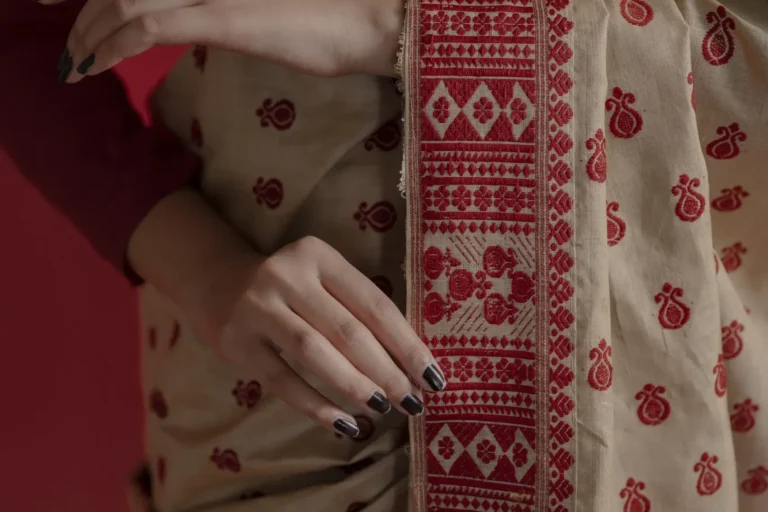
The Axomiya saree adapts this tradition to the pan Indian saree format, taking the design vocabulary of the mekhela chador and distributing it across the different structure of the six metre saree. The border patterns that run along the edges of the mekhela become the saree border. The pallu of the saree carries the concentrated patterning that would appear at the top of the mekhela and across the chador. The body of the saree carries the scattered motifs that characterise the body of the mekhela. The translation is not always seamless, because the saree format and the mekhela chador format have different proportions and different draping logics, but in the hands of skilled weavers and thoughtful designers, the Axomiya saree successfully carries the tradition’s essential character into a form accessible to the whole of India.
The Motifs: Reading the Forest in Thread
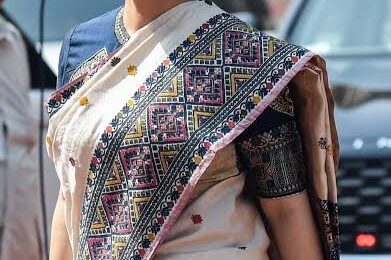
The design vocabulary of Axomiya weaving is one of the richest and most distinctive in Indian textile art. It draws from three primary sources: the natural world of the Brahmaputra valley, the iconographic traditions of Vaishnavite Hinduism as practiced in Assam, and the geometric traditions inherited from the various indigenous communities whose weaving cultures have contributed to the broader Assamese tradition.
From the natural world come the animal motifs that are perhaps the most immediately recognisable feature of Axomiya textiles. The hastir, the elephant, appears across the border and pallu of sarees and mekhela chadors in a stylised form that reduces the massive animal to an elegant geometric silhouette, identifiable and graceful simultaneously. The mora, the peacock, spreads its tail in supplementary weft patterns that require extraordinary technical skill to execute with the precision the tradition demands. The hans or goose, sacred in Vaishnavite iconography, glides across borders in paired formations. The fish, the deer, the rhinoceros: each appears in the traditional design vocabulary with a stylisation so refined over centuries that the natural form and the geometric abstraction have become perfectly fused.
From the Vaishnavite tradition come the iconographic motifs associated with the worship of Vishnu and his avatars, particularly Krishna, whose cult is central to Assamese religious life through the institution of the sattra, the Vaishnavite monastery that is both a religious centre and a cultural one. The lotus, the conch, the disc, the mace, the tulsi plant: these sacred symbols appear in the weaving in ways that are simultaneously devotional and decorative, carrying religious meaning for those who read them and pure aesthetic pleasure for those who do not.
From the geometric traditions of the indigenous communities come the diamond forms, the stepped patterns, the interlocking geometric shapes that give many Axomiya textiles their structural backbone. These patterns, which have no specific representational meaning but are part of the inherited design vocabulary of particular communities and regions, provide the framework within which the more figurative motifs are placed.
The characteristic Assamese border, the most immediately recognisable element of Axomiya textile design, typically combines all three of these sources: a geometric framework containing floral and animal motifs, worked in a specific colour combination that identifies the saree’s origin and character. The border of an Axomiya saree is not merely a frame. It is a text, readable to those who know the language.
The Sattra and the Saree
The Vaishnavite sattras of Assam occupy a unique position in the cultural life of the state and a significant one in the history of its weaving tradition. The sattras, monastic institutions founded by the sixteenth century saint and reformer Srimanta Sankardev, became centres not only of religious life but of music, dance, drama, and textile art. Many sattras maintained their own weaving traditions, producing the fine silks and cottons used in their religious ceremonies and performances, and the design vocabulary of sattra textiles became one of the major streams feeding the broader Assamese weaving tradition.
The Vaishnavite aesthetic that the sattras represent, with its emphasis on beauty in worship, on the decoration of the deity and of the devotee as an act of devotion, gave Assamese textile art a particular orientation toward refinement and toward the incorporation of religious symbolism into everyday dress. A woman wearing a fine muga mekhela chador to the sattra was not merely dressing well. She was participating in an aesthetic of devotion that understood beautiful cloth as a form of offering.
This religious dimension of Axomiya textile culture is not merely historical. The sattras continue to function as cultural centres in Assam, and the tradition of fine textile production associated with them continues. Some of the most beautifully worked Axomiya sarees and mekhela chadors being produced today come from weaving communities with long associations with the sattra tradition, and they carry in their design vocabulary the layered meanings of a textile art that has always understood itself as participating in something larger than commerce or fashion.
Bihu: When the Whole State Weaves
No account of the Axomiya saree is complete without an account of Bihu, because no festival in India has a more complete and more beautiful relationship with a textile tradition than Bihu has with Assamese silk weaving.
Rongali Bihu, the spring festival that marks the Assamese new year in mid April, is the occasion when the whole state seems to dress simultaneously in its finest silk. Women and girls wear their best mekhela chadors and sarees, typically in muga or pat silk with elaborate borders and pallus. Men wear their best dhotis and gamusas. The kopou phool, the delicate foxtail orchid that blooms in the spring, is worn tucked into the hair against the gold of the muga silk.
The visual effect of this collective dressing, at the Bihu celebrations that take place across the state, in fields and on riverbanks and in community spaces, is extraordinary. The gold of the muga silk catching the spring sunlight, the bright colours of the supplementary weft patterns moving as the women dance the Bihu dance, the orchids in the hair: it is one of the most beautiful scenes in the annual calendar of Indian cultural life.
Bihu is also the occasion for the exchange of the gamusa, the traditional Assamese cotton towel that is the most culturally loaded object in the state’s textile life. The gamusa, a white cotton cloth with red borders woven in the traditional Assamese manner, is given as a mark of respect and affection: to guests, to elders, to teachers, to deities. It is placed around the neck of honoured visitors. It is offered at the sattra as an act of devotion. It is, in its simplicity and its ubiquity, the textile that most completely expresses the democratic heart of Assamese culture: the sense that cloth is not merely for display but for the expression of human connection.
Kangana Ranaut and the National Conversation
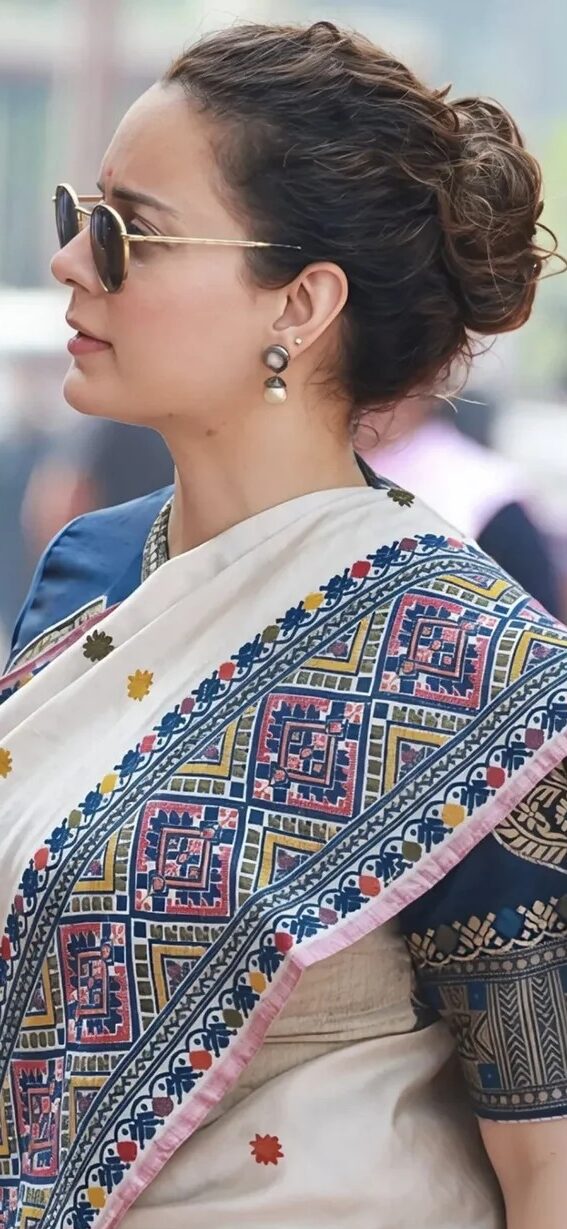
When Kangana Ranaut was photographed in an Axomiya saree, she was participating in a conversation that has been growing in India for several years: a conversation about the value of regional textile traditions, about the importance of recognising and celebrating the craft cultures of states that have not always received their share of national attention.
Assam and the northeast of India more broadly have historically been somewhat marginal in the national imagination, perceived as peripheral to the cultural mainstream in ways that the region’s extraordinary richness of culture, art, and textile tradition does not justify. The northeast has its own music, its own dance, its own literary traditions, its own extraordinary diversity of languages and communities. And it has its textiles: among the most technically accomplished and aesthetically distinctive in all of India, yet far less known nationally and internationally than the silks of Varanasi or the cottons of Gujarat.
Kangana Ranaut’s choice of an Axomiya saree was, in this context, not merely a fashion decision but a cultural one. It said: look at this. This is part of India. This is part of what India means. This is as beautiful as anything this country produces, and it deserves to be seen.
The response suggested that the audience was ready to receive this message. The interest in Axomiya textiles following the appearance was genuine and widespread, extending beyond the usual community of craft enthusiasts to a broader public that had simply not previously encountered this tradition in a context where it demanded their attention.
The Loom in the Home
One of the most distinctive features of the Axomiya weaving tradition is its domestic character. Unlike many Indian weaving traditions, where the work is concentrated in specialized workshops or in particular weaving villages that function as industrial clusters, Assamese weaving is genuinely domestic: the loom is in the home, weaving is done by women as part of their household life, and the fabric produced is as likely to be for the weaver’s own use as for sale.
This domestic character has shaped the tradition profoundly. Because the weaver is weaving for herself, for her family, for the occasions of her own life, she brings to the work a standard of care and a quality of attention that purely commercial production cannot always sustain. A woman weaving a mekhela chador for her own wedding, or for her daughter’s, brings a motivation to that work that goes beyond the economic. She is making something that matters in a way that is personal and deep.
The domestic loom in Assam is typically a frame loom or a body tension loom, simpler in its mechanics than the pit looms of Varanasi or the complex Jacquard looms of Kanchipuram but capable, in skilled hands, of producing fabric of extraordinary complexity and beauty. The skill of reading and executing complex supplementary weft patterns on these looms, working from memory and from the inherited pattern vocabulary of the community, is one of the most remarkable forms of embodied knowledge in Indian textile culture.
Threads Across the Northeast
The Axomiya saree tradition does not exist in isolation. It is part of a broader ecosystem of textile traditions across the northeast of India, each distinct in its specific expression but sharing certain fundamental values and certain common roots. The Manipuri sarees and phanek, woven in silk and cotton on similar looms with related design vocabularies. The naga shawls of Nagaland, woven in wool and cotton with geometric patterns of great boldness and power. The mizo and kuki textiles of Mizoram and Manipur’s hill communities. The Tripuri textiles with their distinctive colour combinations and motif systems.
All of these traditions are part of a textile culture that is in some ways more ancient and more continuous than any of the better known weaving traditions of mainland India, because the northeast has been inhabited by weaving communities for millennia, in an unbroken continuity of practice that has not been disrupted by the major historical upheavals that affected the rest of the subcontinent. The tradition is old, and its age shows not as obsolescence but as depth: as the accumulated wisdom of a very long conversation between human beings and their material world.
The Future of the Golden Loom
The Axomiya weaving tradition faces the familiar challenges of all handloom cultures in the contemporary world: the competition of cheaper machine produced textiles, the difficulty of ensuring adequate income for weavers, the slow attrition of the most skilled practitioners as younger generations consider other options, the problem of reaching markets beyond the immediate community.
But it also has resources that not all handloom traditions possess. The geographical uniqueness of muga silk, which cannot be replicated elsewhere, provides a natural protection against the most direct forms of competition. The strong identity of Assamese cultural life, in which weaving is connected to festival, to religion, to social identity, in ways that are still living and vital, provides a cultural demand that purely economic calculations cannot fully account for. And the growing national and international interest in Indian craft textiles, of which Kangana Ranaut’s Axomiya moment was one expression, creates market opportunities that did not exist a generation ago.
The Geographical Indication tags granted to Assam’s silk traditions, including the first ever Indian GI tag granted to muga silk in 2007, provide legal protection and market recognition. Government schemes for handloom promotion have brought some benefit to Assamese weavers. Social enterprises and designer collaborations have connected Assamese weaving with urban markets in new ways.
What will sustain the tradition in the long run, as it always has, is the combination of weavers who find meaning in the work and buyers who understand what they are holding. The Axomiya saree is not a difficult thing to love, once you have seen it properly. It asks only for the attention that it rewards so generously.
A Civilization at the Loom
The Axomiya saree is, finally, an argument about what civilization means. Not civilization in the grand, monument building, empire creating sense, though Assam has had its kingdoms and its monuments. But civilization in the quieter sense: the accumulated wisdom of a community about how to make beautiful things, how to live well in a specific place, how to pass knowledge from one generation to the next in forms that allow it to grow and develop without losing its essential character.
This kind of civilization does not always make it into the standard histories. It does not always attract the cameras and the commentary that it deserves. But it endures, in the hands of the weavers and in the wardrobes of the women who wear what the weavers make, carried forward in the most direct and most embodied way possible: through practice, through use, through the daily act of sitting at the loom and producing something beautiful from the materials that the land provides.
When Kangana Ranaut wore an Axomiya saree, she was wearing this civilization. She was wearing the Brahmaputra valley, the Vaishnavite sattras, the Bihu celebrations, the domestic looms of Sualkuchi, the forests where the golden silkworm spins its cocoon on the som tree. She was wearing several thousand years of knowing how.
That is what a great saree does. It does not merely clothe the body. It connects the wearer to a world larger and deeper than any individual life, to a tradition of beauty that was already old when history began to be written and that continues, on the looms of Assam, to produce its golden cloth for the generations that are still to come.