Muga Silk Saree (Assam)
There is a silk that does not need to be dyed. It arrives from the cocoon already golden, already luminous, already wearing the colour of the Brahmaputra river catching the late afternoon sun. It does not borrow its beauty from a dye vat or a chemical process. It grows into its colour the way a living thing grows into its nature: slowly, completely, without effort. This is muga silk, the golden silk of Assam, one of the rarest natural fibres in the world, produced nowhere else on earth in its authentic form, worn by royalty and woven into the identity of a civilization that has been making it for longer than most nations have existed.
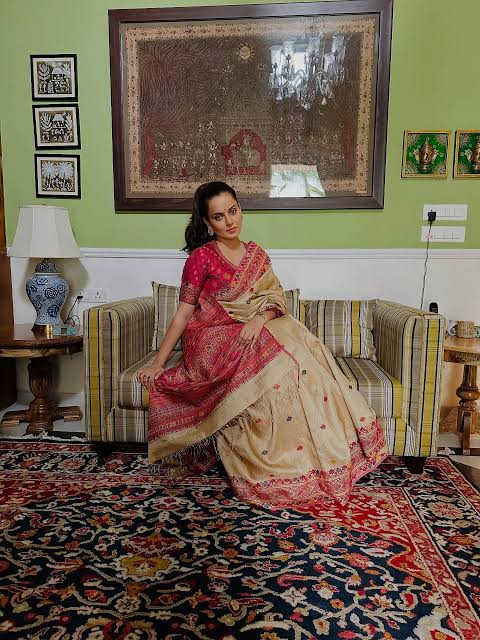
When Kangana Ranaut recently appeared in a muga silk saree, the fashion world paid attention. But the women of Assam, who have been wearing muga since before recorded history, simply nodded. They already knew what the cameras were discovering: that muga is not merely a fabric. It is a statement about where beauty comes from when it comes from the earth itself, unhurried and irreducible, golden as the soil of a river valley that has never stopped giving.
The Brahmaputra and Its Valley
To understand muga silk, you must first understand Assam, and to understand Assam you must understand the Brahmaputra. The great river enters India from the Tibetan plateau through the eastern Himalayas and flows westward across the length of Assam in a valley of extraordinary fertility and biodiversity. The valley is wide and flat and green with a density of green that belongs only to places where the rainfall is generous and the soil deep and rich. The hills on either side, the Himalayan ranges to the north and the smaller ranges of Meghalaya and Nagaland to the south, contain some of the most biodiverse forests in Asia. And in these forests, on the trees that line the valley and climb the lower slopes of the hills, lives the silkworm that produces muga.
Assam is a state of enormous cultural complexity, home to dozens of distinct ethnic communities, languages, and weaving traditions. It has been at various points a powerful independent kingdom, a Mughal tributary, a British province, and an Indian state, and each of these phases has left its mark on the culture. But through all of these political transformations, the weaving of silk has remained a constant. The Ahom kingdom, which ruled Assam for nearly six centuries from the thirteenth to the nineteenth century, was an enthusiastic patron of the silk traditions, and it was under Ahom rule that muga weaving achieved the sophistication and the social prestige that it still carries.
What Makes Muga Unique
There are several types of silk produced in India: the smooth, white mulberry silk of Varanasi and Kanchipuram; the earthy, textured tussar of Bhagalpur; the fine eri silk also produced in Assam; and muga. Each is produced by a different species of silkworm, each with its own food preferences, its own cocoon structure, and its own fibre characteristics. But muga is unique among them, and indeed unique in the world, for one extraordinary quality: its natural golden colour.
The muga silkworm, Antheraea assamensis, feeds exclusively on the leaves of som and soalu trees, which grow in the specific climatic and soil conditions of the Brahmaputra valley. The combination of these specific host trees, the specific climate of Assam, and the specific biology of this silkworm produces a fibre of naturally golden colour that no other silkworm in any other location has been able to replicate. Attempts to rear Antheraea assamensis outside Assam, or to feed it on substitute trees, produce silk of inferior quality and diminished colour. The golden colour of muga is not a property of the silkworm alone but of the entire ecosystem in which it lives: the trees, the soil, the water, the air of the Brahmaputra valley.
This means that muga silk cannot be produced anywhere else. Not in China, which produces the vast majority of the world’s mulberry silk. Not in Japan, with its centuries of sericulture expertise. Not in Karnataka or West Bengal, which produce significant quantities of other Indian silks. Only in Assam, and more specifically only in the conditions created by the Brahmaputra valley ecosystem, does this specific golden silk exist. It is a geographically unique natural phenomenon, as specific to its place as a particular variety of wine grape is to its terroir.
The golden colour of muga, furthermore, does not fade with washing and wearing. It deepens. Each wash, each wearing, each exposure to light and air makes the gold richer and more intense. A muga saree that has been worn for twenty years is more beautiful, in this specific dimension, than a muga saree that was woven last month. This is an almost unheard of quality in any textile: a fabric that improves not despite use but because of it. It is as though the muga fibre is still alive in some sense even after it has been woven into cloth, still responding to its environment, still developing.
The Silkworm and Its Keepers
The rearing of muga silkworms is a semi wild process that reflects the nature of the fibre itself: it cannot be fully domesticated, fully controlled, fully industrialized without losing its essential character. The silkworms are reared on living som and soalu trees, not on harvested leaves in a controlled indoor environment as Bombyx mori silkworms are reared. The eggs are placed on the trees, and the hatched larvae feed and grow in the open air, subject to the natural conditions of the Assamese climate.
This outdoor rearing makes muga sericulture vulnerable to weather, to predators, and to disease in ways that indoor silkworm rearing is not. A sudden cold snap or an unexpected rain during the critical feeding period can damage or destroy a crop of silkworms. Birds and insects prey on the larvae on the open trees. The yield of muga cocoons per tree and per season is therefore more variable and less predictable than that of mulberry silk, which is why muga has always been scarcer and more expensive than other Indian silks.
The communities most closely associated with muga rearing and weaving are the Ahom, the Mishing, the Sonowal Kachari, and several other indigenous communities of Assam’s plains. For these communities, muga is not merely an economic activity. It is a cultural identity, a ritual practice, and a form of ancestral knowledge. Young women in traditional Assamese families learn to weave on the loom as part of their domestic education, and the ability to weave well is a mark of accomplishment and social standing. The loom, in the Assamese domestic imagination, occupies a position similar to the kitchen: a space of creative and practical work that is central to household life and female identity.
The Loom of Assam: Mekhela Chador and Saree
The muga silk saree is a relatively recent form of the tradition. The classical garment of Assamese women woven in muga is the mekhela chador, a two piece garment in which a cylindrical lower wrap, the mekhela, is worn with a draped upper cloth, the chador. This garment is woven on the traditional Assamese loom, a backstrap or frame loom that allows the weaver to control the tension of the warp with her own body, producing a fabric of exceptional tightness and density.
The muga silk saree, woven in the continuous six metre format of the standard Indian saree, is the form in which muga has reached the national and international market most successfully. It represents an adaptation of the traditional fibre to a form that is legible and desirable across the whole of India, a meeting of Assamese material culture and the pan Indian saree tradition. The best muga silk sarees maintain the design vocabulary of the Assamese weaving tradition while adapting it to the different structural requirements of the saree format.
The design vocabulary of Assamese muga weaving draws from a rich source of natural and cultural imagery. Animals of the Brahmaputra valley appear repeatedly: the one horned rhinoceros, the elephant, the peacock, the fish. Flowers of the Assamese landscape: the kopou phool or foxtail orchid, the state flower of Assam, which is worn by women in their hair during the Bihu festival; the lotus; various other flowering plants. Geometric patterns derived from the traditional textiles of the various ethnic communities of the state. And the characteristic Assamese motifs that have no single name but are immediately recognizable to anyone familiar with the tradition: the interlocking diamond, the stepped geometric border, the dense supplementary weft patterns that cover the body and pallu of the finest pieces.
The Gold That Grows
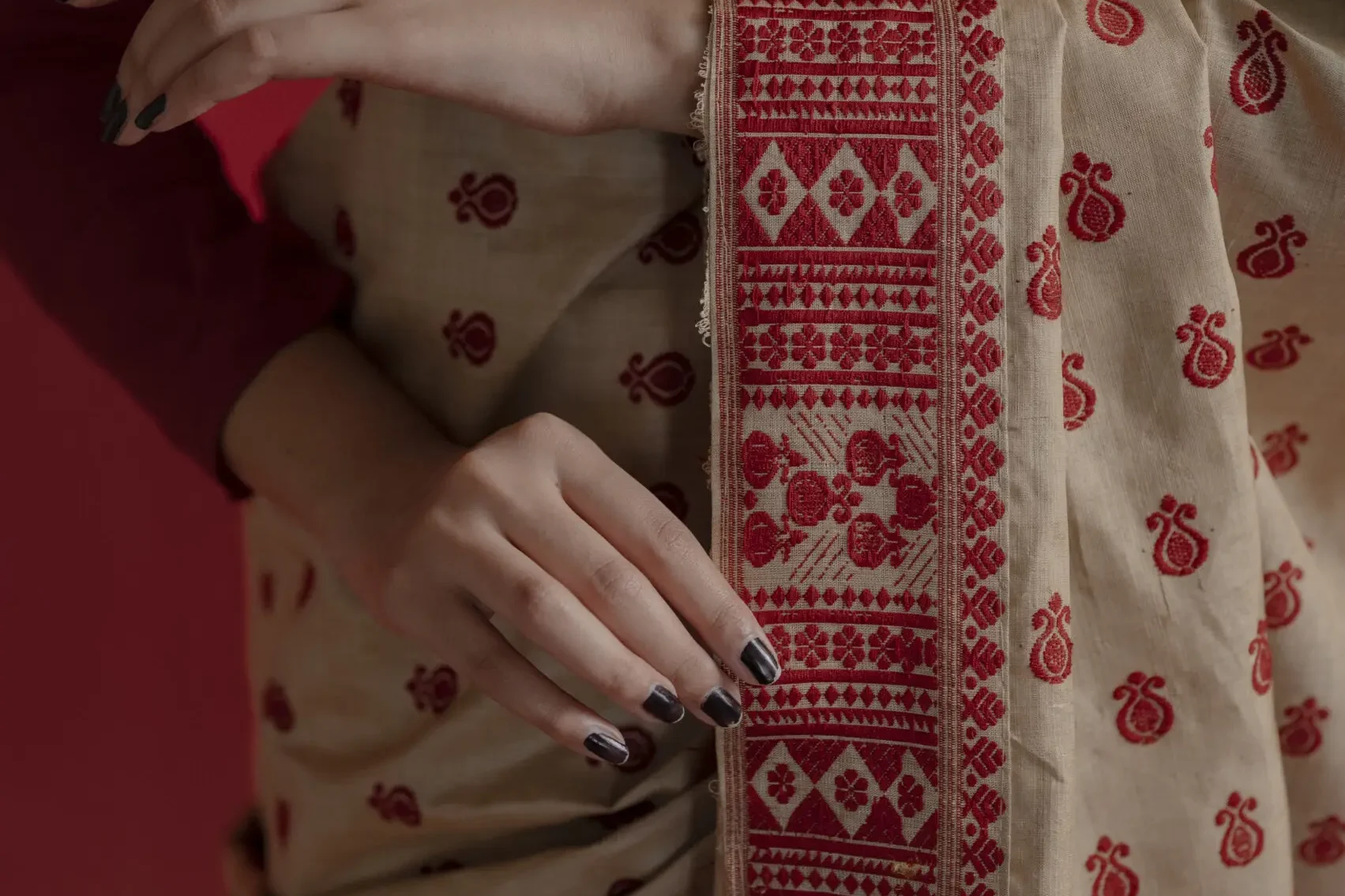
The colour of muga silk deserves sustained attention, because it is not a single colour but a range, and the range is wide and subtle enough to constitute an entire palette in itself.
Freshly reeled muga yarn is a pale, warm gold, close to the colour of good honey or the skin of a ripe mango. As it is woven and finished, this colour deepens slightly. As the fabric is worn and washed over months and years, it deepens further, moving through a succession of golden tones toward a richer, more intense amber gold that in very old muga approaches the colour of old teak or the shell of a polished walnut. Along this trajectory, the silk also develops a lustre that new muga does not have: the wearing and washing aligns the fibre structure in a way that increases the reflectivity of the surface, so that old muga has a sheen that is different from the sheen of new muga, deeper and more complex, as though the light is coming from further inside the fabric.
This quality of improving with age is, among those who love muga, its most treasured characteristic. It means that a muga saree is not an object that depreciates with use but one that appreciates: that the investment of wearing it, of giving it the washing and the light and the movement that it needs to develop its full colour, is an investment that pays increasing returns over time. Women in Assam speak of their muga sarees with the affection and the pride that people give to things that have accompanied them through significant moments of life: the saree worn to a wedding, the saree worn during Bihu, the saree that belonged to a mother or grandmother and carries in its deepened gold the history of years of wearing.
Kangana Ranaut and the Moment of Recognition
When Kangana Ranaut appeared publicly in a muga silk saree, the response was immediate and enthusiastic. Fashion commentators noted the distinctiveness of the fabric, the way it caught the light differently from other silks, the warmth and depth of its natural gold. Searches for muga silk sarees reportedly spiked in the days following the appearance. The craft that had been quietly known to connoisseurs of Indian textiles was suddenly visible to a much wider audience.
This kind of celebrity visibility is a complicated thing for traditional craft traditions. On one hand, it creates genuine market demand and brings economic benefit to weavers who have often struggled to reach buyers beyond their immediate region. On the other hand, it can create pressure for rapid scaling of production that the tradition cannot accommodate without compromising quality, and it can attract the imitators who are always waiting for a craft to become fashionable enough to be worth copying badly.
The specific case of muga silk is somewhat protected from the worst of these risks by the geographical uniqueness of the fibre. Unlike a woven pattern or an embroidery technique that can be approximated by machine or replicated in another location, the natural golden colour of genuine muga silk cannot be produced outside Assam without the specific ecosystem that creates it. A muga imitation in another silk, dyed gold to approximate the colour, will reveal itself as an imitation the moment it is examined carefully: the dyed colour is flat and uniform in a way that the natural muga gold is not, lacking the depth and the internal variation that come from the fibre’s natural pigmentation.
Kangana Ranaut’s choice of muga was also, in the contemporary political and cultural context, a statement about Indian craft and Assamese identity. The actress, who has been publicly committed to wearing Indian handloom textiles on significant occasions, positioned the muga saree as an object of national cultural pride: something Indian, something indigenous, something irreplaceable, something worth celebrating. This framing resonated with a broad audience in a moment when questions of cultural identity and the value of Indian craft traditions have become increasingly prominent in public discourse.
The Economics of Rarity
Genuine muga silk is expensive, and the expense is entirely justified by the economics of its production. The semi wild rearing of the silkworms, which cannot be industrialized without losing the qualities that make muga muga, limits the scale of production. The manual reeling of the cocoons, which requires skill and patience, adds further cost. The hand weaving on traditional looms, which is the only method that produces the quality of fabric the tradition demands, multiplies the cost again. A fine muga silk saree represents many months of work across the sericulture and weaving chain, and its price reflects this honestly.
The Geographical Indication tag granted to Assam muga silk in 2007, the first GI tag granted to any product in India under the Geographical Indications of Goods Act, is a recognition of the fibre’s unique geographical specificity and its cultural significance. This tag provides legal protection against the labelling of other silks as muga and helps authenticate genuine Assam muga in the market. It is a form of intellectual property protection for the ecosystem and the community that produces this extraordinary fibre.
Within Assam, the muga silk industry supports thousands of families across the sericulture and weaving chain. The Assam government has invested in sericulture development, in the promotion of muga weaving, and in connecting Assamese weavers with national and international markets. Organizations like the Silk Mark, which certifies genuine Indian silk products, help buyers identify authentic muga in a market where imitation is always tempting.
Bihu and the Sacred Garment
The relationship between muga silk and the cultural life of Assam is most vividly expressed during Bihu, the state’s most important festival, which celebrates the Assamese new year and the agricultural cycle of planting and harvest. Bihu is celebrated three times a year, with Rongali Bihu in spring being the most significant and most joyful.
During Rongali Bihu, muga silk becomes the centrepiece of a complex system of gift exchange and social affirmation. Young women wear their finest muga sarees or mekhela chadors to the Bihu celebrations. Families give muga silk as gifts to mark significant relationships and social bonds. The kopou phool, the foxtail orchid that blooms in the spring and is the symbol of the festival, is worn in the hair against the background of the muga silk’s gold.
This ritual centrality of muga during Bihu is not merely decorative. It connects the fabric to the deepest rhythms of Assamese life: to the agricultural cycle, to the seasonal renewal of the natural world, to the social bonds that hold communities together. Wearing muga during Bihu is an act of cultural affirmation, a statement of belonging to a specific place and a specific tradition. It is the garment in which the Assamese woman presents herself to her community at the moment of the year’s most important celebration.
Beyond Bihu, muga is the appropriate fabric for significant ceremonial occasions in Assamese life: weddings, where the bride may wear a full muga mekhela chador in the most formal and traditional style; religious ceremonies at the Vaishnavite sattras that are the cultural and spiritual centres of Assamese Hindu life; and the formal occasions of state where Assamese dignitaries and officials choose muga as the appropriate expression of their regional identity.
The River in the Thread
There is a quality in muga silk that no description quite captures but that everyone who has handled it notices: it feels alive. Not in any mystical sense but in a practical, sensory one. The fibre has a slight texture, a presence against the skin, that smooth mulberry silk does not have. It is not rough, not uncomfortable, nothing approaching either of those things. It is simply there, in a way that more processed silks are not, reminding you with gentle persistence of its origin in a living creature, its growth on a living tree, its connection to the specific living ecosystem of the Brahmaputra valley.
This aliveness is related to the fact that muga silk is minimally processed compared to other silks. The natural sericin that coats the fibre is partially retained, rather than being completely removed in the degumming process, and this retained sericin contributes both to the fabric’s texture and to its characteristic sheen. The natural colour is of course retained entirely. The result is a silk that is closer to its natural state than most other commercial silks, a fabric that still carries something of the forest and the river in its structure.
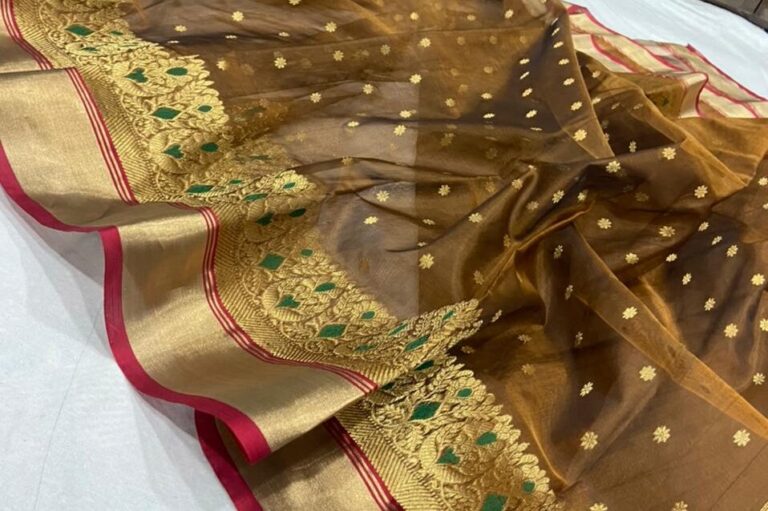
When you hold a muga silk saree to the light, the gold that comes through is warm and complex: not the flat metallic gold of zari or the uniform yellow of a dyed silk, but a gold with depth and variation, with lighter and slightly darker threads creating a subtle pattern of light within the uniformity of the colour. This variation is the mark of the natural fibre: no two cocoons produce exactly the same shade, and the weaving of yarns from many cocoons creates this gentle, living variation that makes the fabric so much more interesting than any uniformly dyed alternative.
Assam’s Gift to the World
India is the second largest producer of silk in the world, and it produces all four commercially significant types of silk: mulberry, tussar, eri, and muga. Of these four, muga is the rarest, the most geographically specific, and the most irreplaceable. It is also, in the opinion of many who have worn all four, the most beautiful: not in the spectacular, immediately legible way of a heavily zari worked mulberry silk, but in the deeper, quieter way of something that has no equal and therefore cannot be compared.
The muga silk saree asks of the world what the Brahmaputra valley has always asked of those who have lived near it: patience, attention, and the willingness to let beauty develop in its own time. The river has been flowing through Assam for millions of years. The golden silkworm has been spinning its cocoons on the som and soalu trees for as long as anyone knows. The weavers of Assam have been turning that gold into cloth for centuries beyond counting.
What Kangana Ranaut wore on that day was not merely a saree. It was a river valley. It was a civilization. It was the accumulated knowledge of generations of Assamese women who understood that some beauty cannot be manufactured or engineered or replicated elsewhere. It must be grown, in a specific place, by a specific creature, on a specific tree, and then it must be woven by hands that have always known how.
The muga silk saree is Assam’s gift to India and to the world. It is a gift of extraordinary rarity and extraordinary beauty, and it arrives already golden, already complete, asking nothing except to be worn and to be recognised for what it is.
Muga silk does not borrow its gold from anywhere. It grows it, slowly, in the light of the Brahmaputra valley, and it keeps growing richer every year that it is worn.