Vegan Strawberry Shortcake

When I was growing up it was tradition that my mom would always make me some variation of strawberry shortcake for my birthday. I am not entirely sure why. Maybe it was because of my love of the Strawberry Shortcake. Or maybe it was because strawberries were showing up on grocery store shelves in April. No matter the reason, I loved it. The cake. The strawberries. The whipped cream. Mmmmm…
Vegan Strawberry Shortcake
- 1 pint fresh strawberries, sliced (you can use frozen, but it is so much better when you have fresh strawberries)
- 1/4 cup sugar
- 2 cups flour (I used only white all-purpose flour)
- 2 Tbsp. sugar
- 3 tsp. baking powder
- 1 tsp. salt
- 1/3 cup shortening (or you can probably use Earth Balance or Soy Garden)
- 3/4 cup milk (I used unsweetened Silk soy milk)
- Vegan plain or vanilla yogurt, or vegan vanilla ice cream, or Soyatoo
Mix the strawberries and the 1/4 cup sugar together and let it sit while you make the cake.
Heat the oven to 450 degrees Fahrenheit. In a large bowl mix all of your dry ingredients well, then cut in the shortening or vegan butter with a pastry blender or two knives. When the mixture has fine crumbs, stir in the milk until it is just blended.
On a lightly floured surface knead the dough a few times, then you can prepare your cake(s) in one of a couple of ways:
1. You can roll out the dough until it is 1/2 inch thick, and use a large biscuit cutter to cut the dough. Place these on a cookie sheet and then bake for about 10-12 minutes.
OR
2. You can do what I did. We have little Pyrex baking dishes which are perfect for making little cakes. I split the dough in half into equal pieces and then I pressed them into two small Pyrex dishes. I then placed the dishes on a cookie sheet (makes it easier to take out of the oven), and then baked them in the oven for about 15 minutes. I also checked in on them occasionally to make sure I wasn’t over baking.
When you take these out of the oven, take them off of their cookie sheet or out of their Pyrex containers and put on a cooling rack. Let them completely cool if possible, or at least wait until they are cool enough to comfortably handle.
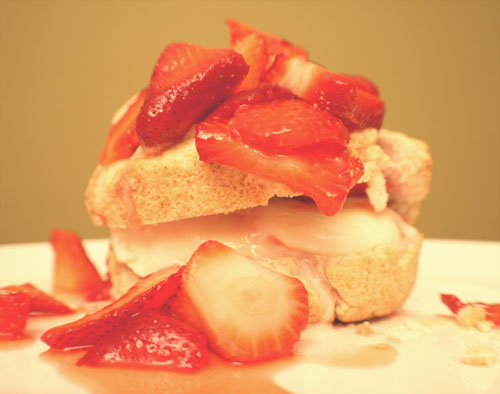
Cut one of the cakes in half horizontally, then place the bottom half on a plate. Scoop some vegan yogurt, ice cream, or squirt Soyatoo on top of the cake. Spoon some of your strawberries on top of this. Place the top half of the cake on top of your strawberries and cream, and repeat with more yogurt, ice cream, or Soyatoo and strawberries.

I have to say that I love this. The cake is sweet, but not too sweet. The fresh strawberries add more sweet and the flavor of spring. And the yogurt/ice cream/Soyatoo rounds it out with creaminess.