
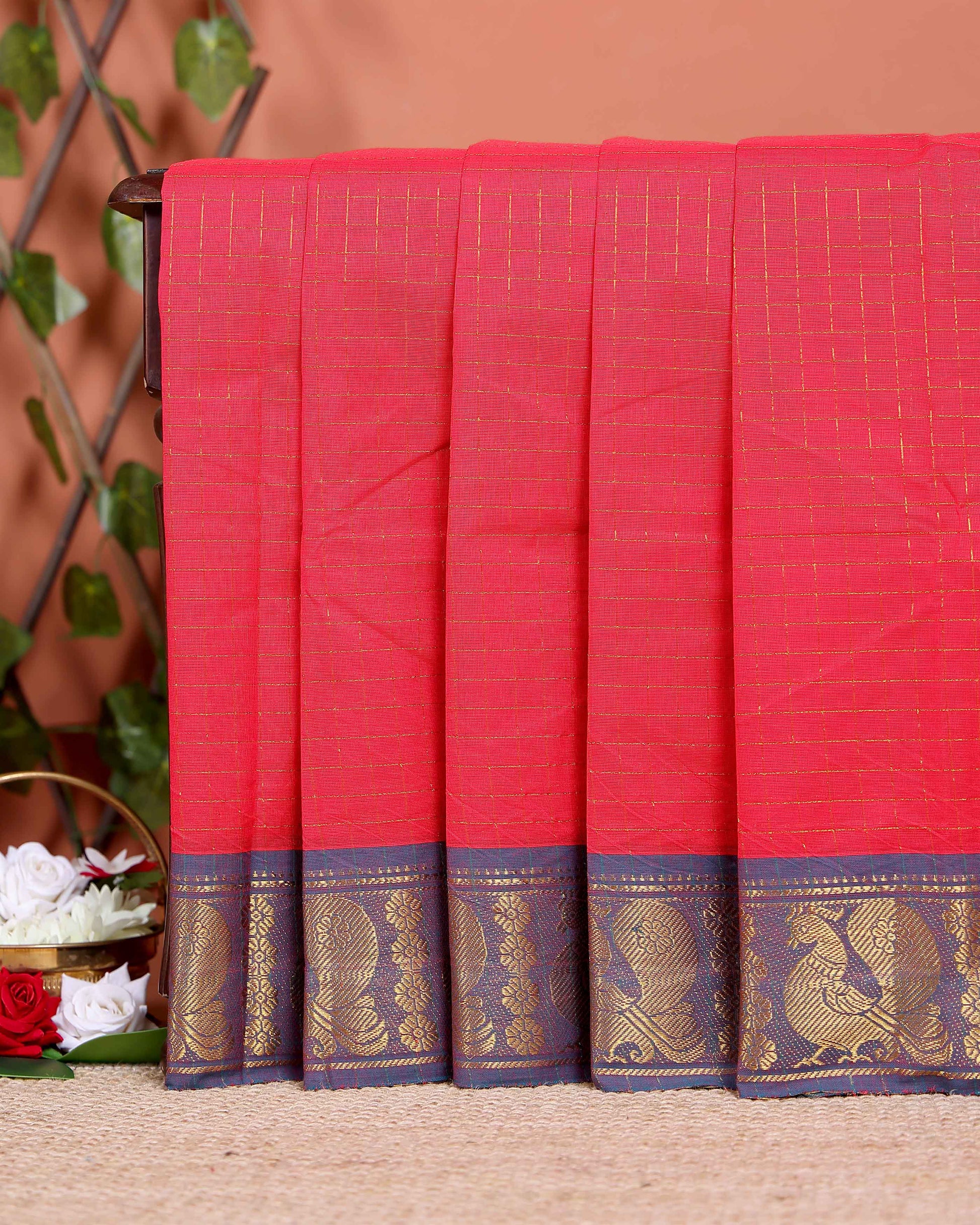
Chettinadu Cotton Saree (Tamil Nadu)
There are fabrics that whisper and fabrics that speak. The Chettinad cotton saree speaks clearly, directly, without apology. It does not seduce with shimmer or overwhelm with ornamentation. It arrives in the room the way a person of genuine confidence arrives: without announcement, without performance, entirely sure of itself. Woven in the arid heartland of Tamil Nadu, in a cluster of villages that once sat at the centre of one of South India’s most extraordinary mercantile civilizations, the Chettinad cotton saree is a textile that carries the character of the people who made it: proud, practical, deeply cultured, and built to last.
The Land and Its People


To wear a Chettinad saree is to carry something of Chettinad itself, and so the land deserves to be understood before the cloth. The Chettinad region occupies a stretch of Sivaganga district in Tamil Nadu, roughly between Madurai and Thanjavur, where the landscape is dry and flat and the light falls hard and bright on terracotta soil. It is not, by any obvious measure, a landscape of abundance. The rains are uncertain. The earth is not especially fertile. And yet, from this unpromising terrain, emerged the Nattukotai Chettiars, one of the most remarkable merchant communities in Indian history.
The Chettiars were financiers, traders, and moneylenders whose commercial networks extended across South and Southeast Asia. They built banks in Burma, financed plantations in Ceylon, established trading houses in Malaya and Vietnam and Mauritius. They were the financial infrastructure of a large part of colonial era Asia. And with the wealth they accumulated across these far flung ventures, they came home to their villages in Tamil Nadu and built. They built mansions of extraordinary scale and ambition, with Burmese teak pillars, Belgian glass windows, Italian marble floors, and walls inlaid with tiles shipped from as far as England. These houses still stand today, many of them, crumbling at the edges but still monumental, still astonishing, still carrying in their proportions the self assurance of people who believed their civilization was worth building for permanence.
The Chettinad cotton saree was made for these people and by the people who lived among them. It carries, in its no nonsense structure and its quiet geometric elegance, something of the Chettiar temperament itself: serious about quality, uninterested in empty decoration, respectful of tradition, and possessed of a dignity that does not need to announce itself.
The Weavers and Their Villages
The weaving of Chettinad cotton is concentrated in a small number of villages in Sivaganga district, of which Karaikudi is the largest town and something of a regional centre. The principal weaving villages include Kanadukathan, Pallathur, Nattarasankottai, and several smaller settlements where handlooms have been part of domestic life for generations.
The weavers belong primarily to the Devanga and Sengunthar communities, whose association with the loom stretches back centuries. Weaving in these villages is not a recent or imported craft. It grew up alongside the Chettiar merchant community, supplying the cotton sarees that Chettiar women wore at home and in temple, that were given as gifts at weddings and festivals, that marked the rhythms of domestic life in the region’s great mansions.
Unlike some weaving traditions that are concentrated in a single workshop or practised by a single family, Chettinad weaving is distributed across many households. The loom sits in the home. The weaver and his family work together. The saree emerges from a domestic space, carrying with it something of the warmth and intimacy of that origin. This is cloth made in a house, for houses, by people who understand what daily life asks of a fabric.
Cotton: The Democratic Fibre
The choice of cotton as the primary material for the Chettinad saree is significant, and it is worth pausing on. In the hierarchy of Indian textiles, silk has traditionally occupied the summit. It is the fabric of brides, of goddesses, of royal occasions. Cotton, by contrast, is the fabric of the everyday, the democratic fibre, the material that most Indians have worn most of the time throughout most of history.
Chettinad weavers have always worked in cotton, and they have brought to this material an attention and refinement that elevates it far beyond the utilitarian. The cotton used for Chettinad sarees is typically a fine, tightly spun yarn that produces a fabric of good weight without heaviness, with a slight crispness when new that softens beautifully with washing and wearing. Unlike silk, which can feel demanding and precious, a Chettinad cotton saree feels immediately friendly, immediately wearable. It breathes well in the fierce heat of Tamil Nadu summers. It drapes without fuss. It washes easily and emerges looking more itself than before, the colours deepening slightly with each wash rather than fading.
This relationship between the saree and the climate is not accidental. Chettinad cotton was evolved for the conditions of its home, and those conditions are specific: hot, dry, occasionally very hot, and merciless to anyone wearing synthetic fibre. A woman working in a Chettinad home, managing a household, going to temple in the morning and cooking in the afternoon, needs a saree that will keep her comfortable across all of these demands. The Chettinad cotton saree does this without complaint.
The Visual Grammar: Checks, Stripes, and the Koorai
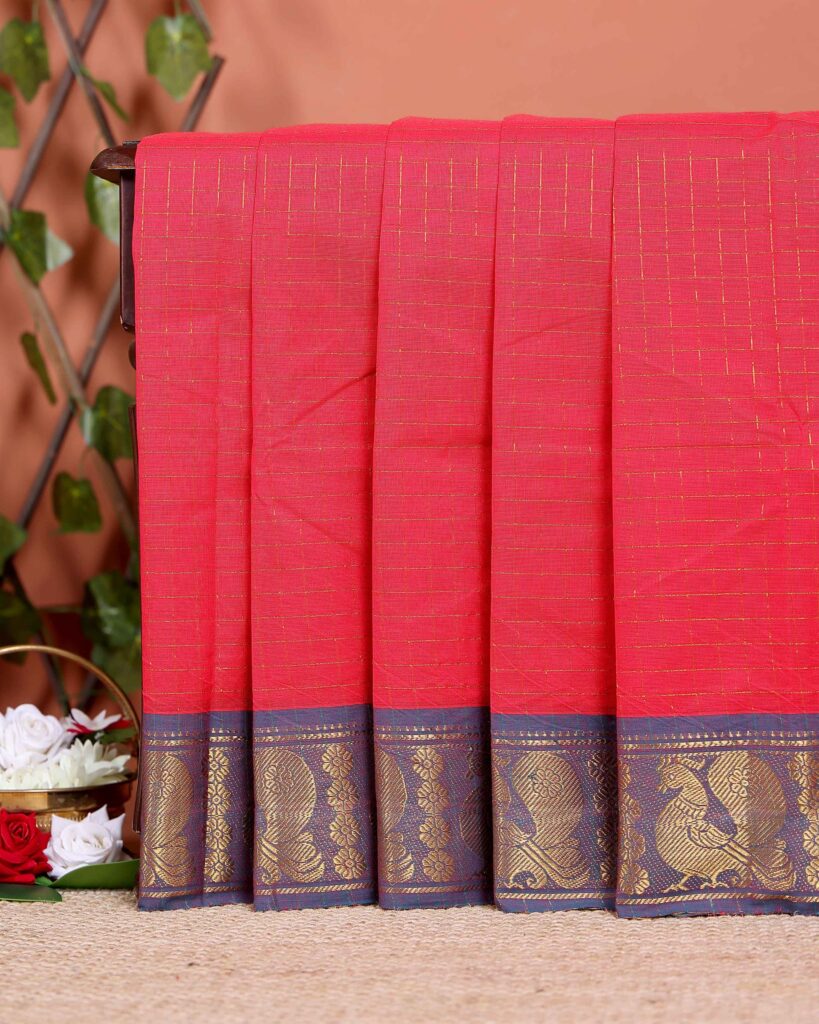
The design vocabulary of the Chettinad saree is immediately recognisable and unlike that of any other Indian textile tradition. Where Banarasi overwhelms with floral abundance and Patola astonishes with geometric complexity, Chettinad works with restraint. Its primary elements are checks and stripes: bold, clear, unapologetically geometric.
The checks are produced by alternating coloured threads in both warp and weft, creating a grid of colour that is simple in principle and endlessly variable in practice. The size of the check, the relationship between the two or three colours used, the width of the stripe that borders the checked field: these variables allow a seemingly limited vocabulary to generate enormous variety. No two Chettinad sarees are quite alike even when they are working within the same basic design logic.
The characteristic colour combinations of Chettinad cotton are bold and joyful. Ruby red and black. Mustard yellow and green. Peacock blue and white. Magenta and gold. These are not timid combinations. They are the colours of a community that was not shy about its prosperity, that built houses with painted ceilings and mosaic floors and teak doors carved with peacocks. The saree colours belong to the same aesthetic world as those houses: confident, warm, and built to be seen.
The border is a crucial element of the Chettinad saree. Typically woven in a contrasting colour or a zari infused thread, it defines the saree’s edges with a clean authority. The pallu, draped over the shoulder, often carries a denser version of the body’s check pattern or a more elaborate stripe arrangement. The overall effect is of a composition that knows exactly what it is doing, that has placed every element where it belongs.
Among the most celebrated varieties is the Chettinad koorai saree, the traditional bridal saree of the community. The koorai is typically woven in pure cotton with a silk border, in the auspicious combination of red and green, with gold zari woven through the border and pallu. It is the saree in which Chettiar brides have been married for generations, and it carries with it all the emotional weight that bridal textiles accumulate over centuries of use. To see a woman married in her mother’s koorai, or her grandmother’s, is to understand how textiles carry memory across time.
The Weave: Simple Tools, Complex Knowledge
The Chettinad saree is woven on a pit loom, the same basic technology used by handloom weavers across South India. The weaver sits with his legs in a pit beneath the loom, his feet operating the treadles that control the shed, while his hands throw the shuttle and beat the weft. It is a physically demanding way to work, requiring a coordination of hands and feet that becomes unconscious only after years of practice.
What makes Chettinad weaving technically interesting is the management of the colour patterns in the warp. Producing the characteristic checks requires the weaver to arrange threads of two or more colours in the warp in a precise sequence before weaving begins, and then to use the same colour sequence in the weft, throwing alternating coloured shuttles according to the pattern. The alignment of warp and weft colours is what creates the check: it looks simple from the outside and is far less simple to execute consistently across six metres of fabric.
The temple border, a feature of many Chettinad sarees, requires additional skill. Woven separately on a supplementary warp or using an extra shuttle, the temple motif, a repeating stepped geometric shape derived from the profile of a gopuram tower, adds a dimension of visual interest to the border without introducing the kind of elaborate figuration found in Banarasi or Kanjeevaram weaving. It is ornament in service of structure, decoration that does not overwhelm.
In recent years, some weavers have introduced dobby attachments to their looms, allowing for more complex border patterns and supplementary weft motifs. These innovations have expanded the design vocabulary of Chettinad cotton without fundamentally altering its character. The checks remain. The cotton remains. The directness remains.
The Smell of the New, the Feel of the Old
There is something particularly pleasurable about a new Chettinad cotton saree that people who love them speak about with real feeling. The fabric arrives with a slight stiffness, a crispness that is partly the natural character of tightly woven cotton and partly the residual sizing that is applied during production. It has a clean smell, faintly starchy, entirely wholesome. When you hold it up to the light, the weave is visible, the individual threads legible.
Then you wash it. And the transformation that happens is one of the small joys of owning cotton. The stiffness softens. The fabric relaxes into itself. The colours, if they are the good natural or reactive dyes used by the best producers, settle and deepen. The check pattern, which was crisp and graphic when new, becomes warmer, more lived in, more itself. A Chettinad saree that has been washed fifty times has a quality that no new saree can replicate: it has become personal, adapted to the specific way its owner drapes it, marked by the history of its wearing.
This is what good cotton does. It improves. It remembers.
Chettinad Cuisine and Chettinad Cotton: A Shared Aesthetic
It is impossible to write about anything from Chettinad without mentioning the cuisine, because the two things, the food and the fabric, share a sensibility that tells you something essential about the culture that produced them. Chettinad cooking is famous across India for its bold flavours, its unapologetic use of spice, its willingness to be intense. It is not a cuisine of subtlety or understatement. It is confident, layered, built on a deep knowledge of how individual strong elements combine into something greater than their parts.
The Chettinad cotton saree works the same way. Two strong colours in a bold check. A contrasting border. A pallu that amplifies rather than quietly echoes the body. Each element is decided, committed, certain of its own value. The whole is confident in the way that things made by people who know what they are doing are always confident. There is no hedging in a Chettinad saree, just as there is no hedging in a Chettinad meal. You get exactly what is offered, and what is offered is very good indeed.
The Crisis of the Craft
The Chettinad weaving community has not been spared the pressures that have tested every Indian handloom tradition in recent decades. Powerloom imitations of Chettinad checks are produced in large quantities in Erode and Coimbatore, cities with established textile industries that can replicate the look of handwoven checks at a fraction of the cost and time. These imitations, sold in markets across Tamil Nadu and beyond, have made it harder for handloom weavers to compete on price and have confused buyers who cannot easily distinguish between the two.
The income available to handloom weavers in Chettinad has historically been low relative to the skill and time required for their work. Many younger members of weaving families have sought other livelihoods, finding better pay in towns and cities. The loom, which was once the assumed inheritance of children born into weaving households, has increasingly become an option rather than a given. Some villages that once rang with the sound of shuttle and treadle have grown quieter.
And yet the tradition has not collapsed. Cooperative societies and self help groups of weavers have worked to access markets more directly, cutting out the layers of middlemen who previously captured most of the value from their labour. Craft organisations, social enterprises, and independent designers have brought Chettinad weavers into contact with urban consumers willing to pay genuinely fair prices for handwoven cloth. Online retail has connected weavers directly with buyers in Chennai, Mumbai, Delhi, and the Tamil diaspora abroad, communities that feel a particular pull toward this cloth.
A Geographical Indication tag for Chettinad handloom cotton, which has been sought for several years, would provide legal protection against imitation and help authenticate the genuine handwoven article in the market. The process has moved slowly, as these processes tend to, but the case for it is strong.
Who Wears Chettinad Cotton
One of the most interesting things about the Chettinad cotton saree in the contemporary moment is the breadth of the community that has come to love it. What began as the domestic textile of a specific merchant community in a specific corner of Tamil Nadu has become, over the past two decades, one of the most admired and widely worn handloom sarees in India.
Women who wear Chettinad cotton tend to be women who have thought carefully about what they want from a saree. They are often not interested in the most formal or the most spectacular. They want something that works: that can be worn to the office and to a dinner, that will outlast trends, that feels good on the body in the heat of an Indian day, that will look better in five years than it does today. They have often arrived at Chettinad cotton through a process of elimination, having tried silks that were too demanding and synthetics that were too uncomfortable, and found in this cotton something that asks nothing of the wearer except to be worn.
There is also, increasingly, a community of younger women who wear Chettinad cotton as a kind of quiet statement: a preference for the handmade over the manufactured, for the local over the global, for the sustainable over the disposable. These women understand that choosing a handwoven saree is an economic and ethical act as well as an aesthetic one, that the price they pay goes to the hands that made it, that the fabric they wear carries no debt to exploitative supply chains or environmentally damaging production methods.
The Durability of the Genuine
Every textile tradition makes an implicit promise. Banarasi promises magnificence. Patola promises perfection. Bandhani promises joy. The promise of Chettinad cotton is something different and perhaps more useful: it promises to be there. To hold up. To wash without drama and dry without fuss. To look right whether you are at a temple in the early morning or a wedding in the evening. To wear in to the shape of your body over months and years of use, until it fits the way only the most loved things fit, with a familiarity that feels like friendship.
This is not a small promise. In a world full of things made to be replaced, a saree that can be worn for decades, that becomes more itself with use, that can be handed down to a daughter not as a museum piece but as a garment still capable of being worn and loved, is genuinely rare. The Chettinad cotton saree makes this promise and keeps it. That is a form of integrity in fabric, and it is worth recognising for what it is.
Threads of a Civilization
The great Chettiar mansions of Kanadukathan and Karaikudi stand today in various states of preservation and neglect. Some have been restored as heritage hotels. Others are inhabited by families who maintain them as best they can. Still others are slowly returning to the earth, their carved teak darkening, their mosaic floors cracking, their painted ceilings fading toward indecipherability.
But the saree endures. It endures because it is useful and beautiful in equal measure, because it has found new wearers beyond the community that first created it, because the weavers have not stopped even when the economics were difficult, because there is something in the directness and honesty of the cloth that speaks to people who are tired of things that pretend to be more than they are.
The Chettinad cotton saree does not pretend. It is exactly what it is: tightly woven, boldly coloured, structurally honest, made by hand in a village in Tamil Nadu by people who learned from their parents who learned from theirs. In that simplicity is a depth that takes years to fully see.
A Chettinad cotton saree does not ask to be admired. It simply endures, and in enduring, earns everything.